
Revision summary
The philosophical approach treats political theory as reasoned inquiry into meaning, right, and the good regime. It defines concepts such as the state, obligation, and justice, and tests them against rival claims. Plato, Aristotle, Hobbes, Locke, Rousseau, Kant, Hegel, and Rawls are central practitioners of this method. Strauss, Oakeshott, Berlin, and Arendt show that texts and categories still organise modern debate. The approach is not a substitute for behavioural data or institutional history, but it supplies questions that measurement cannot invent.
Model answer
Copper italics in this answer — like this — are the key facts. Each one is unpacked in the Facts & figures rail.
Introduction
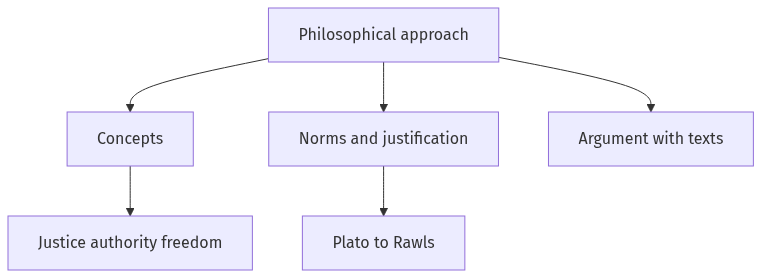
The philosophical approach treats political theory as a search for meaning, right, and the good political life, not only as a catalogue of votes or offices. It asks what justice, authority, and freedom are, and why they ought to bind. From Plato’s Academy to contemporary analytic work, the method is argument.
Body
What the approach does
A philosophical student of politics begins with concepts. What is the state? What is obligation? What distinguishes power from legitimate authority? Plato in the Republic and Aristotle in the Politics and Nicomachean Ethics set this pattern: they define, distinguish, and test a claim against a rival claim. The aim is not a survey of opinions but a reasoned account that can survive objection.
Normative work is central. Hobbes, Locke, and Rousseau did not only describe seventeenth- and eighteenth-century Europe. They asked when coercion is justified. Kant asked whether a maxim of political action could be willed as universal law. Hegel asked how freedom is realised in ethical life and the modern state. John Rawls later rebuilt the social-contract tradition as a theory of justice as fairness. Leo Strauss insisted that classical texts still speak about the best regime, against a historicism that reduces every idea to its date.
Michael Oakeshott, Isaiah Berlin, and Hannah Arendt kept the method alive: tradition, value-pluralism, and recovered categories such as action, against a thin empirical science.
What it is not, and why it still matters
The approach is not a substitute for David Easton’s systems analysis or for archival history. It can become detached from institutions. Behavioural critics charged it with untestable metaphysics. The charge is only half fair. Philosophy still supplies questions that data cannot invent: why majority rule is not justice, and why the state is not only the strongest gang.
Flow diagram
Conclusion
The philosophical approach studies politics through concepts, norms, and argument. Plato, Aristotle, the contract theorists, Hegel, Rawls, Strauss, Berlin, and Arendt show the method. It must sit beside institutions and evidence, but it cannot be replaced by them if political theory is to remain a theory of the right and the good.
Quick related
Students also ask
-
Write a note on the relation between equality and liberty from the multi-cultural perspective
Next question on this syllabus topic (2025 · Q1(b)). View answer →
-
Is the philosophical approach the same as the history of ideas?
History of ideas locates a text in its time. The philosophical approach also asks whether the argument is true or still binding. The two should travel together.
-
Why not replace it with surveys and statistics?
Surveys report preferences. They cannot by themselves say whether a preference is just, or whether majority will is legitimate authority.
Same topic · past papers
UPSC has asked this before
These previous-year questions sit on the same topic. Open one to practise the earlier ask.
-
2025 · Q3(a) · PSIR GS 1 · 20 marks
Provide a comparative analysis of behavioural and institutional approach to the study of Political theory -
2021 · Q2(b) · PSIR GS 1 · 15 marks
Examine the importance of behavioural approach in political theory. What led to its decline? -
2026 · Q1(a) · PSIR GS 1 · 10 marks
Resurgence of political theory. -
2023 · Q1(e) · PSIR GS 1 · 10 marks
Decline of political theory. -
2024 · Q2(b) · PSIR GS 1 · 15 marks
Marxism is a political theory of action demanding strict compliance with its core principles. Comment.
More from this topic
Q8(c) · UPSC Mains 2026 · PSIR GS 1 · 15 marks · Solution
"The lack of political will in preventing environmental degradation is one of the major challenges that India is experiencing." Comment
Political Theory
This 15-mark PSIR answer evaluates India's environmental degradation through the lens of political will, balancing developmental imperatives with ecological imperatives. It examines how electoral cycles, populist short-termism, and growth-first paradigms often sideline ecological security. Key thinkers like Ramachandra Guha and political economy frameworks are integrated to explain the structural inertia. The response provides Indian illustrations ranging from developmental clearances to air pollution crises. It concludes with a policy-forward outlook anchored in constitutional provisions like Article 48A and 51A(g).
Q8(a) · UPSC Mains 2026 · PSIR GS 1 · 20 marks · Solution
Discuss the causes and consequences of inter-State water disputes in India
Political Theory
This answer examines the structural causes and multi-dimensional consequences of inter-State water disputes in India. It highlights federal friction, climate variability, and legal-institutional gaps as primary causes. The consequences span socio-economic losses, inter-regional animosity, and challenges to federal integrity. The response incorporates institutional frameworks like the Inter-State Water Disputes Act and concludes with cooperative water federalism as the way forward.
Q7(c) · UPSC Mains 2026 · PSIR GS 1 · 15 marks · Solution
Map the different types of ethnic conflicts that have emerged in 21st century India
Political Theory
This 15-marker maps the typology of ethnic conflicts in 21st-century India, distinguishing between indigenous-immigrant clashes, tribal identity assertions, and sub-nationalist movements. It examines the structural roots of these conflicts in uneven development, resource competition, and cultural anxiety. The answer integrates theoretical insights on identity politics with concrete Indian case studies across the Northeast and mainland. It concludes with a policy-oriented view emphasizing federal accommodation, democratic dialogue, and inclusive development.