
Revision summary
Liberty is non-arbitrary space of action; equality is the claim that this space belongs to every person. Mill and Berlin warn that liberty can be crushed in the name of a single real self or a uniform good. Taylor, Kymlicka, and Parekh show that recognition and group-differentiated rights can be liberal tools in diverse societies. Uniform rules may still silence minorities; group vetoes may still silence women and dissenters inside a community. The Indian Constitution already pairs equal citizenship with cultural rights, which is the practical form of this relation.
Model answer
Copper italics in this answer — like this — are the key facts. Each one is unpacked in the Facts & figures rail.
Introduction
Liberty is the space in which a person may act without arbitrary interference. Equality is the claim that that space, and the dignity that attends it, is not the privilege of one rank, faith, or culture. A multicultural society tests the pair because cultures are not identical, and because a uniform rule can still silence a minority.
Body
The classical tension
John Stuart Mill defended liberty of thought and lifestyle so long as harm to others was not done. Isaiah Berlin later distinguished negative liberty from positive liberty and warned that a single “real self” can license oppression. Equality, in the liberal canon of Locke and Rawls, is first moral equality: persons as free and equal, entitled to the same basic liberties. Socio-economic equality then enters as fair opportunity or as Rawls’s difference principle.
The clash is familiar. A uniform language or civil code can look like equal citizenship and still silence a minority. Group vetoes can freeze women and dissenters inside “tradition”. Susan Moller Okin asked whether multiculturalism is bad for women, which belongs inside this note.
What multiculturalism changes
Charles Taylor argued that equal dignity also requires recognition of a culture’s worth. Will Kymlicka defended group-differentiated rights — language, land, self-government — as liberal protections of autonomy in a cultural context. Bhikhu Parekh insisted that public values in a diverse polity must be dialogically forged, not exported from one Enlightenment.
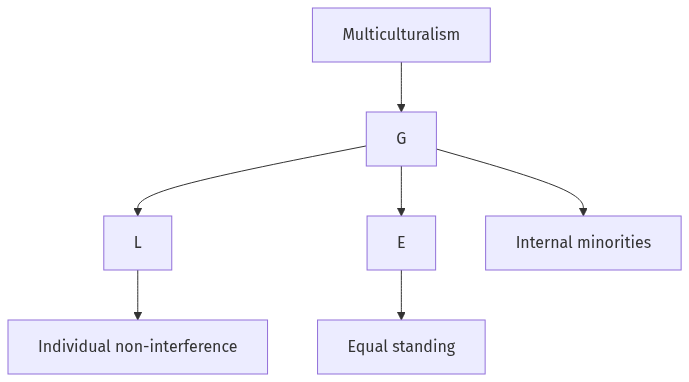
Liberty is then not only the abstract individual against the state. It is also a Sikh’s turban, personal law within constitutional limits, and tribal land and language. Equality is equal standing, not sameness of lifestyle. The Indian Constitution already pairs Articles 14 to 18 with Articles 25 to 30 and the Fifth and Sixth Schedules. Multicultural theory names that design rather than treating it as an exception to “real” liberalism.
Flow diagram
Conclusion
Equality and liberty remain twins, but multiculturalism refuses to treat them as identical uniforms. Group-differentiated rights and recognition can secure liberty for minorities; they must not cancel the equal liberty of members inside the group. The relation is a constitutional conversation, of the kind Taylor, Kymlicka, and Parekh describe, not a choice of one value against the other.
Quick related
Students also ask
-
Explain the Macpherson's view on power
Next question on this syllabus topic (2025 · Q1(c)). View answer →
-
Does multiculturalism reject equality?
It rejects equality as sameness of culture. It affirms equality as equal dignity and standing, which may require different public measures.
-
How does this meet women’s liberty?
Okin’s warning is serious. Group rights need an exit, a floor of basic rights, and the voice of members, not only of male brokers of tradition.
Same topic · past papers
UPSC has asked this before
These previous-year questions sit on the same topic. Open one to practise the earlier ask.
-
2022 · Q2(b) · PSIR GS 1 · 15 marks
"Equality of estates caused equality of power, and equality of power is liberty." Comment
More from this topic
Q8(c) · UPSC Mains 2026 · PSIR GS 1 · 15 marks · Solution
"The lack of political will in preventing environmental degradation is one of the major challenges that India is experiencing." Comment
Political Theory
This 15-mark PSIR answer evaluates India's environmental degradation through the lens of political will, balancing developmental imperatives with ecological imperatives. It examines how electoral cycles, populist short-termism, and growth-first paradigms often sideline ecological security. Key thinkers like Ramachandra Guha and political economy frameworks are integrated to explain the structural inertia. The response provides Indian illustrations ranging from developmental clearances to air pollution crises. It concludes with a policy-forward outlook anchored in constitutional provisions like Article 48A and 51A(g).
Q8(a) · UPSC Mains 2026 · PSIR GS 1 · 20 marks · Solution
Discuss the causes and consequences of inter-State water disputes in India
Political Theory
This answer examines the structural causes and multi-dimensional consequences of inter-State water disputes in India. It highlights federal friction, climate variability, and legal-institutional gaps as primary causes. The consequences span socio-economic losses, inter-regional animosity, and challenges to federal integrity. The response incorporates institutional frameworks like the Inter-State Water Disputes Act and concludes with cooperative water federalism as the way forward.
Q7(c) · UPSC Mains 2026 · PSIR GS 1 · 15 marks · Solution
Map the different types of ethnic conflicts that have emerged in 21st century India
Political Theory
This 15-marker maps the typology of ethnic conflicts in 21st-century India, distinguishing between indigenous-immigrant clashes, tribal identity assertions, and sub-nationalist movements. It examines the structural roots of these conflicts in uneven development, resource competition, and cultural anxiety. The answer integrates theoretical insights on identity politics with concrete Indian case studies across the Northeast and mainland. It concludes with a policy-oriented view emphasizing federal accommodation, democratic dialogue, and inclusive development.