
Revision summary
The anti-arrack movement in Andhra Pradesh was a rural women’s campaign against cheap liquor shops and their social effects. Women picketed, used literacy networks, and made domestic violence and lost wages into a public issue. The state was both target and accomplice because excise revenue and contractors were involved. Governments responded with bans that were later weakened, showing both agenda power and structural limits. The movement is a clear Indian illustration that household injury can become political action.
Model answer
Copper italics in this answer — like this — are the key facts. Each one is unpacked in the Facts & figures rail.
Introduction
The anti-arrack movement in Andhra Pradesh in the early 1990s was a mass campaign, led largely by rural women, against the sale and consumption of cheap liquor. It showed women as political actors in villages, not only as a vote bank. The household’s injury became a public demand on the state.
Body
What women did
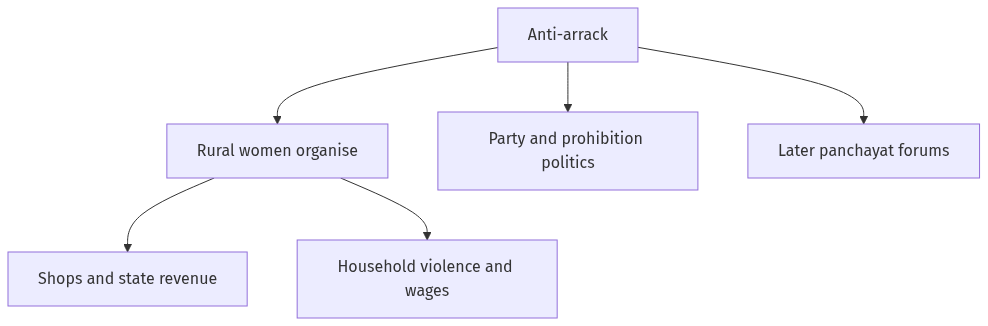
Women in Nellore and then across districts organised pickets of arrack shops, burnt packets, held night vigils, and used literacy and sangham networks that had grown around adult education. They named domestic violence, wasted wages, and indebtedness as effects of a state-linked liquor economy. The demand was prohibition or strict control, and an end to the revenue logic that treated arrack as a fiscal good.
The movement entered party competition. Governments announced bans and later diluted them, which showed both the power of women’s collective action and the limits of a demand that cut state revenue and contractor interest. Pressure-group politics here was not an urban lobby. It was neighbourhood organisation.
Political meaning
- The episode illustrates that the personal is political: the kitchen and the wage packet were already organised by excise policy. It also illustrates Gramsci’s civil society: women built a counter-common-sense against official development talk. Later women’s reservation in panchayats after the 73rd Amendment gave some of the same actors an institutional forum, including the Gram Sabha. The note should not claim a permanent prohibition victory. It should claim a permanent lesson: rural women can set the agenda of the state.
Flow diagram
Conclusion
Women’s role in the anti-arrack movement was to organise, to name liquor as a public injury, and to force parties to respond. The movement politicised the household without waiting for permission from elite feminism. Its unfinished policy result does not cancel that political fact.
Quick related
Students also ask
-
Discuss the role of environmental movements in shaping environmental governance in India.
Next question on this syllabus topic (2024 · Q8(a)). View answer →
-
Was this only a temperance campaign?
Temperance was the surface. The political content was control over wages, violence, and a state that funded itself from women’s injury.
-
Did it succeed?
It succeeded in setting the agenda and forcing policy announcements. Lasting prohibition was not secured. Success in political theory includes the making of new public actors.
Same topic · past papers
UPSC has asked this before
These previous-year questions sit on the same topic. Open one to practise the earlier ask.
-
2025 · Q5(b) · PSIR GS 1 · 10 marks
Write a note on the Dalit perspective of Indian National Movement -
2023 · Q7(c) · PSIR GS 1 · 15 marks
Dr. Ambedkar's clarion call, "Educate, Agitate and Organize", strategizes the Dalit movement towards achieving civil liberty. Discuss -
2022 · Q5(a) · PSIR GS 1 · 10 marks
Analyse the workers' movement in India in the pre-Independence period. -
2021 · Q5(d) · PSIR GS 1 · 10 marks
Analyze the Marxist perspective of the nature of Indian National Movement. -
2024 · Q7(a) · PSIR GS 1 · 20 marks
Discuss the contribution of the Dalit struggle to establish egalitarianism in Indian society during the freedom movement.
More from this topic
Q8(b) · UPSC Mains 2026 · PSIR GS 1 · 15 marks · Solution
Critically comment on the shifts in the functioning of the Indian Parliament in the last two decades
Indian Nationalism
This 15-mark answer analyses the transformation of the Indian Parliament over the past two decades, moving from a deliberative forum to an arena of executive assertion. It highlights declining debate hours, bypassing of Department-Related Standing Committees (DRSCs), and the rise of ordinance-making and bypassing of bicameral consensus through Money Bills. The critique incorporates Morris-Jones and Pratap Bhanu Mehta's insights on the hollowing out of institutions. The conclusion argues for systemic institutional reforms to restore Parliament's core constitutional role as a deliberative check on executive power.
Q7(a) · UPSC Mains 2025 · PSIR GS 1 · 20 marks · Solution
Enunciate the impediments to women's participation in local governance in the process of political decentralisation
Indian Nationalism
The 73rd and 74th Amendments reserved local seats for women, which is a structural opening, not yet equal participation. Sarpanch-pati proxy rule, unpaid care, and a male bureaucracy remain the everyday patriarchal impediments. Caste and class decide which women can act; Dalit women office-holders face additional violence and veto. Thin devolution of money and staff makes many local offices ceremonial, so participation has no policy content. Parties and seat rotation often transfer the reserved ticket to a household rather than building a woman’s public career.
Q7(b) · UPSC Mains 2025 · PSIR GS 1 · 20 marks · Solution
Caste remains a vital axis for political mobilisation in India. How would the caste census address the aspirations of people? Discuss
Indian Nationalism
Caste remains a mobilisation axis because it still structures dignity, land, and access to the state, as Kothari, Mandal, and bahujan politics show. Parties already count jatis; the demand is that the official Census should too, beyond SC and ST. Aspirations include fairer reservation design, targeting of welfare, and recognition after the unpublished 2011 SECC caste data. Risks include reification of identity and a pure percentage war that forgets class, gender, and Ambedkar’s horizon of annihilation. A democratic census would publish usable aggregates while protecting persons and keeping constitutional individual rights at the centre.