
Revision summary
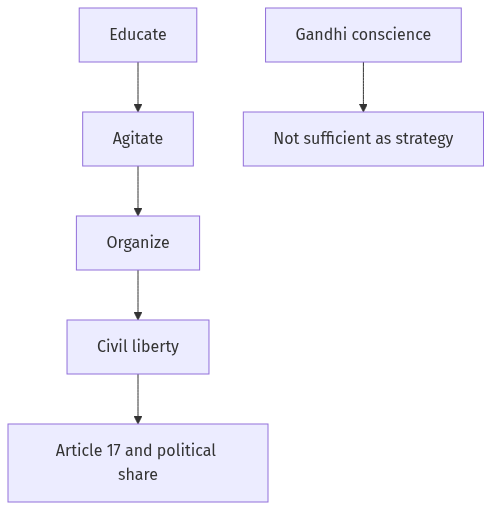
Ambedkar’s call is a three-step strategy: education for capacity, agitation for public claim, organisation for lasting power. The end is civil liberty: equal law, public access, and a share in the state, stated in Article 17 and in political reservation. He rejected dependence on upper-caste moral reform as the engine of that liberty. Mahad, parties from the Independent Labour Party to the SCF, and the 1956 conversion are applications of the three terms. The strategy fails if any one term is dropped: schooling without power, protest without organisation, or office without liberty.
Model answer
Copper italics in this answer — like this — are the key facts. Each one is unpacked in the Facts & figures rail.
Introduction
B. R. Ambedkar’s call to educate, agitate, and organise is a strategy of civil liberty for those excluded by caste. Civil liberty here means equal public standing: movement, occupation, representation, and protection of law, not a favour from a religious majority.
Body
The three terms as strategy
- Educate: caste exclusion works through denial of letters, temples, and offices. Schools, colleges, and a public literature of rights create the person who can use liberty. Ambedkar’s own education was the proof of the first term.
- Agitate: public protest, temple-entry satyagraha at Mahad and Nashik, and the burning of the Manusmriti made humiliation a political fact, not a private sorrow.
- Organise: the Bahishkrit Hitakarini Sabha, Independent Labour Party, Scheduled Castes Federation, and later the Republican Party turned numbers into a bargaining agent, which Dahl would recognise as an interest that can prevail on some decisions.
- The order is not a slogan of spontaneity. Without education, agitation is noise; without organisation, agitation is a moment.
Civil liberty as the end
- Civil liberty for Ambedkar is Article 17, equal protection, access to water and temples, and a share in the state through reservation and adult franchise.
- He did not treat Gandhi’s harijan moral reform as a sufficient strategy, because liberty that depends on the conscience of the dominant caste is not a right.
- The Poona Pact (1932) showed the conflict between separate electorates as a tool of organisation and Gandhi’s fast; Ambedkar still kept organisation inside the joint electorate plus reserved seats.
- The 1956 conversion to Buddhism, with Dhamma as equal worth, was education and organisation in a religious key, an emancipation of political action discussed in Q4(a).
- Constitutional morality, in his Assembly speeches, is the civic form of the same liberty: procedure against popular prejudice.
Discussion of limits
- Education without agitation can produce a small class that exits without moving the mass, the creamy-layer problem in another language.
- Agitation without organisation is absorbed as riot or as charity.
- Organisation can become only office-seeking unless civil liberty remains the test.
- The strategy still organises Dalit parties, student groups, and legal mobilisation under the Scheduled Castes and Scheduled Tribes (Prevention of Atrocities) Act, 1989.
- Compared with Rawls, it is a historically situated path to the equal basic liberties that the original position assumes too quickly.
Flow diagram
Conclusion
- Educate, Agitate, Organise is Ambedkar’s sequence for Dalit civil liberty: capacity, public claim, and lasting power. It strategises a movement that does not wait on Gandhian conscience. Article 17 and political organisation are its constitutional and party forms.
Quick related
Students also ask
-
"The Panchayats with Gram Sabhas should be so organised as to identify the resources locally available for the development in agricultural and industrial sectors." Examine the statement in the context of Gram Swaraj
Next question on this syllabus topic (2022 · Q4(b)). View answer →
-
Did Ambedkar reject all satyagraha?
No. He used public satyagraha at Mahad and Nashik. He rejected a national strategy that waited on the dominant caste’s change of heart.
-
Is reservation the whole of ‘organise’?
Reservation is one organised share in the state. Parties, unions, and religious association are the wider meaning of organise.
Same topic · past papers
UPSC has asked this before
These previous-year questions sit on the same topic. Open one to practise the earlier ask.
-
2026 · Q2(c) · PSIR GS 1 · 15 marks
Discuss B. R. Ambedkar's views on democracy and State socialism -
2022 · Q4(a) · PSIR GS 1 · 20 marks
Ambedkar's idea of social justice leads to 'egalitarian justice' as compared to Rawls' 'justice as fairness' which aims at the notion of 'pure procedural justice'. Comment
More from this topic
Q8(b) · UPSC Mains 2026 · PSIR GS 1 · 15 marks · Solution
Critically comment on the shifts in the functioning of the Indian Parliament in the last two decades
Indian Nationalism
This 15-mark answer analyses the transformation of the Indian Parliament over the past two decades, moving from a deliberative forum to an arena of executive assertion. It highlights declining debate hours, bypassing of Department-Related Standing Committees (DRSCs), and the rise of ordinance-making and bypassing of bicameral consensus through Money Bills. The critique incorporates Morris-Jones and Pratap Bhanu Mehta's insights on the hollowing out of institutions. The conclusion argues for systemic institutional reforms to restore Parliament's core constitutional role as a deliberative check on executive power.
Q7(a) · UPSC Mains 2025 · PSIR GS 1 · 20 marks · Solution
Enunciate the impediments to women's participation in local governance in the process of political decentralisation
Indian Nationalism
The 73rd and 74th Amendments reserved local seats for women, which is a structural opening, not yet equal participation. Sarpanch-pati proxy rule, unpaid care, and a male bureaucracy remain the everyday patriarchal impediments. Caste and class decide which women can act; Dalit women office-holders face additional violence and veto. Thin devolution of money and staff makes many local offices ceremonial, so participation has no policy content. Parties and seat rotation often transfer the reserved ticket to a household rather than building a woman’s public career.
Q7(b) · UPSC Mains 2025 · PSIR GS 1 · 20 marks · Solution
Caste remains a vital axis for political mobilisation in India. How would the caste census address the aspirations of people? Discuss
Indian Nationalism
Caste remains a mobilisation axis because it still structures dignity, land, and access to the state, as Kothari, Mandal, and bahujan politics show. Parties already count jatis; the demand is that the official Census should too, beyond SC and ST. Aspirations include fairer reservation design, targeting of welfare, and recognition after the unpublished 2011 SECC caste data. Risks include reification of identity and a pure percentage war that forgets class, gender, and Ambedkar’s horizon of annihilation. A democratic census would publish usable aggregates while protecting persons and keeping constitutional individual rights at the centre.