
Revision summary
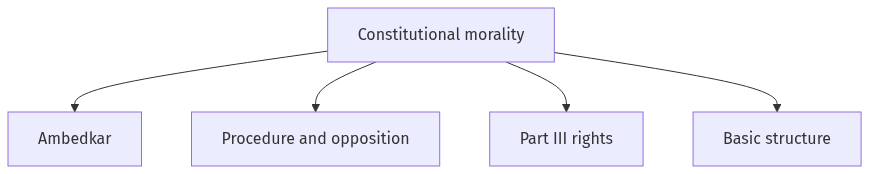
Constitutional morality is respect for constitutional forms, rights, and limits beyond the will of a passing majority. Ambedkar treated it as necessary because Indian social life still contained caste hierarchy. Part III, judicial review, federalism, and parliamentary procedure are the institutional face of that morality. Kesavananda’s basic structure is a judicial cousin of the same idea. The term is contested when courts apply it, but its political core remains a warning against personal and purely majoritarian rule.
Model answer
Copper italics in this answer — like this — are the key facts. Each one is unpacked in the Facts & figures rail.
Introduction
Constitutional morality is the habit of respecting the forms, limits, and spirit of a constitution even when a majority could ignore them. In India the phrase is tied to Dr B. R. Ambedkar’s speeches in the Constituent Assembly and to later judicial use of the same idea.
Body
Ambedkar and the text
Ambedkar warned that democracy in India must not rest only on social soil that still held caste. It must rest on constitutional morality: respect for procedure, for opposition, for limits on power, and for the administration of law without personal rule. Grote’s history of Greece had used the term; Ambedkar applied it to a new republic. The Constitution’s devices — adult franchise, judicial review, federal distribution, and justiciable rights in Part III — assume that holders of office will not treat the text as a temporary inconvenience.
Contemporary meaning
Courts have invoked constitutional morality in cases on individual liberty, dignity, and institutional propriety, treating it as more than majoritarian morality. Critics say judges should not make the phrase a second constitution. The political meaning remains Ambedkar’s: parties, legislatures, and citizens keep the basic structure that Kesavananda Bharati later named, including liberty and constitutional amendment within limits. Without that habit, the document is only paper.
Flow diagram
Conclusion
Constitutional morality in the Indian Constitution is the practised respect for constitutional limits, rights, and procedure. Ambedkar made it a condition of democracy in a hierarchical society. Courts and public argument still use the term to resist both personal rule and unrestrained majority will.
Quick related
Students also ask
-
Imprint of the British Constitution on the Indian Constitution.
Next question on this syllabus topic (2023 · Q5(a)). View answer →
-
Is constitutional morality the same as public morality?
No. Public or social morality may support caste or majoritarian custom. Constitutional morality binds power to the Constitution’s equality and liberty.
-
Who must practise it?
Ambedkar named citizens and leaders. Without that habit, even a well-written constitution will not work.
Same topic · past papers
UPSC has asked this before
These previous-year questions sit on the same topic. Open one to practise the earlier ask.
-
2021 · Q5(a) · PSIR GS 1 · 10 marks
"The Constitution of India is a product of a historical process, rich with constitutional antecedents." Comment. -
2026 · Q7(b) · PSIR GS 1 · 15 marks
Highlight any five constitutional provisions that restrain the powers of the executive, and evaluate their effectiveness in current times -
2025 · Q5(c) · PSIR GS 1 · 10 marks
Land reforms programmes led to some constitutional amendments. Comment -
2025 · Q6(b) · PSIR GS 1 · 15 marks
Examine the constitutional provisions and nature of advisory jurisdiction of Supreme Court of India. Evaluate your answer with relevant examples -
2023 · Q6(a) · PSIR GS 1 · 20 marks
Discuss the major provisions of the 74th Constitutional Amendment Act. Do you think that the Act remains an 'unfulfilled dream'? Argue your case
More from this topic
Q5(a) · UPSC Mains 2023 · PSIR GS 1 · 10 marks · Solution
Imprint of the British Constitution on the Indian Constitution.
Making of the Indian Constitution
India took parliamentary cabinet government, Westminster procedure, and much 1935 institutional design from Britain. Dicey’s rule of law influenced Article 14, but India wrote rights and judicial review into the text. Federal lists, the Governor, and emergencies also travel from the 1935 Act. Austin’s cornerstone argument treats this as a new nation’s charter, not a colonial statute continued. Parliamentary sovereignty in the British sense was refused.
Q8(b) · UPSC Mains 2022 · PSIR GS 1 · 15 marks · Solution
The making of the Indian Constitution is described as an attempt towards a 'social revolution'. Comment
Making of the Indian Constitution
Austin named social revolution as a strand of the constitutional web beside democracy and unity. Ambedkar drafted justiciable equality, including abolition of untouchability, as the legal engine. Directive Principles state economic democracy as a continuing duty. Land reform and reservations extend the attempt against estates and caste monopoly. The making is an attempt; social facts still lag the text.
Q5(b) · UPSC Mains 2022 · PSIR GS 1 · 10 marks · Solution
The Preamble of the Indian Constitution reflects itself as a 'social contract'. Elucidate.
Making of the Indian Constitution
The Preamble’s “We, the People” is popular contract language of self-authorisation. Justice, liberty, equality, and fraternity are the terms of the trust, closer to Locke and Rousseau than to Hobbes. Austin treated this as the Assembly’s nation-making bargain. Kesavananda tied the Preamble to basic structure. Ambedkar’s social democracy is the test of whether the contract is lived.