
Revision summary
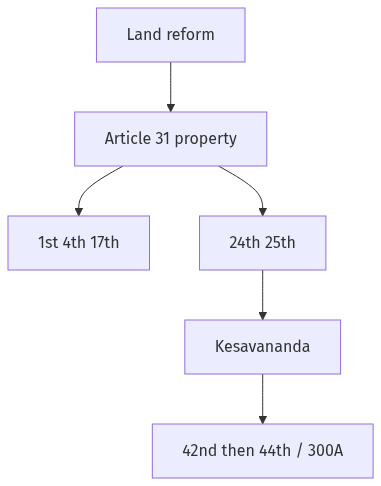
Zamindari abolition and ceilings collided with the fundamental right to property, so Parliament built Articles 31A, 31B, and the Ninth Schedule in the First Amendment. The Fourth and Seventeenth Amendments tightened compensation rules and widened ‘estate’ to catch more tenures. Golaknath led to the Twenty-fourth Amendment restoring the power to amend fundamental rights. The Twenty-fifth Amendment’s Article 31C linked land and resource redistribution to Directive Principles; Kesavananda then limited Parliament through basic structure. The Forty-second Amendment over-expanded that project; the Forty-fourth Amendment ended property as a fundamental right and placed it in Article 300A.
Model answer
Copper italics in this answer — like this — are the key facts. Each one is unpacked in the Facts & figures rail.
Introduction
Land reform was a promise of the freedom struggle and a test of the Constitution. Zamindari abolition, tenancy protection, and ceilings struck at property as a fundamental right. Parliament therefore amended the Constitution repeatedly so that agrarian legislation would not die in court. The comment is on that constitutional struggle, not on every state’s land-record success.
Body
The First and Fourth Amendments
Early zamindari laws were challenged as violations of Articles 14, 19, and 31. In Kameshwar Singh and related litigation, the Supreme Court and High Courts constrained the project. The First Amendment (1951) inserted Articles 31A and 31B and the Ninth Schedule to immunise specified agrarian laws. Nehru told Parliament that social revolution must not be vetoed by a colonial-minded reading of property.
- The Fourth Amendment (1955) further tightened Article 31: the adequacy of compensation for certain acquisitions would not be justiciable in the same way, and more state laws entered the Ninth Schedule. The political theory is clear. Property remained a right, but it was made to bow to agrarian redistribution.
Seventeenth, and the Kesavananda sequence
The Seventeenth Amendment (1964) widened ‘estate’ so ryotwari tenures could be reached after Karimbil Kunhikoman. Golaknath (1967) then barred amendment of fundamental rights. The Twenty-fourth Amendment (1971) restored that power. The Twenty-fifth inserted Article 31C, protecting laws for Articles 39(b) and (c) from 14, 19, and 31. Kesavananda (1973) added basic structure. The Forty-second Amendment (1976) tried to widen 31C to all Directive Principles. The Forty-fourth (1978) deleted the fundamental right to property and placed it in Article 300A. Implementation is another story; the amendments show land justice as a constitutional battlefield.
Flow diagram
Conclusion
Land reform forced India to rewrite the property clauses. The First, Fourth, and Seventeenth Amendments saved agrarian laws; the Twenty-fourth and Twenty-fifth reopened amending power and Directive Principle protection; the Forty-second overreached; the Forty-fourth took property out of Part III. The comment is that the Constitution was not a barrier accidentally; it was a battlefield by design.
Quick related
Students also ask
-
The legacy of the Planning Commission still has a bearing on India's development policies. Discuss.
Next question on this syllabus topic (2024 · Q6(c)). View answer →
-
Did the Ninth Schedule make land laws eternal?
It tried to immunise them. In *I. R. Coelho* (2007) the Court held that Ninth Schedule laws can still be tested against the basic structure, so immunity is not absolute.
-
Was the Forty-second Amendment mainly about land?
No. It was a wide Emergency rewrite. For land and social revolution it mattered because it sought to expand 31C to all Directive Principles.
Same topic · past papers
UPSC has asked this before
These previous-year questions sit on the same topic. Open one to practise the earlier ask.
More from this topic
Q6(c) · UPSC Mains 2024 · PSIR GS 1 · 15 marks · Solution
The legacy of the Planning Commission still has a bearing on India's development policies. Discuss.
Planning and Economic Development
The Planning Commission was a 1950 extra-constitutional body that wrote Five-Year Plans and used plan assistance to steer states. It embodied Nehru’s mixed-economy development state, with public-sector industry and later poverty programmes as plan objects. Gandhian village reconstruction remained secondary to this national industrial and fiscal centre. After 2014, NITI Aayog lost grant power, but Union schemes, indices, and industrial and welfare missions continue the coordinating habit. The legacy is a national development project under political direction, now in a more market-open form, still bounded by constitutional rights.
Q7(c) · UPSC Mains 2021 · PSIR GS 1 · 15 marks · Solution
What explains India's modest improvements in social development outcomes even as the rate of growth has accelerated since the initiation of economic reforms?
Planning and Economic Development
Growth after 1991 outpaced improvements in health, nutrition, and learning. Explanations include informal employment, weak public-goods bureaucracies, and federal unevenness. Caste and gender still filter who benefits from clinics and schools. Ambedkar’s social-democracy lag and Rawls’s least-advantaged test both fit the puzzle. Modest is not nil; it is slow relative to income growth and to public-goods successes elsewhere.