
Revision summary
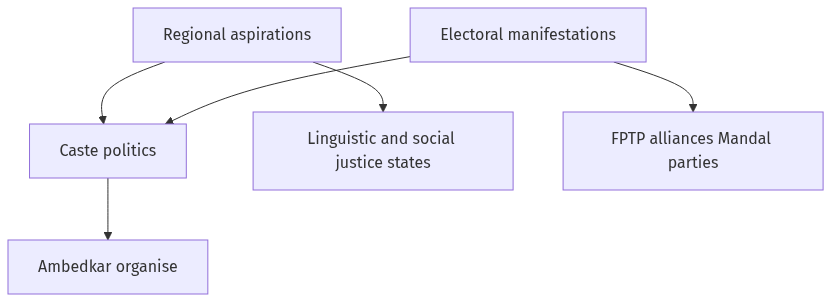
Caste politics is the public organisation of caste for power. Regional aspirations after linguistic States and in Dravidian and OBC movements gave caste a territorial and dignity language. Electoral manifestations — adult franchise, first-past-the-post, Mandal, and State parties — turned numbers into cabinets. The two causes work together: region supplies the map, elections supply the incentive. Caste politics is not the whole of Indian voting, and it can freeze identities that civil liberty aims to equalise.
Model answer
Copper italics in this answer — like this — are the key facts. Each one is unpacked in the Facts & figures rail.
Introduction
Caste politics in India is the organisation of caste identities for public power. The comment that its rise comes from regional aspirations and from electoral manifestations is right if both are treated as causes that work together, not as rival slogans.
Body
Regional aspirations
- After linguistic States, politics moved into regional arenas where locally dominant peasant and intermediate castes could seek the state that the Congress system had kept more national and upper-caste in its early leadership.
- Dravidian mobilisation in Tamil Nadu joined anti-Brahmin social justice to a Tamil regional self, which is caste politics as regional aspiration.
- Other Backward Classes politics in the Hindi belt, after Karpoori Thakur and then Mandal, sought a regional social majority inside Uttar Pradesh and Bihar, not only a national quota.
- Adivasi and Dalit claims in Jharkhand, Chhattisgarh, and Maharashtra mixed region, resource, and caste-tribe lists.
- Ambedkar had already tied Dalit liberty to organisation; regional federalism after Article 3’s new States gave that organisation a territory.
Electoral manifestations
- Adult franchise made numbers count. Rajni Kothari described a Congress system that later opened to caste coalitions as the vote expanded.
- First-past-the-post rewards geographically concentrated caste blocs and alliance arithmetic more than a single national class party.
- The Mandal Commission report’s implementation in 1990, the rise of the Bahujan Samaj Party, Samajwadi Party, Rashtriya Janata Dal, and many State parties are electoral forms of caste.
- Reservation in panchayats after the 73rd Amendment created a local electoral career for caste and gender lists together.
- Dahl’s polyarchy predicts that excluded groups will organise where contestation is open; Indian elections were that opening.
How the two causes join, and what they do not mean
- Regional aspiration supplies a map and a language of dignity. Electoral rules supply the incentive to turn caste into a party, a ticket, and a cabinet share.
- Neither cause means that caste is only a voting machine. Kinship, marriage, and violence still structure who can use Mill’s individuality.
- Walzer’s and Sandel’s membership help explain why caste is a constitutive identity, not only an electoral label, and why Rawls’s unencumbered self is a poor description of this field.
- National parties also caste-engineer tickets; regionalism is not the only site.
- The comment is therefore: rise of caste politics = federal-regional opportunity + electoral-system incentive, inside a society that Ambedkar had already named as graded inequality.
Limit of the comment
- Economic class, religion, and a national Hindu majority politics also organise votes. Caste politics is a major rise, not the only rise.
- Electoral caste can freeze the identity that civil liberty was meant to loosen, which is the standing tension with Article 17.
Flow diagram
Conclusion
Caste politics rose because regionalised federalism gave locally strong castes a state to capture, and because electoral competition rewarded organised caste numbers. Kothari, Ambedkar, and Dahl explain the two sides. The comment holds as a joint attribution, not as a claim that caste is only region or only a ballot.
Quick related
Students also ask
-
Discuss the composition and functions of the Inter-State Council. To what extent has this body been successful in achieving its objectives?
Next question on this syllabus topic (2022 · Q6(c)). View answer →
-
Is caste politics only a Hindi-belt story?
No. Dravidian parties, Maratha and Lingayat mobilisation, and Dalit parties in the west and south are regional caste politics too.
-
Did Ambedkar want caste parties?
He wanted organisation for civil liberty. Electoral caste parties are one historical form of that organisation, not the whole of his theory.
Same topic · past papers
UPSC has asked this before
These previous-year questions sit on the same topic. Open one to practise the earlier ask.
-
2021 · Q8(a) · PSIR GS 1 · 20 marks
"The success of electoral democracy can partly be attributed to the status and role of the Election Commission of India." Explain
More from this topic
Q7(b) · UPSC Mains 2026 · PSIR GS 1 · 15 marks · Solution
Highlight any five constitutional provisions that restrain the powers of the executive, and evaluate their effectiveness in current times
Federalism
This model answer examines five constitutional mechanisms designed to check executive overreach in India: parliamentary accountability, judicial review under Article 13 and 32, the President's suspensive veto, the federal distribution of powers under the Seventh Schedule, and constitutional bodies like the Election Commission. It analyses their formal design alongside contemporary challenges to their operational efficacy, such as declining parliamentary scrutiny, ordinance routes, and pressure on institutional autonomy. The synthesis underscores that while the textual architecture for executive restraint is robust, its real-world effectiveness depends on political morality and judicial vigilance.
Q6(c) · UPSC Mains 2026 · PSIR GS 1 · 15 marks · Solution
Evaluate the Centre-State relation with reference to Article 293 and analyze its implications for the Indian federal structure
Federalism
Article 293 empowers states to borrow within territory limits subject to Centre's consent if central loans are outstanding. This fiscal lever has triggered intense friction between the Union and opposition-ruled states over net borrowing ceilings and off-budget borrowings. While designed for macroeconomic stability, its centralized enforcement risks undermining the fiscal autonomy of states. The judiciary and Sarkaria-Punchhi commissions have repeatedly emphasized consultative fiscal federalism to resolve such tensions.
Q6(b) · UPSC Mains 2025 · PSIR GS 1 · 15 marks · Solution
Examine the constitutional provisions and nature of advisory jurisdiction of Supreme Court of India. Evaluate your answer with relevant examples
Federalism
Article 143 lets the President refer questions of public importance to the Supreme Court for an opinion. Clause (1) is discretionary for the Court; clause (2) on certain treaty disputes requires a report. The opinion is not an ordinary decree, though it is politically and legally weighty. Kerala Education Bill and Berubari show the jurisdiction at its best as advance constitutional counsel. The Ayodhya reference shows the Court may refuse a question that is better left to a pending suit; 2G shows how an invited opinion can bind the inviter politically.