
Revision summary
A code of ethics states values; a code of conduct states forbidden acts; both need leaders who obey them. Whistle protection, rotation, checked assets and small consistent punishments build culture. India’s fourth-largest-economy rank (IMF) sits beside under-used and stolen public money in some schemes. PFMS, outcome budgets, social audit, GeM and CAG follow-up are the accountability kit. Growth to third place is ethical only if the ladder is not stolen from the poor.
Model answer
Copper italics in this answer — like this — are the key facts. Each one is unpacked in the Facts & figures rail.
Introduction
A code of ethics says what we believe. A code of conduct says what we may not do on Tuesday. Part (a) wants both, alive in an office, not framed for a VIP. Part (b) notes IMF’s line that India is the fourth-largest economy in the world and still loses public money in some sectors. Size without probity is a hollow rank.
Body
(a) Measures for an ethical work culture
Write a short code of ethics: integrity, objectivity, empathy, constitutional morality. Write a conduct code: gifts, conflict of interest, social media, sexual harassment. Induction that uses case discussion, not only a PPT. Leaders eat last: if the head takes a private jet for a family wedding on an official booking, the code is dead. Speak-up: a protected whistle channel to CVO. No revenge posting. Rotate sensitive desks. Asset declarations that are checked. Celebrate the clerk who refused a tout. Punish the first small leak; culture is a thousand Tuesdays.
Value-based culture is Socrates in the canteen. Compliance culture is the audit trail. India needs both. Second ARC and the Nolan principles (selflessness, integrity, objectivity, accountability, openness, honesty, leadership) are ready furniture.
(b) Accountability so the fourth can become a third without theft
IMF’s 2025-class projection of India as the fourth-largest economy (nominal dollars) is a headline of scale. Under-used and misused funds are a headline of waste: stalled irrigation, empty food parks, ghost MGNREGA, delayed health buildings. Measures: just-in-time releases (PFMS) so money does not rot in a park account; outcome budgets that a legislature can read; social audit that is not captured by the same sarpanch; geotagged assets; CAG and PAC with time-bound ATR; benami and procurement e-markets (GeM) with blacklisting that bites; CWC/CVC on big tickets; Parliamentary and media sunlight; capacity so a district can spend well, not only surrender in March.
Probity is Kautilya’s watchmen. Gandhi’s talisman — the face of the poorest — is the test of a leaked scholarship. Becoming third by honest productivity is ethics. Becoming third by inflated invoices is a statistical sin.
The civil servant’s specific honour is to stop the leakage without stopping the school.
Flow diagram
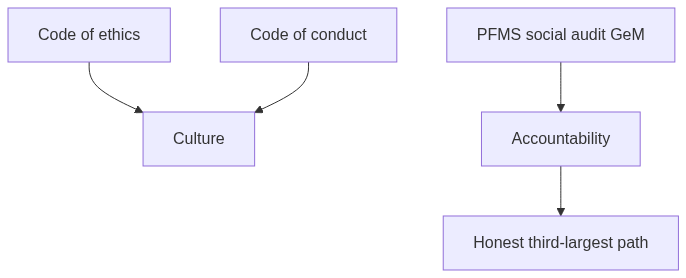
Conclusion
An ethical office needs a living code, a speaking leader and a safe whistle. A fourth-largest economy still leaking funds will not become a fair third without PFMS, audits, geotags and punishment that is real.
Quick related
Students also ask
-
The application of Artificial Intelligence as a dependable source of input for administrative rational decision-making is a debatable issue. Critically examine the statement from the ethical point of view
Next question on this syllabus topic (2024 · Q1(a)). View answer →
-
Is a framed code enough?
No. Culture is what happens when the boss is not in the room.
-
Does stopping leakage mean stopping welfare?
The ethical aim is the opposite: every rupee that was meant for work should become work, not a Swiss joke.
More from this topic
Q1(b) · UPSC Mains 2026 · GS IV · 10 marks · Solution
A business house is working on a project that could displace a forest community from their habitat. As the administrative officer of that district, what ethical challenges are you likely to face?
Probity in Governance
This GS4 10-marker examines the ethical dilemmas faced by a district administrator dealing with industrial displacement of a forest community. The answer navigates the core tension between economic development and social justice, highlighting stakeholder conflicts such as corporate pressure versus tribal rights, the paradox of legal compliance versus moral duty, and personal integrity under administrative coercion. It incorporates a structured Mermaid flowchart mapping out the stakeholder dilemma and concludes with a balanced administrative approach upholding constitutional empathy and statutory safeguards like PESA and FRA.
Q1(a) · UPSC Mains 2026 · GS IV · 10 marks · Solution
Owing to paucity of time, a university professor generates a Ph.D. evaluation report using Artificial Intelligence and submits it with some modifications. Discuss this from the perspective of accountability and integrity.
Probity in Governance
This GS4 ethics case study examines the dilemma of a university professor using AI to generate a Ph.D. evaluation report due to time constraints. It analyses the failure of professional accountability in delegating core academic judgment to an automated tool. The response evaluates the breach of intellectual integrity, the erosion of institutional trust in research degrees, and outlines a principled course of action balancing urgency with ethical duty.
Q6(b) · UPSC Mains 2024 · GS IV · 10 marks · Solution
Mission Karmayogi is aiming for maintaining a very high standard of conduct and behaviour to ensure efficiency for serving citizens and in turn developing oneself. How will this scheme empower the civil servants in enhancing productive efficiency and delivering the services at the grassroots level?
Probity in Governance
Indian ethos and the Constitution promise equal opportunity; women’s numbers in public service have risen, but command postings still lag. Gender-specific challenges include safety, POSH failure, care burden, infrastructure, ACR bias and isolation that aids capture. Measures mix predictable postings, working POSH, creche, bias audit and support for the officer who refuses a tout. Mission Karmayogi is a competency and conduct programme on iGOT, meant to shift from rule-parrot to role skill. It empowers grassroots delivery only if content, language and measures reach the last-mile worker and change the thana, not only the dashboard.