
Revision summary
AI can speed pattern-finding in administration, but it is ethically unsafe as an unreviewed verdict. Bias, opacity, privacy harm and an accountability gap mean the officer remains answerable. A dependable use is explainable input plus human review of high-stakes harm. Ethics that shapes action includes duty, consequence, virtue, rights, role and care. A professional framework turns those dimensions into stakeholders, reasons, records and appeal.
Model answer
Copper italics in this answer — like this — are the key facts. Each one is unpacked in the Facts & figures rail.
Introduction
A file used to wait for a human. It now waits for a model. Part (a) asks whether that model can be a dependable source for rational administrative choice, and what ethics says when the model is wrong about a widow’s ration. Part (b) steps back: ethics is not one slogan. It is several dimensions that already live in a civil servant’s Tuesday — intent, consequence, duty, virtue, rights and the role.
Body
(a) AI as input for administrative rational decision-making
Rational administration, in Weber’s sense, is reasoned, rule-bound and reviewable. AI can help that reason: it can flag a flood village, match a duplicate PAN, or queue a hospital bed. Speed and pattern-finding are real goods. The ethical debate begins when the same tool is treated as a verdict, not as an input.
Bias. Training data copy old exclusion. A credit or policing score can punish a pincode or a caste cluster that the officer never named. Kant’s test fails if a person is used as a data point, not an end. Opacity. A black box cannot give the reasons that natural justice and administrative law demand. An order that says “the model scored you low” is not a speaking order. Accountability. When a death follows an automated stop of dialysis funds, who is guilty — the vendor, the secretary, or “the algorithm”? Ethics of responsibility (Jonas, and ordinary service rules) says the human in the chair remains answerable. Dignity and privacy. Facial recognition in a protest, or Aadhaar-linked welfare without a manual override, can starve a rights-holder for a “tech glitch”. Autonomy of the officer. Over-trust is a new vice: the file is signed because the dashboard is green.
So the statement is half right. AI is a dependable aid only inside a cage: explainability, audit of bias, human review of high-stakes harm, data minimisation (DPDP Act as a floor), and a published redress. It is not a dependable source of moral judgement. Aristotle’s prudence still sits with the officer who visits the village the model has erased.
(b) Key dimensions of ethics and professional decision-making
Ethics that actually moves a hand has several dimensions, not one exam heading.
Normative content: what is right — duty (Kant, Gita’s nishkama), consequence (Mill: greatest sustainable good), virtue (Aristotle: courage, temperance, justice). Intent and motive: a lawful transfer done to punish a whistle-blower is still rotten inside. Rights and dignity: Article 14 and 21 as ethical floors, not only clauses. Character and habit: one honest year is a disposition, not a poster. Context and role: a doctor’s confidentiality is not a journalist’s; a District Magistrate’s role morality is not a private citizen’s. Social dimension: Durkheim’s conscience of the group; Vivekananda’s man-making. Relational care: Gilligan’s reminder that a rule can be correct and still cruel to the person in the queue.
In professional ethical decision-making these dimensions become a sequence, not a speech. Name the stakeholders. Name the duty of office (Constitution, law, Conduct Rules). Test consequences for the weakest face (Gandhi’s talisman). Check conflict of interest and appearance of bias. Record reasons. Leave a path for appeal. A well-structured professional framework is therefore values written down, rules that bite, cases practised in training, and leaders who eat last. Dimensions without that structure stay as optional poetry. Structure without dimensions becomes GFR theatre that still starves a person.
Flow diagram
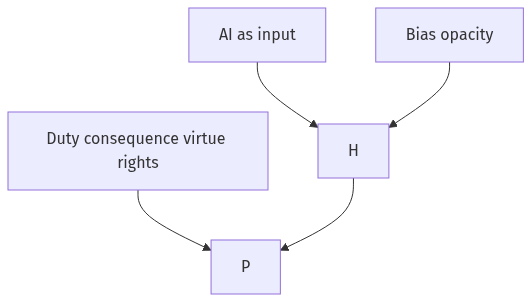
Conclusion
AI can inform a rational file; it cannot own the file. Bias, opacity and the accountability gap make it an aid under human review, not a moral authority. Ethics works through duty, consequence, virtue, rights, role and care; a profession is ethical when those dimensions are built into reasons, records and redress.
Quick related
Students also ask
-
"Ethics encompasses several key dimensions that are crucial in guiding individuals and organizations towards morally responsible behaviour." Explain the key dimensions of ethics that influence human actions. Discuss how these dimensions shape ethical decision-making in the professional context.
Next question on this syllabus topic (2024 · Q1(b)). View answer →
-
Should a district stop using AI dashboards?
No. It should stop treating a dashboard as a court. Use the tool, visit the excluded household, and write why the tool was accepted or overruled.
-
Are dimensions of ethics the same as Conduct Rules?
Conduct Rules list forbidden acts. Dimensions of ethics explain why an act is wrong even when a rule is silent, and how a professional should reason.
Same topic · past papers
UPSC has asked this before
These previous-year questions sit on the same topic. Open one to practise the earlier ask.
-
2021 · Q2(a) · GS IV · 10 marks
Impact of digital technology as a reliable source of input for rational decision making is a debatable issue. Critically evaluate with a suitable example. -
2024 · Q1(b) · GS IV · 10 marks
"Ethics encompasses several key dimensions that are crucial in guiding individuals and organizations towards morally responsible behaviour." Explain the key dimensions of ethics that influence human actions. Discuss how these dimensions shape ethical decision-making in the professional context.
More from this topic
Q1(b) · UPSC Mains 2026 · GS IV · 10 marks · Solution
A business house is working on a project that could displace a forest community from their habitat. As the administrative officer of that district, what ethical challenges are you likely to face?
Probity in Governance
This GS4 10-marker examines the ethical dilemmas faced by a district administrator dealing with industrial displacement of a forest community. The answer navigates the core tension between economic development and social justice, highlighting stakeholder conflicts such as corporate pressure versus tribal rights, the paradox of legal compliance versus moral duty, and personal integrity under administrative coercion. It incorporates a structured Mermaid flowchart mapping out the stakeholder dilemma and concludes with a balanced administrative approach upholding constitutional empathy and statutory safeguards like PESA and FRA.
Q1(a) · UPSC Mains 2026 · GS IV · 10 marks · Solution
Owing to paucity of time, a university professor generates a Ph.D. evaluation report using Artificial Intelligence and submits it with some modifications. Discuss this from the perspective of accountability and integrity.
Probity in Governance
This GS4 ethics case study examines the dilemma of a university professor using AI to generate a Ph.D. evaluation report due to time constraints. It analyses the failure of professional accountability in delegating core academic judgment to an automated tool. The response evaluates the breach of intellectual integrity, the erosion of institutional trust in research degrees, and outlines a principled course of action balancing urgency with ethical duty.
Q6 · UPSC Mains 2025 · GS IV · 10 marks · Solution
(a) It is said that for an ethical work culture, there must be code of ethics in place in every organisation. To ensure value-based and compliance-based work culture, what suitable measures would you adopt in your work place? (b) India is an emerging economic power of the world as it has recently secured the status of fourth largest economy of the world as per IMF projection. However, it has been observed that in some sectors, allocated funds remain either under-utilised or misutilised. What specific measures would you recommend for ensuring accountability in this regard to stop leakages and gaining the status of third largest economy of the world in near future?
Probity in Governance
A code of ethics states values; a code of conduct states forbidden acts; both need leaders who obey them. Whistle protection, rotation, checked assets and small consistent punishments build culture. India’s fourth-largest-economy rank (IMF) sits beside under-used and stolen public money in some schemes. PFMS, outcome budgets, social audit, GeM and CAG follow-up are the accountability kit. Growth to third place is ethical only if the ladder is not stolen from the poor.