
Revision summary
What counted as just can become unjust when facts, rights and harm are seen more clearly, as in sexuality, talaq, sedition and biometric exclusion. Scrutiny by courts, audits and honest officers is what stops both frozen custom and cynical ‘everyone did it’. Addiction to form turns a stamp into a wall against a widow; substance is the purpose of the statute. A perceptive civil servant uses lawful discretion and a speaking record to carry intent, not to gift a nephew a waiver. Equity without jurisdiction is another injustice.
Model answer
Copper italics in this answer — like this — are the key facts. Each one is unpacked in the Facts & figures rail.
Introduction
Yesterday’s just file can be today’s cruelty. Part (a) asks the officer to watch the context so that justice is not miscarried by a dead habit. Part (b) asks the same officer not to worship the form — the stamp, the column, the literal word — while the substance of the law dies in the queue.
Body
(a) Just and unjust is contextual — under scrutiny
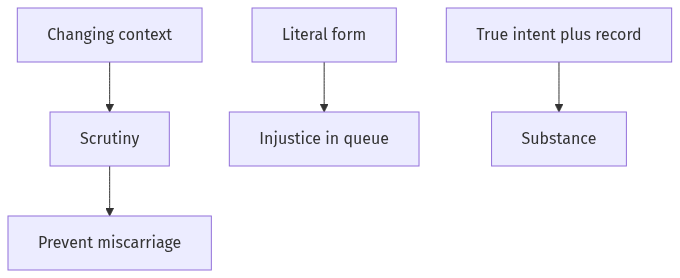
Context is not a licence to call atrocity a culture. It is the honest admission that facts, knowledge and constitutional meaning move. Section 377 as enforced against consenting adults was long treated as “public morality”; Navtej Johar read dignity and said the old justice was unjust. Triple talaq as instant private power failed equality. Sedition’s colonial use against a slogan sits badly beside a republic of free speech, which is why the Court paused it and the BNS recast the idea. Aadhaar as inclusion became exclusion when a biometric failure was treated as a moral failure of the hungry. COVID lockdown that saved lungs could still starve a migrant; the just aim needed a just means (food, trains, wages).
Scrutiny is the ethical engine: Parliament, courts, social audit, journalism, and an officer who revisits a circular. Without scrutiny, context-talk becomes relativism (“everyone took a cut that year”). With only rigidity, justice becomes ancestor worship. Aristotle’s equity already knew that a general rule can miss this person. Rawls asks us to test institutions as if we might be the least advantaged in the new context. A civil servant prevents miscarriage by recording why the old template no longer fits, not by quietly inventing a private Constitution.
(b) Form, substance, and true intent
Form is the application window, the affidavit, the GFR clause, the two-witness box. It exists to stop theft and whim. Mindless addiction to it is when a widow is turned away because a stamp is 2 mm small, when MGNREGA is closed for a portal glitch, when anticipatory bail is a ritual and liberty is not. The substance is the purpose: food, work, a fair trial, a living river.
A perceptive civil servant reads the intent of the NFSA, FRA, or a disaster-relief order and uses residual discretion that the law actually gives — a manual override with a record, a site inspection instead of a paper pond, a speaking order that a court can test. This is not “ignore the Act because I am kind”. Kindness that breaks a safeguard is how a nephew’s firm enters. The skill is purposive interpretation (as courts say), equity within jurisdiction, and escalation when the form is unlawful. Kautilya wanted watchmen; Gandhi wanted the poorest face. The perceptive officer holds both: intent of the weak, form that still binds the strong.
Flow diagram
Conclusion
Justice must be re-examined when knowledge, harm and constitutional meaning change, or yesterday’s just rule becomes today’s miscarriage. Form exists to stop theft; a perceptive officer still carries the law’s true intent to the person in the queue, with a record, not a private pardon.
Quick related
Students also ask
-
"Mindless addiction to Form, ignoring the Substance of the matter, results in rendering of injustice. A perceptive civil servant is one who ignores such literalness and carries out true intent." Examine the above statement with suitable illustrations.
Next question on this syllabus topic (2024 · Q4(b)). View answer →
-
If justice is contextual, is corruption sometimes just?
No. Context changes how we see dignity and harm. It does not turn a bribe into a local custom that binds the republic.
-
May an officer ignore GFR to help the poor?
The officer may use every lawful exception and escalate a cruel form. Inventing a parallel treasury is not perception; it is another leak.
Same topic · past papers
UPSC has asked this before
These previous-year questions sit on the same topic. Open one to practise the earlier ask.
-
2016 · Q14 · GS IV · 20 marks
Case study. You are a young, aspiring and sincere employee in a Government office working as an assistant to the director of your department. Since you have joined recently, you need to lean and progress. Luckily your superior is very kind and ready to train you for your job. He is a very intelligent and well-informed person having knowledge of various departments. In short, you respect your boss and are looking forward to lean a lot from him. Since you have good tuning with the boss, he started depending on you. One day due to ill health he invited you at his place for finishing some urgent work. You reached his house and before you could ring the bell you heard shouting noises. You waited for a while. After entering the house the boss greeted you and explained the work. But you were constantly disturbed by the crying of a woman. At last, you inquired with the boss but his answer did not satisfy you. Next day, you were compelled to inquire further in the office and found out that his behavior is very bad at home with his wife. He also beats up bit wife. His wife is not well educated and is a simple woman in comparison to her husband. you see that though your boss is a nice person in the office, he is engaged in domestic violence at home. In such a situation, you are left with the following options. Analyse each option with its consequences. (a) Just ignore thinking about it because it is their personal matter. (b) Repost the case to the appropriate authority. (c) Your own innovative approach towards situation. -
2025 · Q4(a) · GS IV · 10 marks
"For any kind of social re-engineering by successfully implementing welfare schemes, a civil servant must use reason and critical thinking in an ethical framework." Justify this statement with suitable examples. -
2023 · Q1(b) · GS IV · 10 marks
International aid is an accepted form of helping resource-challenged nations. Comment on ethics in contemporary international aid. Support your answer with suitable examples. -
2023 · Q4(b) · GS IV · 10 marks
Differentiate 'moral intuition" from 'moral reasoning' with suitable examples. -
2018 · Q4(a) · GS IV · 10 marks
"In doing a good thing, everything is permitted which is not prohibited expressly or by clear implication". Examine the statement with suitable examples in the context of a public servant discharging his/her duties.
More from this topic
Q5 · UPSC Mains 2026 · GS IV · 10 marks · Solution
(a) Usually schools, working in remote areas, do not fully comply with government regulations. However, if the rules are enforced strictly, it would lead to most schools closing down. How should an administrator strike a balance between enforcement of rules and educational rights of children? (b) In international relations, ethical considerations are often subjugated to the strategic interests of nation-states. Discuss this from an ethical perspective.
Ethics and Human Interface
• Prioritize fundamental human rights and welfare over rigid procedural rules in governance. • Apply "progressive
Q4(b) · UPSC Mains 2026 · GS IV · 10 marks · Solution
Efficiency is doing things right, while effectiveness is doing the right thing. How do you strike a balance between the two to enhance productivity?
Ethics and Human Interface
This GS4 answer explores the ethical and operational distinction between efficiency and effectiveness. Efficiency focuses on optimal resource use and process execution, whereas effectiveness prioritizes goal alignment and moral direction. Striking a balance requires systemic prioritization, ethical oversight, and agile feedback mechanisms. Public administrators must ensure resources are utilized correctly while serving the right societal objectives. Ultimately, sustainable productivity merges technical competence with moral clarity.
Q4(a) · UPSC Mains 2026 · GS IV · 10 marks · Solution
Citing the serious adverse effects of long-term medication, a doctor convinces the family of a female patient for surgery. This led the patient to reluctantly consent for the surgery, though her original choice was to opt for medication. Explain the concepts of paternalism and beneficence by analysing the doctor's action.
Ethics and Human Interface
This GS4 ethics case study examines the intersection of medical paternalism and beneficence. A doctor overrides a competent female patient's preference for medication, using family influence and risk warnings to secure reluctant consent for surgery. The answer defines beneficence as acting in the patient's best interest and paternalism as overriding patient autonomy. It analyses how the doctor's well-intentioned action crossed into soft or coercive paternalism by bypassing direct informed consent with the patient herself, offering a structured evaluation for future clinical practice.