
Revision summary
Vivekananda asked India to learn the good from others and digest it, not to become a copy that scorns its own poor. Patel held that faith without strength cannot complete a great public work, and strength without faith is only force. Kant drew a line: law waits for the rights-violating act; ethics already condemns the will to do it. Together they train identity, delivery and inner integrity. A dashboard, a riot plan and an unsent communal file are the present-tense tests.
Model answer
Copper italics in this answer — like this — are the key facts. Each one is unpacked in the Facts & figures rail.
Introduction
Three lamps, one present tense. Vivekananda warns a borrowing nation not to become the lender. Patel warns a pious officer that faith without muscle does not integrate a State. Kant warns that ethics begins before the FIR. Together they are identity, capacity and inner law — still the civil servant’s kit.
Body
(a) Vivekananda: absorb, do not become others
The line is against imitation that erases the self. Learn germ theory, a good civil code, a working port. Do not import contempt for your own people or a costume of another civilisation. “In your own way” is digestion, which is how India took the Constitution’s borrowed furniture and still had to grow constitutional morality (Ambedkar) at home. For a civil servant this is policy transfer with a field visit: a Singapore dashboard that excludes a tribal household is not “world class”. It is becoming others at the poor’s cost. Atmanirbhar is ethical when it is self-respect plus learning, not xenophobia. Vivekananda’s man-making is character that can use a tool without worshipping the tool’s country.
(b) Patel: faith and strength
Sardar Patel integrated hundreds of States with negotiation, pressure and an army in reserve. Faith without strength is a prayer over a collapsing dam. Strength without faith is brutality. The quote is Weber’s ethic of responsibility plus ethic of conviction in one Indian mouth. A communal riot needs belief in fraternity and a lathi that arrives. A welfare scheme needs belief in the widow and a payment system that works. Mission-mode without values is target cruelty. Values without delivery are a speech. Patel’s civil servant is the one who files, moves, and still does not hate.
(c) Kant: guilty in ethics at the thought of violating rights
Law, in a liberal State, generally waits for an act (and sometimes a preparation). Ethics, for Kant, looks at the maxim. If I will to falsify a muster, I have already used persons as means, even if the pen has not moved. This is not a call for a thought police. It is a call for integrity before audit. Professional ethics — a doctor imagining a fake trial, a judge imagining a caste bias, an officer imagining a nephew’s tender — must stop the will, not only the gazette. Mens rea in criminal law is a cousin; Kant is stricter because inner respect for the moral law is the motive he wants, not fear of CBI. In the present context of viral hate and silent communal files, the quote says: the tweet you almost sent already failed ethics if it willed harm.
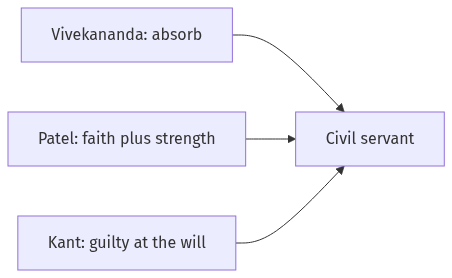
- The three together: do not become a copy, do not be a weak believer, do not wait for the crime to begin in the street.
Flow diagram
Conclusion
Vivekananda wants learning without self-erasure. Patel wants faith that can actually finish the work. Kant wants guilt to start when the will to violate a right is born, not only when the statute is broken. A public servant needs all three.
Quick related
Students also ask
-
"The concept of Just and Unjust is contextual. What was just a year back, may turn out to be unjust in today's context. Changing context should be constantly under scrutiny to prevent miscarriage of justice." Examine the above statement with suitable examples
Next question on this syllabus topic (2024 · Q4(a)). View answer →
-
Does Kant want the State to punish thoughts?
No. He is describing the inner court. Criminal law still needs an act. The officer’s honour is to lose the corrupt will before the CBI arrives.
-
Is Patel anti-faith?
No. He is anti faith that cannot protect a Union or a riot-torn street. Strength here is competence and lawful force, not cruelty.
Same topic · past papers
UPSC has asked this before
These previous-year questions sit on the same topic. Open one to practise the earlier ask.
More from this topic
Q5 · UPSC Mains 2026 · GS IV · 10 marks · Solution
(a) Usually schools, working in remote areas, do not fully comply with government regulations. However, if the rules are enforced strictly, it would lead to most schools closing down. How should an administrator strike a balance between enforcement of rules and educational rights of children? (b) In international relations, ethical considerations are often subjugated to the strategic interests of nation-states. Discuss this from an ethical perspective.
Ethics and Human Interface
• Prioritize fundamental human rights and welfare over rigid procedural rules in governance. • Apply "progressive
Q4(b) · UPSC Mains 2026 · GS IV · 10 marks · Solution
Efficiency is doing things right, while effectiveness is doing the right thing. How do you strike a balance between the two to enhance productivity?
Ethics and Human Interface
This GS4 answer explores the ethical and operational distinction between efficiency and effectiveness. Efficiency focuses on optimal resource use and process execution, whereas effectiveness prioritizes goal alignment and moral direction. Striking a balance requires systemic prioritization, ethical oversight, and agile feedback mechanisms. Public administrators must ensure resources are utilized correctly while serving the right societal objectives. Ultimately, sustainable productivity merges technical competence with moral clarity.
Q4(a) · UPSC Mains 2026 · GS IV · 10 marks · Solution
Citing the serious adverse effects of long-term medication, a doctor convinces the family of a female patient for surgery. This led the patient to reluctantly consent for the surgery, though her original choice was to opt for medication. Explain the concepts of paternalism and beneficence by analysing the doctor's action.
Ethics and Human Interface
This GS4 ethics case study examines the intersection of medical paternalism and beneficence. A doctor overrides a competent female patient's preference for medication, using family influence and risk warnings to secure reluctant consent for surgery. The answer defines beneficence as acting in the patient's best interest and paternalism as overriding patient autonomy. It analyses how the doctor's well-intentioned action crossed into soft or coercive paternalism by bypassing direct informed consent with the patient herself, offering a structured evaluation for future clinical practice.