
Revision summary
TRIPS allows members to exclude plants and animals but not necessarily microorganisms; CBD and Nagoya add benefit-sharing. India bars patents on plants and animals under Section 3(j) and uses PPVFR for varieties, plus TKDL as a defensive record. The US and others have patented engineered microbes and fought over genes; Myriad limited patents on mere natural sequences. High Indian filing has not meant commercialisation because of weak lab-to-industry transfer, thin biotech capital and slow regulation. Volume of patents is not a market; quality, licences and a usable product are.
Model answer
Copper italics in this answer — like this — are the key facts. Each one is unpacked in the Facts & figures rail.
Introduction
A seed, a gene, a microbe and a cell line are life materials. The world now treats some of them as property and some of them as things no one may own. India files a large number of patents, and the question notes that it stands second in the world on filings. Commercialisation — a product, a licence, a plant that actually runs — has not kept pace. Volume is not a market.
Body
Life materials and world IPR
After Diamond v. Chakrabarty in the United States, a genetically engineered bacterium could be patented. TRIPS Article 27.3(b) lets members exclude plants and animals other than microorganisms, and biological processes for their production, while still requiring some protection for plant varieties. The Budapest Treaty deposits microorganisms. The Convention on Biological Diversity and the Nagoya Protocol insist on access and benefit-sharing when genetic resources and traditional knowledge are used. The European debate on stem cells and on animal patents remains tighter than the US. Gene patents were cut back in the US after Association for Molecular Pathology v. Myriad Genetics: a mere isolated natural sequence is not an invention. India, under Section 3(j) of the Patents Act, excludes plants and animals (other than microorganisms) and essentially biological processes; Section 3(d) blocks evergreening of known substances; Section 3(c) blocks the mere discovery of a scientific principle. Plant breeders use the Protection of Plant Varieties and Farmers’ Rights Act, 2001, which also protects the farmer’s right to save seed. Traditional Knowledge Digital Library is a defensive database against misappropriation. The world scene is therefore split: patents on microbes and biotech tools in many offices, no patent on plants and animals in India, and a running fight over genes, CRISPR and digital sequence information.
- Peg: Novartis v. Union of India showed that a patent on a life-related medicine still has to clear Section 3(d).
- Peg: CBD/Nagoya sit beside TRIPS: a patent office grant does not erase a biodiversity permit.
Why so little commercialisation
Filing is a count. Commercialisation is a firm, a trial, a factory and a buyer. Indian patents are often academic or CSIR/ICAR filings with weak industry liaison. Many specifications are thin, so they do not survive opposition or attract a licensee. Technology transfer offices in universities are still young. Venture capital for deep biotech is thinner than for software. Regulatory paths for GM crops, biologics and diagnostics are slow and politically contested, so even a valid patent may never become a product. Firms import licences rather than scale a domestic file. Quality versus quantity: a rush to file for ranking, without freedom-to-operate searches, produces paper that cannot be sold. The missing piece is governance of the last mile — incubation, public procurement of innovation, and a farm or hospital that will use the thing.
- Peg: A patent without a technology-readiness path is a certificate, not a commercial asset.
- Peg: Software-style filing culture does not transfer to wet-lab products that need years of trial.
Flow diagram
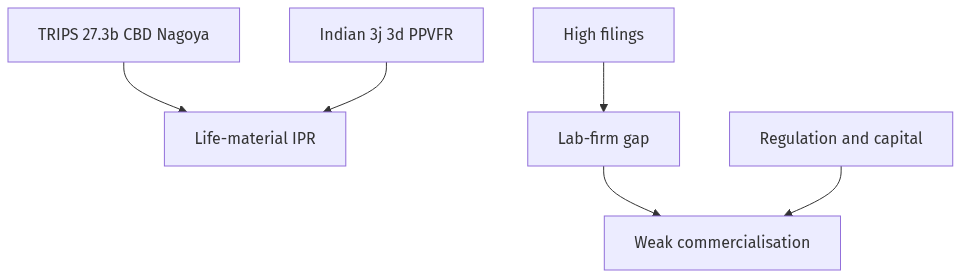
Conclusion
The world patents some life tools and still argues over plants, genes and benefit-sharing. India files a lot and sells little because labs, firms, regulation and capital do not yet form one pipeline. The remedy is transfer and quality, not a larger filing target.
Quick related
Students also ask
-
Describe the context and salient feature of Digital Personal Data Protection Act 2023.
Next question on this syllabus topic (2024 · Q10). View answer →
-
Can India patent a new plant variety?
Not under the Patents Act. Breeders use the PPVFR Act. Farmers’ rights travel with that statute.
-
Does more filing mean a stronger biotech industry?
No. A commercialised patent needs a firm, a regulator and a buyer, not only a number on a WIPO table.
Same topic · past papers
UPSC has asked this before
These previous-year questions sit on the same topic. Open one to practise the earlier ask.
More from this topic
Q17 · UPSC Mains 2026 · GS III · 15 marks · Solution
What are the challenges to solid waste management in India? Discuss the governmental policy framework on solid waste management. Discuss the success/failure cases of Delhi and Indore cities highlighting the salient features of their solid waste management initiatives.
Indian Economy
• Rapid urbanization has made solid waste management a critical environmental and public health crisis in India. • Key challenges include lack of source segregation, inadequate processing infrastructure, reliance on unprotected informal workers, and financially weak urban local bodies. • The policy framework relies on the SWM Rules 2016, Swachh Bharat Mission (Urban), and Plastic Waste Management Rules 2016. • Indore succeeded through 100% source segregation, zero dump-site remediation, and strict enforcement with digital monitoring. • Delhi failed due to overloaded legacy landfills (Ghazipur, Bhalswa), lack of decentralization, and fragmented municipal governance. • A successful transition requires moving to a circular economy focused on source segregation, decentralized processing, and polluter accountability.
Q16 · UPSC Mains 2026 · GS III · 15 marks · Solution
What is Agentic Artificial Intelligence (AI)? Explain its working. Describe its applications with suitable examples. Discuss the advantages, risks and challenges associated with agentic AI systems.
Indian Economy
Agentic Artificial Intelligence represents an advanced paradigm where AI systems operate with autonomy, setting goals and executing complex workflows without constant human prompts. Unlike traditional generative AI that merely responds to queries, agentic AI uses perception, planning, memory, and tool-use to achieve multi-step objectives. Its applications span across autonomous software engineering, supply chain optimization, and automated financial trading. While offering massive productivity gains and dynamic problem-solving, these systems pose significant risks including lack of transparency, alignment failures, security vulnerabilities, and ethical dilemmas. Governance frameworks and robust guardrails are essential to harness their potential safely.
Q15 · UPSC Mains 2026 · GS III · 15 marks · Solution
Mention salient features of 'Mission Drishti'. Discuss the imaging techniques used in the satellite launched on 3rd May 2026. Why is it being considered world's first satellite of its kind?
Indian Economy
Mission Drishti represents a major leap in India's space-based Earth observation capabilities, launched on 3rd May 2026. The mission employs advanced multi-spectral and hyperspectral imaging techniques to capture high-resolution data across various atmospheric and terrestrial layers. It is hailed as a global first due to its unique integration of real-time onboard edge computing with quantum encryption for secure data transmission. The satellite significantly enhances resource management, disaster response, and strategic surveillance. It aligns with India's policy of leveraging space technology for sustainable development and national security.