
Revision summary
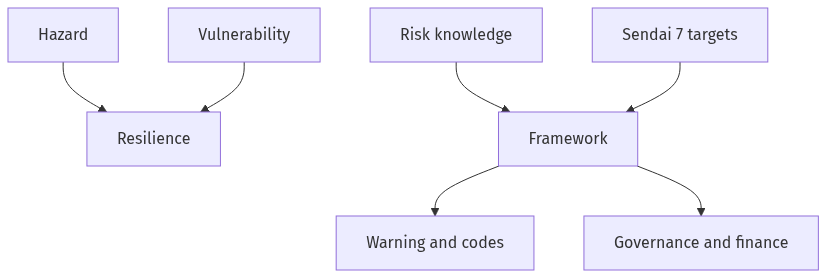
Disaster resilience is the capacity to anticipate, absorb, adapt and recover without losing essential functions. It is determined by hazard knowledge, exposure, vulnerability and institutional as well as household capacity. A resilience framework includes assessment, risk reduction, preparedness, response, build-back-better recovery, finance and learning. The Sendai Framework (2015–2030) has seven global targets on mortality, affected people, economic loss, infrastructure, national/local strategies, international cooperation and multi-hazard early warning. Sendai’s four priorities are understanding risk, governance, investment in resilience, and preparedness for recovery.
Model answer
Copper italics in this answer — like this — are the key facts. Each one is unpacked in the Facts & figures rail.
Introduction
A disaster is a hazard plus a vulnerable society. Resilience is the capacity of that society to absorb, adapt and recover without losing its basic functions — a school that reopens, a clinic that still has power, a household that is not permanently poor after the flood. It is determined by what was built and practised before the siren, not by the bravery of the week after.
Body
Meaning and determination
Disaster resilience is the ability of people, infrastructure and institutions to anticipate, resist, absorb, accommodate, adapt to, transform and recover from a hazard, in time and in a way that preserves essential identity and function. It is determined by a mix of risk knowledge (hazard maps, climate data), exposure (who lives on the floodplain), vulnerability (poverty, caste, disability, housing quality), coping capacity (savings, social networks), and institutional capacity (codes, drills, insurance, a working NDMA–SDMA–DDMA chain). Engineers measure some of it in building codes and redundancy. Economists measure how fast GDP and livelihoods return. Communities measure whether the poorest still eat. A high-rise with no fire stair is not resilient because it is new. A mangrove belt can be more resilient than a concrete wall that fails once.
- Peg: Resilience is capacity before impact, not only relief after impact.
- Peg: Determination is multi-layer: hazard × exposure × vulnerability ÷ capacity.
Elements of a resilience framework
A usable framework has risk assessment (what can happen, to whom). It has risk reduction: land-use, building norms, ecosystem buffers, retrofits. It has preparedness: early warning, drills, stockpiles, last-mile communication in local languages. It has response: incident command, search and rescue, medical surge. It has recovery and “build back better”: not reconstructing the same death-trap. It has governance: who decides, how finance flows, how the disabled and women are not an afterthought. It has finance: contingency funds, insurance, social protection that scales on a shock. It has learning: post-disaster reviews that change the next map. India’s official architecture (NDMA guidelines, SDMAs, the Disaster Management Act, 2005) is one national version of that framework.
- Peg: Anticipate, absorb, adapt, transform: four verbs that should appear as budget lines, not posters.
- Peg: Early warning without a last-mile volunteer is an element missing its pair.
Sendai global targets (2015–2030)
The Sendai Framework for Disaster Risk Reduction, adopted at Sendai, Japan, in 2015, sets seven global targets for 2030: (a) substantially reduce global disaster mortality by 2030, relative to 2005–2015; (b) substantially reduce the number of affected people; (c) reduce direct economic loss as a proportion of global GDP; (d) substantially reduce disaster damage to critical infrastructure and disruption of basic services, including health and educational facilities; (e) substantially increase the number of countries with national and local disaster risk reduction strategies by 2020 (a date now passed, used as a process target); (f) substantially enhance international cooperation to developing countries; (g) substantially increase the availability of and access to multi-hazard early warning systems and disaster risk information. Those seven sit on four priorities: understanding risk, strengthening governance, investing in resilience, and enhancing preparedness for better recovery.
- Peg: Sendai shifted the global script from disaster response toward risk reduction, with countable 2030 targets.
- Peg: India is a Sendai party; NDMA planning is meant to map onto those targets, not only onto relief norms.
Flow diagram
Conclusion
Resilience is the pre-built capacity to take a hit and continue. It is read off maps, poverty, codes and institutions. A framework joins assessment, reduction, warning, response, recovery and finance. Sendai’s seven 2030 targets count deaths, affected people, losses, infrastructure, strategies, cooperation and early warning.
Quick related
Students also ask
-
Flooding in urban areas is an emerging climate-induced disaster. Discuss the causes of this disaster. Mention the features of two such major floods in the last two decades in India. Describe the policies and frameworks in India that aim at tackling such floods.
Next question on this syllabus topic (2024 · Q18). View answer →
-
Is resilience the same as relief?
No. Relief is after. Resilience is the school code, the mangrove and the warning that were in place before.
-
Did Sendai set a zero-death target?
No. It asks for a substantial reduction in mortality and affected people by 2030 against a 2005–2015 baseline.
Same topic · past papers
UPSC has asked this before
These previous-year questions sit on the same topic. Open one to practise the earlier ask.
-
2025 · Q18 · GS III · 15 marks
Write a review on India's climate commitments under the Paris Agreement (2015) and mention how these have been further strengthened in COP26 (2021). In this direction, how has the first Nationally Determined Contribution intended by India been updated in 2022? -
2018 · Q18 · GS III · 15 marks
Describe various measures taken in India for Disaster Risk Reduction (DRR) before and after signing 'Sendai Framework for DRR (2015-2030)'. How is this framework different from 'Hyogo Framework for Action, 2005'? (250 Words, 15 Marks).
More from this topic
Q18 · UPSC Mains 2026 · GS III · 15 marks · Solution
"Community participation is the cornerstone of effective disaster management." Analyse this statement with suitable examples from India. Also discuss the challenges to community participation and measures to strengthen it.
Disaster Management
• Local communities are vital first responders, using indigenous knowledge and grassroots action before state help arrives, as seen in Odisha's cyclone preparedness. • Major roadblocks include a centralized top-down bureaucratic planning approach, low public risk awareness, and a severe lack of local rescue resources. • Empowering local governance bodies like Gram Panchayats under the Disaster Management Act, 2005, is essential for decentralized resilience. • Conducting regular, community-led mock drills and school safety programs builds crucial muscle memory and proactive risk reduction habits. • Inclusive planning must actively integrate vulnerable groups, especially women and youth, into district and local disaster management frameworks. • Sustainable disaster resilience requires shifting from state-dependent relief to active people's ownership, bridging grassroots action with national plans.
Q7 · UPSC Mains 2026 · GS III · 10 marks · Solution
Discuss how the contradiction between 'rapid infrastructure development' and 'disaster-risk reduction' in ecologically-sensitive areas of India can be managed, with suitable examples.
Disaster Management
• Rapid infrastructure push in fragile zones (Himalayas, Western Ghats) clashes with disaster-risk reduction (DRR). • Unchecked road-widening, tunneling, and hydropower destabilize slopes, causing landslides and flash floods. • Deforestation and wetland loss strip away natural shock absorbers, increasing community vulnerability. • Manage the trade-off by basing approvals on scientific carrying capacity and strict ecological limits. • Reform Environmental Impact Assessments (EIA) to mandate cumulative impact studies for sensitive areas. • Enforce eco-sensitive zoning to separate strictly protected regions from permissible development. • Integrate local communities and traditional knowledge into early warning and disaster management systems.
Q18 · UPSC Mains 2024 · GS III · 15 marks · Solution
Flooding in urban areas is an emerging climate-induced disaster. Discuss the causes of this disaster. Mention the features of two such major floods in the last two decades in India. Describe the policies and frameworks in India that aim at tackling such floods.
Disaster Management
Climate-linked urban floods come from heavier downpours on sealed soil, lost wetlands, clogged drains and tidal lock. Mumbai on 26 July 2005 combined record rain, a choked Mithi and high tide; rails and the airport stopped. Chennai in late 2015 saw prolonged monsoon rain, tank and river overflow, and city-wide disruption tied to wetland loss. National response sits in the Disaster Management Act, NDMA urban-flooding guidelines, AMRUT/Smart Cities, and Wetlands Rules. The binding failure is still local: encroachment and drains that exist on a map.