
Revision summary
Asteroids are rocky, metal-rich small bodies; near-Earth objects are the ones that can meet our orbit. An extinction-level impact is geologically real (Chicxulub) and very unlikely on a human calendar given current catalogues. Smaller city-threatening objects are less fully known and are the practical hazard. Planetary defence: survey, characterise, then deflect, chiefly by kinetic impact. NASA’s DART mission in 2022 proved a spacecraft can change an asteroid moon’s orbit; civil defence is the short-warning backup.
Model answer
Copper italics in this answer — like this — are the key facts. Each one is unpacked in the Facts & figures rail.
Introduction
Asteroids are rocky leftovers of the early solar system, orbiting mainly between Mars and Jupiter, with some thrown onto paths that cross Earth’s. A large enough impact can end a world of species; that is not a film line, it is the K–Pg story. The daily threat to a city is much smaller. Strategy now is to find, track and, if needed, nudge — not to panic.
Body
What asteroids are
Asteroids are small Solar System bodies of rock and metal, larger than meteoroids and without a comet’s routine coma. The main belt sits between Mars and Jupiter. Near-Earth objects (NEOs) are those whose orbits come close to ours. A meteor is the streak; a meteorite is what lands. Composition ranges from rubble piles to nickel-iron. They matter because their kinetic energy at closing speeds of many kilometres a second is enormous even for a modest diameter.
- Peg: Main-belt asteroids are the population; NEOs are the ones planetary defence cares about.
- Peg: Chelyabinsk (2013) was a small airburst that still blew out windows; it was not an extinction object.
How real is extinction?
Earth has taken extinction-scale impacts. The Chicxulub event is the standard link to the end-Cretaceous mass dying. That class of object is very rare on human timescales. Surveys of NEOs have already catalogued a large share of the kilometre-class bodies that could cause a global catastrophe; none on the public lists is on an imminent extinction path. Smaller objects that could destroy a city are more numerous and less fully catalogued. So the honest answer is: extinction is real as geology, remote as this century’s calendar; regional disaster is the more practical risk. Complacency is wrong. Apocalypse as next year’s policy is also wrong.
- Peg: Extinction-class impacts are low-probability, high-consequence; city-killers are the gap in the catalogue.
- Peg: NASA and other agencies publish impact-probability tables; a non-zero Palermo or Torino scale number is a watch, not a prophecy.
Prevention strategies
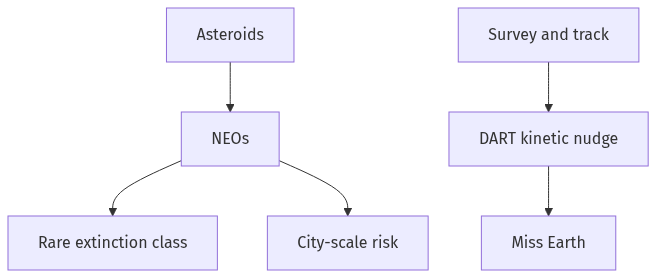
- The first strategy is survey: optical and infrared telescopes (ground and space) to find NEOs and compute orbits decades ahead. The second is characterisation: radar and fly-bys to know if the body is a rubble pile. The third is deflection. NASA’s DART mission (2022) hit Dimorphos, moon of Didymos, and shortened its orbital period, proving kinetic impact. ESA’s Hera follows up on that system. Other paper strategies are a gravity tractor (a spacecraft that hovers and tugs) and, in extreme theoretical cases, nuclear standoff blast — politically and legally fraught. Civil defence (evacuate, shelter) is the last layer if warning is short, as with Chelyabinsk’s incoming from the sunward sky. International coordination sits in UNCOPUOS and planetary-defence groups. The workable doctrine is early find, small nudge, years before a predicted hit.
- Peg: DART is the first real deflection test, not a science-fiction sketch.
- Peg: Time is the weapon: a millimetre-per-second change years out is a miss at Earth.
Flow diagram
Conclusion
Asteroids are rocky Solar System bodies; some are near-Earth. Extinction impacts have happened and are unlikely this century; city-scale objects are the live risk. Strategy is catalogue, track and kinetic nudge, as DART showed. Early astronomy is the defence.
Quick related
Students also ask
-
Social media and encrypting messaging services pose a serious security challenge. What measures have been adopted at various levels to address the security implications of social media? Also suggest any other remedies to address the problem.
Next question on this syllabus topic (2024 · Q20). View answer →
-
Should we nuclear-bomb asteroids as first choice?
No. Kinetic nudge with long warning is the tested, cleaner idea. Nuclear options are last-resort paper, with legal and debris problems.
-
Is a dinosaur-killer due soon?
No known kilometre-class NEO is on an imminent extinction path. The scientific job is to keep the catalogue complete.
Same topic · past papers
UPSC has asked this before
These previous-year questions sit on the same topic. Open one to practise the earlier ask.
-
2016 · Q19 · GS III · 12 marks
Border management is a complex task due to difficult terrain and hostile relations with some countries. Elucidate the challenges and strategies for effective border management. -
2015 · Q19 · GS III · 12 marks
The persisting drives of the government for development of large industries in backward areas have resulted in isolating the tribal population and the farmers who face multiple displacements. With Malkangiri and Naxalbari foci, discuss the corrective strategies needed to win the Left Wing Extremism (LWE) doctrine affected citizens back into mainstream of social and economic growth.
More from this topic
Q17 · UPSC Mains 2026 · GS III · 15 marks · Solution
What are the challenges to solid waste management in India? Discuss the governmental policy framework on solid waste management. Discuss the success/failure cases of Delhi and Indore cities highlighting the salient features of their solid waste management initiatives.
Indian Economy
• Rapid urbanization has made solid waste management a critical environmental and public health crisis in India. • Key challenges include lack of source segregation, inadequate processing infrastructure, reliance on unprotected informal workers, and financially weak urban local bodies. • The policy framework relies on the SWM Rules 2016, Swachh Bharat Mission (Urban), and Plastic Waste Management Rules 2016. • Indore succeeded through 100% source segregation, zero dump-site remediation, and strict enforcement with digital monitoring. • Delhi failed due to overloaded legacy landfills (Ghazipur, Bhalswa), lack of decentralization, and fragmented municipal governance. • A successful transition requires moving to a circular economy focused on source segregation, decentralized processing, and polluter accountability.
Q16 · UPSC Mains 2026 · GS III · 15 marks · Solution
What is Agentic Artificial Intelligence (AI)? Explain its working. Describe its applications with suitable examples. Discuss the advantages, risks and challenges associated with agentic AI systems.
Indian Economy
Agentic Artificial Intelligence represents an advanced paradigm where AI systems operate with autonomy, setting goals and executing complex workflows without constant human prompts. Unlike traditional generative AI that merely responds to queries, agentic AI uses perception, planning, memory, and tool-use to achieve multi-step objectives. Its applications span across autonomous software engineering, supply chain optimization, and automated financial trading. While offering massive productivity gains and dynamic problem-solving, these systems pose significant risks including lack of transparency, alignment failures, security vulnerabilities, and ethical dilemmas. Governance frameworks and robust guardrails are essential to harness their potential safely.
Q15 · UPSC Mains 2026 · GS III · 15 marks · Solution
Mention salient features of 'Mission Drishti'. Discuss the imaging techniques used in the satellite launched on 3rd May 2026. Why is it being considered world's first satellite of its kind?
Indian Economy
Mission Drishti represents a major leap in India's space-based Earth observation capabilities, launched on 3rd May 2026. The mission employs advanced multi-spectral and hyperspectral imaging techniques to capture high-resolution data across various atmospheric and terrestrial layers. It is hailed as a global first due to its unique integration of real-time onboard edge computing with quantum encryption for secure data transmission. The satellite significantly enhances resource management, disaster response, and strategic surveillance. It aligns with India's policy of leveraging space technology for sustainable development and national security.