
Revision summary
After 1991, social-services spending did not jump at once; it thickened from the mid-2000s with school, health, work and food missions. States spend more on social services than the Union; education is the largest slice and health is smaller. The direction matches inclusive growth: more public money on people, not only on factories. The match is incomplete because learning, public health and out-of-pocket medical costs still exclude many. Inclusive growth is tested by who is reached, not by the size of a budget head alone.
Model answer
Copper italics in this answer — like this — are the key facts. Each one is unpacked in the Facts & figures rail.
Introduction
The 1991 reforms cut the State’s industrial licence Raj. They did not abolish the State’s duty to educate, heal and insure the poor. Social services — education, health, water, sanitation, housing and welfare — therefore became the test of whether growth after liberalisation would be inclusive. The rupee spent is only half that test. The other half is whether the extra rupee reached the household that needed it.
Body
Pattern and trend after 1991
In the first reform decade the Union’s priority was stabilisation and industrial deregulation. Combined public spending on social services did not jump at once. From the mid-2000s the pattern changes. Rights and missions enter the budget: school missions, the health mission, rural work, food law, and later sanitation and tap-water missions. States remain the larger spenders on social services; the Union designs and co-finances. Education takes the thickest slice. Health stays thinner, though it thickened after the National Health Mission and after the pandemic. The trend is therefore upward in outlay and in scheme coverage, with a federal tilt toward State budgets and a composition still biased toward education rather than public health.
- Peg: SSA / Samagra Shiksha, NHM, MGNREGA and the National Food Security Act are the large post-reform social vehicles.
- Peg: Combined Centre–State social-services spending as a share of GDP has been reported as rising over the last decade in successive Economic Surveys, without turning India into a high-tax welfare State.
Consonance with inclusive growth
Inclusive growth, as the Eleventh Plan framed it, means the extra GDP is felt in more lives: school, clinic, wage floor, food. Higher social outlay is in the right direction. Literacy, school enrolment, vaccination and official multidimensional poverty have moved the right way. The mismatch is quality and incidence. Learning outcomes remain weak. Public hospital beds and specialists are still thin in poor districts. A large share of health spend is still out of pocket. Urban casual workers and many women fall between scheme cracks. If social expenditure rises while IHDI-type gaps and malnutrition persist, the budget is only partly in consonance with the objective.
- Peg: Inclusion needs outcomes — years of learning, not only classrooms; a clinic that works, not only a mission logo.
- Peg: Growth versus welfare is a false war here: social spending is how a market economy keeps the bottom inside the growth story.
The honest verdict is partial consonance. The post-reform State spends more, and more visibly, on social services than the 1990s State did. It has not yet spent enough, well enough, or evenly enough to call the objective achieved.
Flow diagram
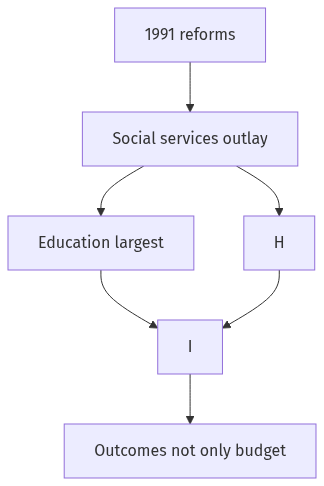
Conclusion
Social-services spending rose after the mid-2000s, led by States and by education. That supports inclusive growth in direction, not yet in depth: health and quality still lag the inclusive-growth claim.
Quick related
Students also ask
-
Is inclusive growth possible under market economy ? State the significance of financial inclusion in achieving economic growth in India.
Next question on this syllabus topic (2022 · Q2). View answer →
-
Did 1991 cut social spending?
The first reform years were fiscally tight. The large expansion of social missions is a later, mainly post-2004, story.
-
Is more spending the same as inclusive growth?
No. Inclusive growth needs the extra rupee to become a school that teaches and a clinic that heals.
Same topic · past papers
UPSC has asked this before
These previous-year questions sit on the same topic. Open one to practise the earlier ask.
-
2022 · Q2 · GS III · 10 marks
Is inclusive growth possible under market economy ? State the significance of financial inclusion in achieving economic growth in India. -
2019 · Q12 · GS III · 15 marks
The public expenditure management is a challenge to the Government of India in context of budget making during the post liberalization period. Clarify it. -
2025 · Q1 · GS III · 10 marks
Distinguish between the Human Development Index (HDI) and the Inequality-adjusted Human Development Index (IHDI) with special reference to India. Why is the IHDI considered a better indicator of inclusive growth? -
2020 · Q1 · GS III · 10 marks
Explain intra-generational and inter-generational issues of equity from the perspective of inclusive growth and sustainable development. -
2019 · Q11 · GS III · 15 marks
It is argued that the strategy of inclusive growth is intended to meet the objectives of inclusiveness and sustainability together. Comment on this statement.
More from this topic
Q1 · UPSC Mains 2025 · GS III · 10 marks · Solution
Distinguish between the Human Development Index (HDI) and the Inequality-adjusted Human Development Index (IHDI) with special reference to India. Why is the IHDI considered a better indicator of inclusive growth?
Inclusive Growth
HDI combines life expectancy, education and GNI per capita into one average. India’s recent HDI is in the medium band, around 0.64, with a rank still in the 130s. IHDI reduces that score for inequality; India has often lost about thirty per cent of HDI to uneven shares. Inclusive growth needs the extra income and services to reach the bottom, which HDI alone can hide. IHDI is therefore the better national test, alongside the multidimensional poverty index.
Q2 · UPSC Mains 2022 · GS III · 10 marks · Solution
Is inclusive growth possible under market economy ? State the significance of financial inclusion in achieving economic growth in India.
Inclusive Growth
A market economy does not by itself deliver inclusive growth; it rewards those who already hold assets. Inclusion is possible when the State provides public goods and repairs missing credit and insurance markets. India pairs liberalisation with MGNREGA, NFSA 2013 and Direct Benefit Transfer. Financial inclusion (Jan Dhan, JAM, UPI, Mudra, PM-Kisan) channels savings, cuts leakage and supports demand. Significance for growth depends on actual use of accounts and fair credit, not on account-opening numbers alone.
Q1 · UPSC Mains 2020 · GS III · 10 marks · Solution
Explain intra-generational and inter-generational issues of equity from the perspective of inclusive growth and sustainable development.
Inclusive Growth
Intra-generational equity is fairness among people alive now; it is the core of inclusive growth. Inter-generational equity is fairness toward the unborn; it is the core of sustainable development. Jobless or unequal booms fail the first test even when GDP rises. Aquifer mining, carbon lock-in, and weak environmental clearance fail the second. Policy must raise present capability without running down the ecological and fiscal stock.