
Revision summary
A market economy does not by itself deliver inclusive growth; it rewards those who already hold assets. Inclusion is possible when the State provides public goods and repairs missing credit and insurance markets. India pairs liberalisation with MGNREGA, NFSA 2013 and Direct Benefit Transfer. Financial inclusion (Jan Dhan, JAM, UPI, Mudra, PM-Kisan) channels savings, cuts leakage and supports demand. Significance for growth depends on actual use of accounts and fair credit, not on account-opening numbers alone.
Model answer
Copper italics in this answer — like this — are the key facts. Each one is unpacked in the Facts & figures rail.
Introduction
A market economy allocates goods by price and profit. Inclusive growth means that the poor, women, small farmers and lagging districts also gain income, assets and voice. The two are not automatic partners. India’s answer has been a market with a public floor: identity, bank accounts, credit and transfers so participation is possible.
Body
Inclusive growth under a market economy
- Markets reward those who already have land, skills, networks and collateral. Left alone they concentrate gains in cities and large firms.
- Inclusive growth is still possible if the State supplies public goods (schools, health, roads, law) and corrects missing markets (credit, insurance, land records).
- India after 1991 combined liberalisation with rural employment (MGNREGA), food security (National Food Security Act, 2013), and Direct Benefit Transfer. That mix is a market economy with a welfare rail, not a pure laissez-faire order.
- Competition can help the poor when it lowers the price of mobiles, data, medicines and travel. It harms them when it strips natural resources or casualises labour without a safety net.
- So the honest answer is yes, if entry barriers fall and the State keeps capability and a floor; no, if growth is only capital-deepening in a few sectors.
Significance of financial inclusion
- Financial inclusion is access to a usable account, payments, credit, insurance and pension at a fair cost.
- The Pradhan Mantri Jan Dhan Yojana, Aadhaar and mobile (JAM) triangle, Unified Payments Interface, Mudras, Stand-Up India, and PM-Kisan transfers put cash and credit into accounts that earlier did not exist.
- Inclusion raises growth by turning savings into bank deposits, cutting leakages in subsidies, and letting a small firm invoice and borrow instead of staying in cash.
- It also stabilises demand: a farmer or gig worker who can receive a transfer or a Kisan Credit Card drawdown does not drop out of the market in a shock.
- Gaps remain: dormant accounts, over-indebtedness through microfinance, digital fraud, and thin credit in the poorest blocks. Inclusion is significant only when the account is used, not merely opened.
Flow diagram
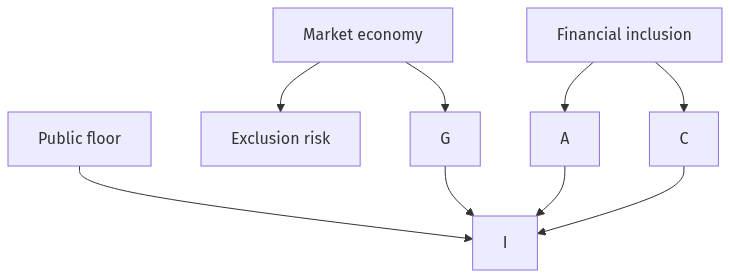
Conclusion
Inclusive growth can occur in a market economy when public goods, regulation and a transfer floor stop the market from excluding the asset-poor. Financial inclusion is the daily machinery of that floor in India: accounts, UPI and scheme credits that make participation real. Opening an account is not the same as raising productivity.
Quick related
Students also ask
-
Explain intra-generational and inter-generational issues of equity from the perspective of inclusive growth and sustainable development.
Next question on this syllabus topic (2020 · Q1). View answer →
-
Is a market economy incompatible with inclusion?
No. It is incompatible with inclusion only if the State does not supply public goods, fair regulation and a basic floor.
-
Does every Jan Dhan account raise growth?
Only if the account is used for savings, payments or credit. A dormant account is a statistic, not inclusion.
Same topic · past papers
UPSC has asked this before
These previous-year questions sit on the same topic. Open one to practise the earlier ask.
-
2025 · Q1 · GS III · 10 marks
Distinguish between the Human Development Index (HDI) and the Inequality-adjusted Human Development Index (IHDI) with special reference to India. Why is the IHDI considered a better indicator of inclusive growth? -
2024 · Q1 · GS III · 10 marks
Examine the pattern and trend of public expenditure on Social Services in the post-reforms period in India. To what extent this has been in consonance with achieving the objective of inclusive growth?( ). -
2020 · Q1 · GS III · 10 marks
Explain intra-generational and inter-generational issues of equity from the perspective of inclusive growth and sustainable development. -
2019 · Q11 · GS III · 15 marks
It is argued that the strategy of inclusive growth is intended to meet the objectives of inclusiveness and sustainability together. Comment on this statement. -
2017 · Q13 · GS III · 15 marks
What are the salient features of 'inclusive growth'? Has India been experiencing such a growth process? Analyze and suggest measures for inclusive growth.
More from this topic
Q1 · UPSC Mains 2025 · GS III · 10 marks · Solution
Distinguish between the Human Development Index (HDI) and the Inequality-adjusted Human Development Index (IHDI) with special reference to India. Why is the IHDI considered a better indicator of inclusive growth?
Inclusive Growth
HDI combines life expectancy, education and GNI per capita into one average. India’s recent HDI is in the medium band, around 0.64, with a rank still in the 130s. IHDI reduces that score for inequality; India has often lost about thirty per cent of HDI to uneven shares. Inclusive growth needs the extra income and services to reach the bottom, which HDI alone can hide. IHDI is therefore the better national test, alongside the multidimensional poverty index.
Q1 · UPSC Mains 2024 · GS III · 10 marks · Solution
Examine the pattern and trend of public expenditure on Social Services in the post-reforms period in India. To what extent this has been in consonance with achieving the objective of inclusive growth?( ).
Inclusive Growth
After 1991, social-services spending did not jump at once; it thickened from the mid-2000s with school, health, work and food missions. States spend more on social services than the Union; education is the largest slice and health is smaller. The direction matches inclusive growth: more public money on people, not only on factories. The match is incomplete because learning, public health and out-of-pocket medical costs still exclude many. Inclusive growth is tested by who is reached, not by the size of a budget head alone.
Q1 · UPSC Mains 2020 · GS III · 10 marks · Solution
Explain intra-generational and inter-generational issues of equity from the perspective of inclusive growth and sustainable development.
Inclusive Growth
Intra-generational equity is fairness among people alive now; it is the core of inclusive growth. Inter-generational equity is fairness toward the unborn; it is the core of sustainable development. Jobless or unequal booms fail the first test even when GDP rises. Aquifer mining, carbon lock-in, and weak environmental clearance fail the second. Policy must raise present capability without running down the ecological and fiscal stock.