
Revision summary
EVs have no tailpipe carbon; life-cycle carbon depends on a still coal-heavy but greening Indian grid. They are usually cleaner than petrol cars because power plants beat small engines, especially as renewables grow. Two- and three-wheelers matter most for India’s kilometres and oil bill. Versus ICE, EVs win on efficiency, running cost, noise, and local air; they lag on price, range, and charging. FAME II and Advanced Chemistry Cell PLI are the Union levers; recycling and clean charging complete the carbon claim.
Model answer
Copper italics in this answer — like this — are the key facts. Each one is unpacked in the Facts & figures rail.
Introduction
An electric vehicle (EV) replaces tank petrol or diesel with a battery and a motor. Tailpipe carbon at the street falls to zero. National carbon falls only if the grid that charges the battery is cleaner, and if the battery is made and recycled without a new mess. India is pushing that shift with Faster Adoption and Manufacturing of Electric Vehicles (FAME II) and industrial incentives.
Body
Reducing the carbon footprint
- No tailpipe CO2 or NOx in the city; that is immediate air-quality gain even before the grid is green.
- Over the vehicle’s life, carbon depends on kWh of electricity and how those kWh are made. India’s grid is still coal-heavy, so a charged EV is not a zero-carbon machine today. It is usually lower carbon than a petrol car because a power plant is more efficient than a small engine, and because renewables on the grid keep rising.
- Two- and three-wheelers dominate Indian kilometres. Electrifying them cuts a large share of urban fuel use with smaller batteries than cars.
- Less oil import is a carbon and a current-account gain: transport is a large slice of diesel and petrol demand.
- Gains shrink if users charge on diesel generators, if batteries are dumped, or if extra coal plants are built only for peak charging. Pair EVs with renewable power, time-of-day tariffs, and recycling.
Benefits versus internal combustion engine (ICE)
- Energy efficiency: more of the energy in the battery becomes motion; an ICE wastes most of the fuel as heat.
- Running cost: electricity per kilometre is typically lower than petrol or diesel at Indian retail prices.
- Local air and noise: no exhaust; quieter streets.
- Maintenance: no oil change, simpler drivetrain; brake wear falls with regenerative braking.
- Torque and drivability in city start-stop traffic.
- Offsets: higher purchase price (falling with scale), range and charge time, charging access, and battery minerals. ICE still wins on long-haul heavy trucks until chemistry and trucks catch up.
Policy
- FAME II subsidises eligible e-buses, two- and three-wheelers and some cars, and supports charging points.
- Production Linked Incentive for Advanced Chemistry Cell batteries and for auto champions aims to make cells in India.
- State EV policies add road-tax waivers. The carbon story succeeds if these raise utilisation of clean kWh, not only showroom numbers.
Flow diagram
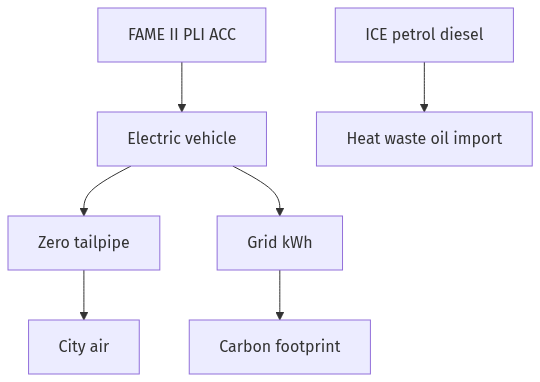
Conclusion
EVs cut street carbon and usually cut life-cycle carbon versus ICE as the grid adds renewables. They win on efficiency, running cost, and city air. FAME II and battery PLI are the adoption tools. They fail the climate test if charging stays coal-only and batteries stay unrecycled.
Quick related
Students also ask
-
Comment on the National Wetland Conservation Programme initiated by the Government of India and name a few India's wetlands of international importance included in the Ramsar Sites.
Next question on this syllabus topic (2023 · Q17). View answer →
-
Is an EV zero-carbon in India today?
No. The tailpipe is zero. The power plant is not. It is still typically lower carbon than a petrol ICE, and improving.
-
Does FAME II build batteries?
FAME II mainly subsidises vehicles and charging. Cell manufacturing is the Advanced Chemistry Cell PLI.
Same topic · past papers
UPSC has asked this before
These previous-year questions sit on the same topic. Open one to practise the earlier ask.
More from this topic
Q8 · UPSC Mains 2026 · GS III · 10 marks · Solution
Discuss the aim and goals of Kunming-Montreal global biodiversity framework. Mention India's commitments and initiatives to achieve the goals and targets of this framework giving suitable examples.
Environment and Conservation
• Adopted at CBD COP15, the Kunming-Montreal Global Biodiversity Framework aims to halt and reverse biodiversity loss by 2030. • It outlines a 2050 vision of living in harmony with nature, supported by four long-term goals and 23 actionable targets. • Key global targets include the "30x30" initiative (conserving 30% of land and oceans), restoring 30% of degraded ecosystems, and cutting harmful subsidies. • India aligns its national policies by updating its National Biodiversity Action Plan (NBAP) to match the framework's 23 targets. • India supports the 30x30 goal through an extensive network of over 990 protected areas covering roughly 5.3% of its landmass. • Flagship species conservation efforts like Project Tiger, Project Elephant, and cheetah introductions drive direct ecosystem restoration. • The Biological Diversity Act, 2002 empowers grassroots conservation via local Biodiversity Management Committees and People's Biodiversity Registers.
Q18 · UPSC Mains 2025 · GS III · 15 marks · Solution
Write a review on India's climate commitments under the Paris Agreement (2015) and mention how these have been further strengthened in COP26 (2021). In this direction, how has the first Nationally Determined Contribution intended by India been updated in 2022?
Environment and Conservation
The 2015 NDC promised a 33–35 per cent cut in emissions intensity by 2030, 40 per cent non-fossil power capacity, and a large forest sink. COP26’s Panchamrit raised the political bar, including 500 GW non-fossil, a billion-tonne cut and net zero by 2070. In August 2022 India updated the NDC to 45 per cent intensity reduction and 50 per cent non-fossil installed capacity by 2030. Per-capita equity remains India’s diplomatic line. Pledges now need coal-path honesty and real forest carbon.
Q17 · UPSC Mains 2025 · GS III · 15 marks · Solution
Mineral resources are fundamental to the country's economy and these are exploited by mining. Why is mining considered an environmental hazard? Explain the remedial measures required to reduce the environmental hazard due to mining.
Environment and Conservation
Mining underpins industry but strips forest, dirties air and water, and displaces people. Open-cast coal, metal tailings, sand mining and illegal pits are the main Indian hazard types. EIA, District Mineral Foundations, scientific closure and forest rights are the legal remedies. Illegal mining needs satellite watch and police, not only a new rule. Some deposits should remain unmined where ecology and consent fail.