
Revision summary
IPCC high-end paths put global sea-level rise near one metre by 2100; lower paths are smaller but still damaging. A higher mean sea lifts every tide and cyclone surge and pushes salt into aquifers. India’s deltas, Sundarbans, and coastal megacities would flood more often; islands have little retreat space. Bangladesh and the Maldives are among the most exposed Indian Ocean neighbours. Adaptation is mangroves, setbacks, and planned retreat, plus global emission cuts.
Model answer
Copper italics in this answer — like this — are the key facts. Each one is unpacked in the Facts & figures rail.
Introduction
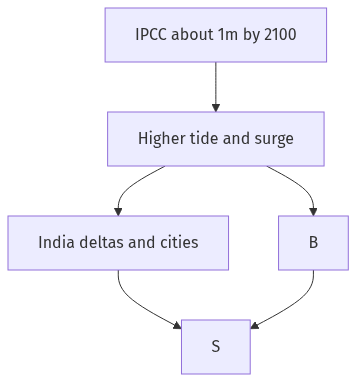
The Intergovernmental Panel on Climate Change (IPCC) projects that, in a high-warming path, global mean sea level could approach about one metre by 2100 (lower paths give a smaller rise; ice-sheet uncertainty cuts both ways). For India and its ocean neighbours this is not a distant tide table. It is saline fields, drowned mangroves, and cities already at the storm line.
Body
What a one-metre rise does physically
- Higher mean sea level raises every high tide and every storm surge.
- Saltwater moves up estuaries and into coastal aquifers.
- Beaches and deltas erode; mangroves drown if they cannot retreat inland.
- Groundwater in coastal cities becomes brackish; drainage fails because the outfall is under water.
Impact on India
- The Ganga–Brahmaputra–Meghna and Mahanadi, Godavari, Krishna, Cauvery deltas: loss of farmland, homestead, and Sundarbans-type mangrove; climate refugees inside the country.
- Mumbai, Chennai, Kochi, Visakhapatnam, Kolkata and other low wards: more frequent tidal flooding, stalled suburban rail, and port downtime.
- Gujarat and Odisha cyclone coasts: the same cyclone then rides a higher base sea, so the surge travels further inland.
- Lakshadweep and parts of the Andaman and Nicobar coasts: limited high ground; coral atolls are in the same class of risk as other small islands.
- Fisheries, salt pans, and naval and commercial harbours face chronic inundation and corrosion costs.
- Adaptation: mangrove buffers, building setbacks, storm-surge shelters, and managed retreat in the worst pockets — cheaper if started before the metre arrives.
Indian Ocean region
- Bangladesh: a large share of the nation is delta; one metre is an existential development shock, with spillover migration.
- Maldives: atoll nation whose average elevation is only a couple of metres; one metre threatens habitability of many islands.
- Sri Lanka, Myanmar, Indonesia, eastern Africa (Kenya, Tanzania, Mozambique): port cities, tourism beaches, and fishing villages.
- Small island developing States in the wider basin lose freshwater lenses first, then land.
- Shared Indian Ocean warming and cyclone intensity compound the slow rise. Regional cooperation on data, mangroves, and loss-and-damage finance is therefore a security and a climate issue, not only an environment footnote.
Flow diagram
Conclusion
An IPCC-scale rise near one metre by 2100 would salt India’s deltas, flood coastal megacities, and shrink island ground. Bangladesh and the Maldives face still sharper loss. The response is cut emissions, protect mangroves, and plan retreat where a wall will not hold.
Quick related
Students also ask
-
Each year a large amount of plant material, cellulose, is deposited on the surface of Planet Earth. What are the natural processes this cellulose undergoes before yielding carbon dioxide, water and other end products ?
Next question on this syllabus topic (2022 · Q6). View answer →
-
Is one metre certain?
It is a high-end, widely cited round figure. Lower emission paths give less rise; faster ice-sheet melt could give more.
-
Will a seawall solve Mumbai?
Walls can buy time for some wards. They do not fix saline aquifers, drainage, or delta villages that cannot wall the sea.
Same topic · past papers
UPSC has asked this before
These previous-year questions sit on the same topic. Open one to practise the earlier ask.
-
2025 · Q7 · GS III · 10 marks
What is Carbon Capture, Utilization and Storage (CCUS)? What is the potential role of CCUS in tackling climate change? -
2021 · Q6 · GS III · 10 marks
Explain the purpose of the Green Grid Initiative launched at World Leaders Summit of the COP26 UN Climate Change Conference in Glasgow in November, 2021. When was this idea first floated in the International Solar Alliance (ISA) ? -
2021 · Q17 · GS III · 15 marks
Describe the major outcomes of the 26th session of the Conference of the Parties (COP) to the United Nations Framework Convention on Climate Change (UNFCCC). What are the commitments made by India in this conference? -
2017 · Q17 · GS III · 15 marks
'Climate Change' is a global problem. How India will be affected by climate change? How Himalayan and coastal states of India will be affected by climate change? -
2025 · Q11 · GS III · 15 marks
Explain how the Fiscal Health Index (FHI) can be used as a tool for assessing the fiscal performance of states in India. In what way would it encourage the states to adopt prudent and sustainable fiscal policies?
More from this topic
Q8 · UPSC Mains 2026 · GS III · 10 marks · Solution
Discuss the aim and goals of Kunming-Montreal global biodiversity framework. Mention India's commitments and initiatives to achieve the goals and targets of this framework giving suitable examples.
Environment and Conservation
• Adopted at CBD COP15, the Kunming-Montreal Global Biodiversity Framework aims to halt and reverse biodiversity loss by 2030. • It outlines a 2050 vision of living in harmony with nature, supported by four long-term goals and 23 actionable targets. • Key global targets include the "30x30" initiative (conserving 30% of land and oceans), restoring 30% of degraded ecosystems, and cutting harmful subsidies. • India aligns its national policies by updating its National Biodiversity Action Plan (NBAP) to match the framework's 23 targets. • India supports the 30x30 goal through an extensive network of over 990 protected areas covering roughly 5.3% of its landmass. • Flagship species conservation efforts like Project Tiger, Project Elephant, and cheetah introductions drive direct ecosystem restoration. • The Biological Diversity Act, 2002 empowers grassroots conservation via local Biodiversity Management Committees and People's Biodiversity Registers.
Q18 · UPSC Mains 2025 · GS III · 15 marks · Solution
Write a review on India's climate commitments under the Paris Agreement (2015) and mention how these have been further strengthened in COP26 (2021). In this direction, how has the first Nationally Determined Contribution intended by India been updated in 2022?
Environment and Conservation
The 2015 NDC promised a 33–35 per cent cut in emissions intensity by 2030, 40 per cent non-fossil power capacity, and a large forest sink. COP26’s Panchamrit raised the political bar, including 500 GW non-fossil, a billion-tonne cut and net zero by 2070. In August 2022 India updated the NDC to 45 per cent intensity reduction and 50 per cent non-fossil installed capacity by 2030. Per-capita equity remains India’s diplomatic line. Pledges now need coal-path honesty and real forest carbon.
Q17 · UPSC Mains 2025 · GS III · 15 marks · Solution
Mineral resources are fundamental to the country's economy and these are exploited by mining. Why is mining considered an environmental hazard? Explain the remedial measures required to reduce the environmental hazard due to mining.
Environment and Conservation
Mining underpins industry but strips forest, dirties air and water, and displaces people. Open-cast coal, metal tailings, sand mining and illegal pits are the main Indian hazard types. EIA, District Mineral Foundations, scientific closure and forest rights are the legal remedies. Illegal mining needs satellite watch and police, not only a new rule. Some deposits should remain unmined where ecology and consent fail.