
Revision summary
Integrated Farming System is a planned mix of enterprises on one holding so waste becomes input. It is matched to agro-ecology: crop-dairy, rice-fish, agri-horti-silvi, or homestead livestock. For small and marginal farmers it diversifies cash flow, spreads climate and price risk, and cuts bought fertiliser and feed. Family labour and household nutrition improve; soil organic matter is recycled. Capital, water realism, KVK design and a market remain necessary; IFS is not every activity on every acre.
Model answer
Copper italics in this answer — like this — are the key facts. Each one is unpacked in the Facts & figures rail.
Introduction
A small or marginal farmer cannot live on one monsoon crop on a hectare or less. Integrated Farming System (IFS) is a designed mix of crops, livestock, trees, fish or bees on the same holding so that waste from one enterprise is an input to another, income is spread across the year, and risk is not a single failed sowing.
Body
What IFS is
- IFS is not a random backyard cow plus paddy. It is a planned combination matched to agro-ecology: crop + dairy; crop + poultry + compost; rice–fish; agri-horti-silvi; or homestead nutrition gardens with goats.
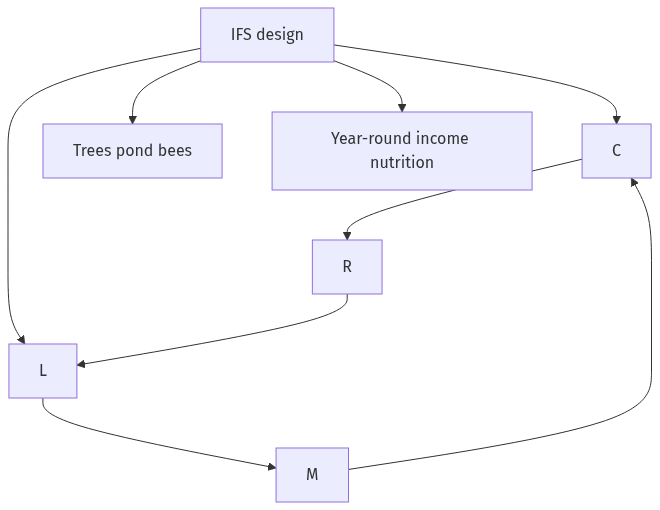
- Principle: recycling. Dung and poultry litter fertilise fields; crop residue feeds animals; pond silt and fish raise rice; trees give fodder, fuel and microclimate.
- It sits in ICAR and Krishi Vigyan Kendra models as a small-farm livelihood system, not as a plantation monoculture.
- Related ideas: mixed farming, agroforestry, and natural farming overlaps (on-farm inputs), but IFS is broader than any one chemical-free slogan.
How it helps small and marginal farmers
- Income diversification: milk, eggs, fish, honey or fruit pay in weeks when grain pays once. That is cash-flow, not only annual profit.
- Risk spreading: a drought that cuts the cereal still leaves the goat or the pond if water was budgeted; a pest on one crop does not zero the household.
- Input cost: on-farm manure, compost and fodder cut the bill for urea and bought feed—the main cash drain on a marginal plot.
- Employment of family labour: women and elders can run dairy, poultry and kitchen gardens; the holding uses household labour that a single wheat crop under-employs.
- Nutrition: milk, eggs, vegetables and fish from the homestead improve household diets, not only the marketed surplus.
- Soil and residue: recycling organic matter and avoiding residue burning protects a small plot that cannot afford degradation.
- Resilience to price crashes: if tomato crashes, the dairy still sells; processors and FPOs can still take a mixed lot more easily than a desperate distress sale of one perishable.
Limits (must be stated)
- Capital for a cow, a pond or a polyhouse is still a barrier; credit, insurance and KVK training matter.
- Water-scarce IFS cannot copy a rice–fish model. Integration must be site-specific.
- Markets for milk and vegetables can still fail; IFS is not a substitute for roads and a buyer.
Policy hook
- Schemes for dairy (Rashtriya Gokul Mission / dairy infrastructure), PM-Kisan cash, horticulture missions, and agroforestry guidelines work better when the KVK treats them as one farm design, not separate silos.
Flow diagram
Conclusion
Integrated Farming System is a planned recycle of crop, animal, tree and sometimes fish on one small farm. For marginal holders it spreads income and risk, cuts bought inputs, uses family labour, and feeds the household. It needs site-specific design, a little capital, and a market—not a poster of every enterprise at once.
Quick related
Students also ask
-
How did land reforms in some parts of the country help to improve the socio-economic conditions of marginal and small farmers ?
Next question on this syllabus topic (2021 · Q3). View answer →
-
Is IFS the same as organic farming?
No. IFS is about combining enterprises and recycling. It can use judicious chemicals or lean organic; the core is integration.
-
Can a one-hectare farmer really add fish and cows?
Only if water, capital and labour fit. A nutrition garden plus two goats may be the real IFS, not a full aquaculture park.
Same topic · past papers
UPSC has asked this before
These previous-year questions sit on the same topic. Open one to practise the earlier ask.
-
2017 · Q15 · GS III · 15 marks
How do subsidies affect the cropping pattern, crop diversity and economy of farmers? What is the significance of crop insurance, minimum support price and food processing for small and marginal farmers? -
2019 · Q3 · GS III · 10 marks
How far is Integrated Farming System (IFS) helpful in sustaining agricultural production.
More from this topic
Q14 · UPSC Mains 2026 · GS III · 15 marks · Solution
Discuss the different types of subsidies and supports provided by the Government of India to agricultural sector. Examine the related issues pertaining to Agreement on Agriculture of World Trade Organisation (WTO).
Crops, Irrigation and Marketing
• India supports farmers through MSP procurement, subsidized inputs like fertilizers and power, and cheap
Q13 · UPSC Mains 2026 · GS III · 15 marks · Solution
In which manner has Indian agriculture been transformed from food scarcity to food-surplus level? Describe the various government policies implemented for diversification of Indian agriculture.
Crops, Irrigation and Marketing
• India shifted from chronic post-independence food scarcity to a surplus nation through systemic technological
Q5 · UPSC Mains 2026 · GS III · 10 marks · Solution
Explain by giving two examples, how biotechnology has helped the Indian farmers in processing their perishable crops.
Crops, Irrigation and Marketing
• Biotechnology extends the post-harvest shelf life and processing capabilities of perishable crops, protecting farmers from distress sales. • Silencing ripening enzymes (like polygalacturonase) in transgenic varieties prevents premature softening and reduces transit losses. • Example 1: Genetically modified tomatoes engineered to resist rapid rotting during storage without complete cold-chain dependency. • Microbial fermentation and bio-processing convert surplus perishable harvests into stable, high-value industrial and food products. • Enzymatic maceration using pectinases and cellulases allows efficient fruit pulp breakdown and juice extraction. • Example 2: Biotech-driven conversion of surplus horticulture crops into stable concentrates, purees, and fermented beverages. • Scaling these interventions requires strengthening public-private research partnerships and biosafety frameworks.