
Revision summary
Tarkunde, Goswami, Law Commission 170/255 and the Election Commission have long asked for ceilings on party spend, faster petitions, and inner-party democracy. Candidate spend is capped; party spend is not, which is why money still dominates the poll. ADR disclosure and Lily Thomas reduced opacity and the conviction cushion; they did not end criminalisation. ONOE, as framed by the Kovind committee, promises one Model Code freeze, lower cost and less policy freeze. Federal cost: truncated Assemblies, President’s Rule risk, and nationalisation of State polls. Simultaneity is not a substitute for audited party finance and a statutory Code. Reform that works is a package, not a single polling date.
Model answer
Copper italics in this answer — like this — are the key facts. Each one is unpacked in the Facts & figures rail.
Introduction
Indian elections are legal, large and still expensive. From the Tarkunde and Dinesh Goswami exercises through the Law Commission and the Election Commission’s own notes, the unfinished list has been money, muscle, inner-party democracy and a Code that can postpone a transfer but cannot unseat a candidate. One nation, one election is one item on that list. It is not a substitute for the rest.
Body
Why reform is still asked
Committees have not been asking for a new polling date. They have been asking for a cleaner poll.
- Peg: Section 77 of the Representation of the People Act, 1951, caps what a candidate may spend; it does not capture what a party spends on the same campaign.
- Peg: Criminalisation continues even after Association for Democratic Reforms forced disclosure of assets and pending cases, and even after Lily Thomas v. Union of India struck down the three-month cushion for convicted sitting members.
- Peg: Paid news, dummy candidates, and parties that never hold inner elections were already flagged in the Law Commission’s 170th Report; the Model Code cannot, by itself, unseat anyone.
- Peg: Voter ID, EVM-VVPAT and the EPIC roll improved the count; they still do not tell the voter who funded the campaign.
One nation, one election
Simultaneous polls are a calendar design with real fiscal appeal and a real federal cost.
- Peg: The Kovind High-Level Committee (2024) argued that Lok Sabha and Assembly elections on a shared clock would freeze the Model Code once instead of several times, and would use security and school buildings once.
- Peg: India is not a presidential republic with a single election day; in S.R. Bommai v. Union of India a State government’s majority is tested on the floor, not dismissed by a remote calendar.
- Peg: If an Assembly collapses, forcing it onto the Union’s clock means a truncated House or a spell of President’s Rule — a constitutional invention, not mere housekeeping.
- Peg: A simultaneous poll can turn every Assembly contest into a referendum on Delhi; hung Houses and no-confidence votes would still need a mechanical fix the Constitution does not presently give.
Package, not a date
Committees that liked a common calendar still put criminality, money and inner-party democracy first.
- Peg: One nation, one election without audited party accounts, a statutory core of the Model Code, and faster election petitions is a change of date.
- Peg: If simultaneity is still wanted, it needs State consent rather than a Union whip on every Assembly’s life.
Flow diagram
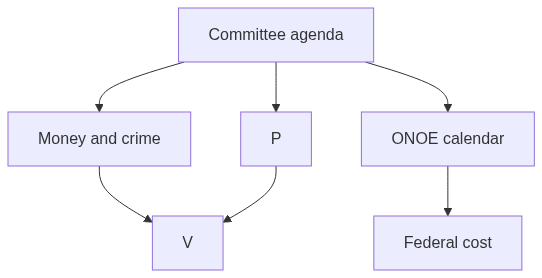
Conclusion
- Electoral reform is a cluster: money, crime, parties and the Code. One nation, one election may cut cost and Model Code fatigue. It cannot, by itself, clean politics, and it must not flatten the federal clock.
Quick related
Students also ask
-
Right to privacy is intrinsic to life and personal liberty and is inherently protected under Article 21 of the constitution. Explain. In this reference discuss the law relating to D.N.A. testing of child in the womb to establish its paternity.
Next question on this syllabus topic (2024 · Q12). View answer →
-
Did the Election Commission invent one nation, one election?
It has, at times, supported a common schedule for logistics. The political design and any amendment bills are the Union’s.
-
Would one nation, one election end horse-trading?
No. Floor tests and the Tenth Schedule would still decide mid-term collapse. The calendar only decides when the next common poll is.
Same topic · past papers
UPSC has asked this before
These previous-year questions sit on the same topic. Open one to practise the earlier ask.
-
2017 · Q14 · GS II · 15 marks
To enhance the quality of democracy in India the Election Commission of India has proposed electoral reforms in 2016. What are the suggested reforms and how far are they significant to make democracy successful? (250 words). -
2021 · Q11 · GS II · 15 marks
The jurisdiction of the Central Bureau of Investigation(CBI) regarding lodging an FIR and conducting probe within a particular state is being questioned by various States. However, the power of States to withhold consent to the CBI is not absolute. Explain with special reference to the federal character of India.
More from this topic
Q17 · UPSC Mains 2026 · GS II · 15 marks · Solution
Can the constitutional mandate of rights-based welfare be effectively realised in the context of non-integrated governance and minimal public investment? Examine.
Indian Constitution
• India’s constitutional welfare mandate struggles due to fragmented administrative silos and low public spending. • Siloed departmental functioning causes duplication, exclusion errors, and severe frontline administrative overload. • Suboptimal public investment in health and education forces heavy reliance on profit-driven private providers. • Fiscal federalism pressures leave financially weaker states unable to co-finance central welfare mandates properly. • Overcoming these bottlenecks requires a whole-of-government approach using unified digital platforms for convergence. • Progressively increasing public expenditure on core social infrastructure is vital to meet statutory entitlements. • Strengthening social audits and grievance redressal ensures legal rights translate into tangible grassroots outcomes.
Q1 · UPSC Mains 2026 · GS II · 10 marks · Solution
Right to privacy relating to self-identity is very dear to every human being and well protected under Article 21 of the Constitution. In this context, examine the effect of the amendment in 2026 to the Transgender Persons (Protection of Rights) Act, 2019.
Indian Constitution
• Article 21 protects personal autonomy, bodily integrity, and the right to self-identity as core components of human dignity. • The Supreme Court's *K.S. Puttaswamy* judgment firmly established privacy as a fundamental right encompassing personal choices. • The 2026 amendment to the Transgender Persons Act, 2019, aims to align statutory laws with evolving constitutional jurisprudence. • Key reforms include decentralising identity certification to eliminate bureaucratic delays and arbitrary state interference. • The amendment also strengthens punitive and remedial mechanisms against social and institutional discrimination. • Persistent challenges remain, notably bridging the gap between legal recognition and deep-rooted societal stigma. • True realization of these rights requires continuous administrative sensitization and inclusive access to education, healthcare, and jobs.
Q3 · UPSC Mains 2025 · GS II · 10 marks · Solution
Compare and contrast the President's power to pardon in India and in the USA. Are there any limits to it in both the countries? What are 'preemptive pardons'?
Indian Constitution
Article 72 (and 161) are exercised on aid and advice; Maru Ram, Kehar Singh, Epuru Sudhakar and Shatrughan Chauhan frame Indian limits and delay. The US Article II pardon is personal, federal-only, and barred in impeachment. Judicial review is stronger in India; political cost is the main US brake. A preemptive pardon forgives before conviction, as in Ford–Nixon. India has no working doctrine of preemptive pardon for the untried.