
Revision summary
Puttaswamy held that privacy is part of Article 21 and that any restriction must be legal, necessary and proportionate. Section 112 of the Evidence Act treats a child born in a valid marriage as legitimate unless non-access is proved. Goutam Kundu and later cases refused to make DNA a routine paternity weapon in a private quarrel. A test on a child still in the womb adds miscarriage risk and collides with the woman’s bodily autonomy. Suchita Srivastava had already linked reproductive choice to personal liberty. Proportionality will rarely justify a prenatal paternity expedition. The law of paternity is not a right to inspect a womb.
Model answer
Copper italics in this answer — like this — are the key facts. Each one is unpacked in the Facts & figures rail.
Introduction
K.S. Puttaswamy v. Union of India held that privacy is not a foreign graft on Article 21. It is intrinsic to life and personal liberty: dignity, bodily autonomy, informational self-control. A demand that a pregnant woman submit her foetus to a paternity DNA test sits at the hardest edge of that holding. Indian evidence law was already cautious about DNA even after birth.
Body
Privacy under Article 21
Privacy is a fundamental right; any restriction must pass legality, legitimate aim and proportionality.
- Peg: Maneka Gandhi v. Union of India held that the procedure which takes away personal liberty must be fair, just and reasonable, not merely a form in a statute.
- Peg: The nine-judge Bench in Puttaswamy (2017) held that privacy is a fundamental right covering the body, the home and personal data.
- Peg: Suchita Srivastava v. Chandigarh Administration treated a woman’s reproductive choice as a dimension of personal liberty; a forced medical procedure is a search of the body.
- Peg: After Puttaswamy, a court order compelling such a procedure is still State action; the party who wants it must show an aim that cannot be met by a milder means.
DNA and paternity after birth
Legitimacy is a rule of evidence, not a husband’s right to a laboratory.
- Peg: Section 112 of the Indian Evidence Act — and the matching provision of the Bharatiya Sakshya Adhiniyam — says a child born during a valid marriage is conclusive proof of legitimacy unless non-access is proved.
- Peg: Goutam Kundu v. State of West Bengal warned that courts should not order tests that “bastardise” a child to satisfy suspicion.
- Peg: Later Benches in Bhabani Prasad Jena, Dipanwita Roy v. Ronobroto Roy and related cases allowed a test only when the interest of justice clearly required it, with a possible adverse inference on refusal — not a routine swab in every maintenance fight.
- Peg: The child’s legitimacy, dignity and privacy do not belong to curiosity.
The child in the womb
A prenatal paternity expedition adds miscarriage risk to an already exceptional power.
- Peg: Amniocentesis or chorionic sampling carries a risk of miscarriage; it is more invasive than a swab after birth.
- Peg: Indian law does not treat the foetus as a full constitutional person in the way it treats a born child; the pregnant woman’s health and privacy are the primary rights on the table.
- Peg: Using the second trimester as a device to prove adultery will almost always fail proportionality.
- Peg: A rare case of serious crime, or a procedure already needed for the woman’s health, is imaginable; a private paternity quarrel is not.
Flow diagram
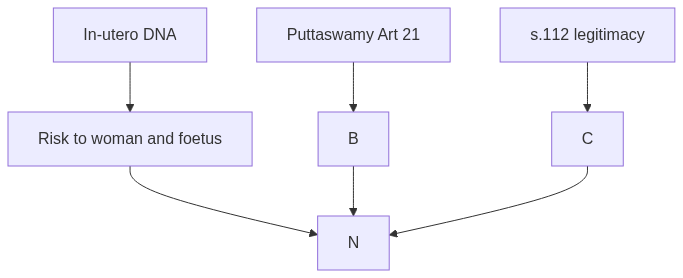
Conclusion
Privacy is part of Article 21. DNA paternity tests are exceptional, not routine, because of Section 112 and the child’s dignity. A test on the unborn child for paternity will almost always fail proportionality against the woman’s bodily autonomy.
Quick related
Students also ask
-
Discuss India as a secular state and compare with the secular principles of the US constitution.
Next question on this syllabus topic (2024 · Q15). View answer →
-
Can a husband compel amniocentesis for paternity?
Almost never. The invasion and risk are on the woman; suspicion is not a proportionate aim.
-
Is a born child’s DNA easier to order?
Easier than in-utero, still not automatic. Courts balance truth against legitimacy and the child’s privacy.
Same topic · past papers
UPSC has asked this before
These previous-year questions sit on the same topic. Open one to practise the earlier ask.
-
2023 · Q11 · GS II · 15 marks
" The Construction of India is a living instrument with capabilities of enormous dynamism. It is a constitution made for a progressive society". Illustrate with special reference to the expanding horizons of the right to life and personal liberty. -
2026 · Q1 · GS II · 10 marks
Right to privacy relating to self-identity is very dear to every human being and well protected under Article 21 of the Constitution. In this context, examine the effect of the amendment in 2026 to the Transgender Persons (Protection of Rights) Act, 2019.
More from this topic
Q17 · UPSC Mains 2026 · GS II · 15 marks · Solution
Can the constitutional mandate of rights-based welfare be effectively realised in the context of non-integrated governance and minimal public investment? Examine.
Indian Constitution
• India’s constitutional welfare mandate struggles due to fragmented administrative silos and low public spending. • Siloed departmental functioning causes duplication, exclusion errors, and severe frontline administrative overload. • Suboptimal public investment in health and education forces heavy reliance on profit-driven private providers. • Fiscal federalism pressures leave financially weaker states unable to co-finance central welfare mandates properly. • Overcoming these bottlenecks requires a whole-of-government approach using unified digital platforms for convergence. • Progressively increasing public expenditure on core social infrastructure is vital to meet statutory entitlements. • Strengthening social audits and grievance redressal ensures legal rights translate into tangible grassroots outcomes.
Q1 · UPSC Mains 2026 · GS II · 10 marks · Solution
Right to privacy relating to self-identity is very dear to every human being and well protected under Article 21 of the Constitution. In this context, examine the effect of the amendment in 2026 to the Transgender Persons (Protection of Rights) Act, 2019.
Indian Constitution
• Article 21 protects personal autonomy, bodily integrity, and the right to self-identity as core components of human dignity. • The Supreme Court's *K.S. Puttaswamy* judgment firmly established privacy as a fundamental right encompassing personal choices. • The 2026 amendment to the Transgender Persons Act, 2019, aims to align statutory laws with evolving constitutional jurisprudence. • Key reforms include decentralising identity certification to eliminate bureaucratic delays and arbitrary state interference. • The amendment also strengthens punitive and remedial mechanisms against social and institutional discrimination. • Persistent challenges remain, notably bridging the gap between legal recognition and deep-rooted societal stigma. • True realization of these rights requires continuous administrative sensitization and inclusive access to education, healthcare, and jobs.
Q3 · UPSC Mains 2025 · GS II · 10 marks · Solution
Compare and contrast the President's power to pardon in India and in the USA. Are there any limits to it in both the countries? What are 'preemptive pardons'?
Indian Constitution
Article 72 (and 161) are exercised on aid and advice; Maru Ram, Kehar Singh, Epuru Sudhakar and Shatrughan Chauhan frame Indian limits and delay. The US Article II pardon is personal, federal-only, and barred in impeachment. Judicial review is stronger in India; political cost is the main US brake. A preemptive pardon forgives before conviction, as in Ford–Nixon. India has no working doctrine of preemptive pardon for the untried.