
Revision summary
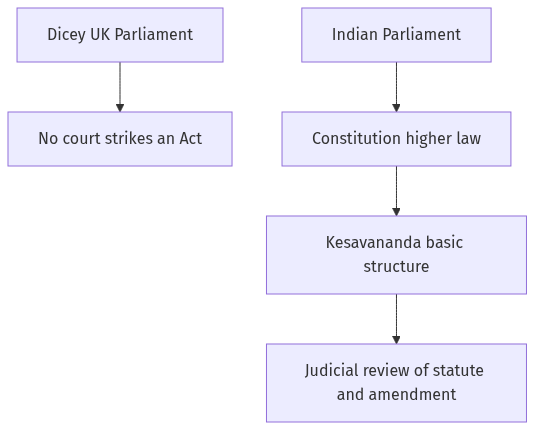
Dicey’s British doctrine makes Parliament legally unlimited and bars courts from voiding an Act. India’s Parliament is created by the Constitution and bound by Articles 13 and 245. Kesavananda Bharati (1973) placed basic structure beyond Article 368. Westminster political forms are shared; legal sovereignty is not. Indian parliamentary sovereignty is therefore limited, unlike the classical British model.
Model answer
Copper italics in this answer — like this — are the key facts. Each one is unpacked in the Facts & figures rail.
Introduction
- A.V. Dicey treated the United Kingdom Parliament as legally unlimited: it could make or unmake any law, and no court could void an Act. India copied parliamentary government but not that unlimited sovereignty, because a written Constitution, fundamental rights, and judicial review sit above ordinary statutes.
Body
The British approach
- Dicey’s Parliamentary sovereignty means that Parliament is the supreme legal authority, that it can legislate on any subject, and that no Parliament can bind its successor.
- There is no single coded Constitution with a higher-law status in the Diceyan model; courts interpret statutes, they do not strike them down as unconstitutional.
- Political checks exist: elections, convention, the House of Lords’ delaying power after the Parliament Acts, and now the Human Rights Act, 1998, which allows a declaration of incompatibility without voiding the statute.
- Even after Jackson v. Attorney General and debate on common-law constitutionalism, the orthodox teaching remains that a clear Act of Parliament is law.
The Indian approach
- Article 245 allows Parliament and State legislatures to make laws, but only subject to the provisions of the Constitution.
- Articles 13, 32, 136, 141, 142 and 226 create judicial review; an ordinary Act that violates Part III is void.
- Kesavananda Bharati v. State of Kerala (1973) held that the amending power under Article 368 cannot destroy the basic structure, so even a constitutional amendment is not sovereign in Dicey’s sense.
- Later cases — Indira Nehru Gandhi v. Raj Narain, Minerva Mills, I.R. Coelho, and the NJAC case — applied that limit to election disputes, rights, judicial review, and appointments.
- India therefore has parliamentary government (collective responsibility, money bills, no-confidence) without parliamentary legal omnipotence.
Comparison and contrast
- Both systems centre debate, budget, and the executive in an elected lower House; that is the shared Westminster political form.
- Britain locates legal sovereignty in Parliament; India locates it in the Constitution, of which Parliament is a creature.
- Britain has no basic-structure doctrine; India uses it to police Article 368.
- Emergency and the 42nd Amendment showed how far an Indian Parliament can try to go; Minerva Mills showed the Court pulling that power back.
- The contrast is therefore not about the existence of Parliament, but about whether Parliament or the Constitution has the last legal word.
Flow diagram
Conclusion
Britain, in Dicey’s teaching, gives Parliament the last legal word. India gives that word to the Constitution, as read by the Court in Kesavananda Bharati, so Indian parliamentary sovereignty is political and procedural, not absolute.
Quick related
Students also ask
-
Explain the structure of the Parliamentary Committee system. How far have the financial committees helped in the institutionalization of Indian Parliament?
Next question on this syllabus topic (2023 · Q16). View answer →
-
Is the Indian Parliament sovereign in political life?
It is the central law-making and confidence body of the Union. It is not legally sovereign over the Constitution.
-
Can the British Supreme Court strike down an Act as India does?
Not on the Indian model of unconstitutionality. It interprets and may declare incompatibility; it does not void the Act.
Same topic · past papers
UPSC has asked this before
These previous-year questions sit on the same topic. Open one to practise the earlier ask.
More from this topic
Q3 · UPSC Mains 2026 · GS II · 10 marks · Solution
Examine whether the constitutional office of the Lok Sabha Speaker has become vulnerable to partisan politics under the current anti-defection regime. What institutional changes are required to ensure the neutrality of the Lok Sabha Speaker in managing a polarised House?
Parliament and State Legislatures
• The Lok Sabha Speaker faces a conflict of interest because they remain in a political party while deciding disqualification cases under the Tenth Schedule. • Key vulnerabilities include dual political allegiance, weaponization of the anti-defection whip for government stability, and tactical delays in rulings. • The Supreme Court (*Keisham Meghachandra Singh*, 2020) criticized these delays and suggested moving to an independent tribunal. • Reform idea 1: Adopt the British convention where the Speaker cuts all party ties and runs unopposed in elections. • Reform idea 2: Shift defection adjudication entirely away from the Speaker to an outside body like the Election Commission. • Reform idea 3: Enforce strict statutory time limits to prevent politicians from stalling defection cases during crises.
Q2 · UPSC Mains 2026 · GS II · 10 marks · Solution
"Women as a class neither belong to a minority group nor are they regarded as forming a backward class." In the light of this statement, discuss the evolution of women's reservation from local bodies to Parliament.
Parliament and State Legislatures
• Women form a cross-cutting demographic, not a traditional minority or caste-based backward class.
Q12 · UPSC Mains 2025 · GS II · 15 marks · Solution
Indian Constitution has conferred the amending power on the ordinary legislative institutions with a few procedural hurdles. In view of this statement, examine the procedural and substantive limitations on the amending power of the Parliament to change the Constitution.
Parliament and State Legislatures
Article 368 uses Parliament’s Houses, not a standing constituent assembly, with special majority and no joint sitting. Federal provisions need ratification by at least half the States. Ordinary Acts cannot amend the Constitution. Kesavananda, Minerva Mills, Indira Gandhi and I.R. Coelho set substantive basic-structure limits, including judicial review and rights-DPSPs balance. NJAC 2015 shows the doctrine applying to institutional design, not only to rights texts.