
Revision summary
Articles 74–75 keep the Cabinet responsible to the Lok Sabha; that is the legal core of parliamentary government. Whips and the Tenth Schedule, ordinances and money-bill classification have moved real initiation to the Cabinet. This is practical marginalisation of the floor, not a legal repeal of Parliament. PAC, standing committees, Rajya Sabha and the floor test still bite. Keisham Meghachandra pressed Speakers to decide disqualification on a clock. A narrower anti-defection law would restore some of the supremacy the quote says is lost. The examiner’s misspelling does not change the demand: show practice squeezing text, not text dying.
Model answer
Copper italics in this answer — like this — are the key facts. Each one is unpacked in the Facts & figures rail.
Introduction
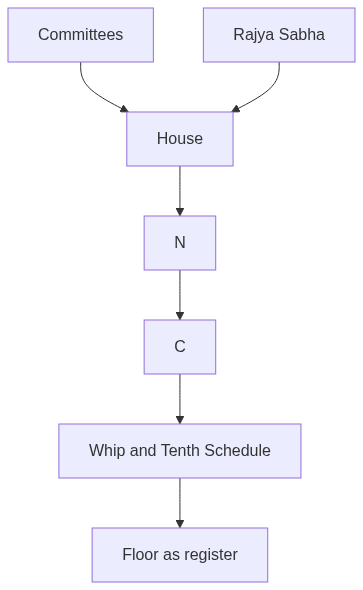
- India copied the Westminster bargain: the Cabinet lives only while the Lok Sabha suffers it. Articles 74 and 75 make ministers collectively responsible to that House. In daily fact a majority machine — whip, Tenth Schedule, ordinance, delegated legislation — has made the floor a place of registration more than of origination. That is practical marginalisation of parliamentary supremacy, not a repeal of the text.
Body
What supremacy still means
Dicey’s idea that Parliament can do anything never fitted a written Constitution with judicial review.
- Peg: The supremacy that still matters is this: the Council of Ministers lives only while the Lok Sabha is prepared to suffer it, the House votes tax and supply, and members may debate.
- Peg: Shamsher Singh v. State of Punjab held that the President and the Governor normally act on aid and advice, not as a rival executive.
- Peg: S.R. Bommai v. Union of India made the floor test the solvent of majority; those holdings are still good law.
How the cabinet ate the floor
A stable majority turns the Cabinet into a committee of the ruling party and the House into its register.
- Peg: The Tenth Schedule punishes a member who votes against a party whip even on an ordinary Bill, so independent judgment is legally dangerous.
- Peg: Classification of a Bill as a Money Bill under Article 110 can shrink the Rajya Sabha’s role; the Aadhaar litigation put that classification under a cloud.
- Peg: Article 123 ordinances legislate when the House is not sitting; delegated legislation moves detail off the floor; Question Hour is frequently lost.
- Peg: Bagehot’s picture is inverted: the Cabinet was meant to be a creature of the House; in daily fact the House is a creature of the Cabinet’s majority.
What is not dead
Elucidation is not a funeral oration for Articles 107–117.
- Peg: A government can still fall; every Budget must still pass; the Rajya Sabha can stall non-money legislation.
- Peg: The Public Accounts Committee, reading the CAG, can embarrass a ministry; privilege motions remain.
- Peg: In Keisham Meghachandra Singh the Court reminded Speakers that the Tenth Schedule is not a private party tool without a clock.
- Peg: Recovering the floor means a narrower anti-defection law (confidence and money Bills only, as older committee reports suggested) and a Speaker who is not a party manager.
Flow diagram
Conclusion
The cabinet system has practically sidelined the floor as a deliberative sovereign. Legally, Parliament still makes and unmakes governments and statutes. Recovering supremacy means recovering the backbencher’s vote, not rewriting Article 75.
Quick related
Students also ask
-
Compare and contrast the British and Indian approaches to Parliamentary sovereignty.
Next question on this syllabus topic (2023 · Q4). View answer →
-
Is India now a prime-ministerial system?
In stable majorities, yes in style. The moment the majority cracks, it is still a parliamentary system.
-
Did the Constitution ever give Diceyan supremacy to Parliament?
No. Judicial review and a written text were always limits. The quote is about the House versus the Cabinet, not about the Court.
Same topic · past papers
UPSC has asked this before
These previous-year questions sit on the same topic. Open one to practise the earlier ask.
More from this topic
Q3 · UPSC Mains 2026 · GS II · 10 marks · Solution
Examine whether the constitutional office of the Lok Sabha Speaker has become vulnerable to partisan politics under the current anti-defection regime. What institutional changes are required to ensure the neutrality of the Lok Sabha Speaker in managing a polarised House?
Parliament and State Legislatures
• The Lok Sabha Speaker faces a conflict of interest because they remain in a political party while deciding disqualification cases under the Tenth Schedule. • Key vulnerabilities include dual political allegiance, weaponization of the anti-defection whip for government stability, and tactical delays in rulings. • The Supreme Court (*Keisham Meghachandra Singh*, 2020) criticized these delays and suggested moving to an independent tribunal. • Reform idea 1: Adopt the British convention where the Speaker cuts all party ties and runs unopposed in elections. • Reform idea 2: Shift defection adjudication entirely away from the Speaker to an outside body like the Election Commission. • Reform idea 3: Enforce strict statutory time limits to prevent politicians from stalling defection cases during crises.
Q2 · UPSC Mains 2026 · GS II · 10 marks · Solution
"Women as a class neither belong to a minority group nor are they regarded as forming a backward class." In the light of this statement, discuss the evolution of women's reservation from local bodies to Parliament.
Parliament and State Legislatures
• Women form a cross-cutting demographic, not a traditional minority or caste-based backward class.
Q12 · UPSC Mains 2025 · GS II · 15 marks · Solution
Indian Constitution has conferred the amending power on the ordinary legislative institutions with a few procedural hurdles. In view of this statement, examine the procedural and substantive limitations on the amending power of the Parliament to change the Constitution.
Parliament and State Legislatures
Article 368 uses Parliament’s Houses, not a standing constituent assembly, with special majority and no joint sitting. Federal provisions need ratification by at least half the States. Ordinary Acts cannot amend the Constitution. Kesavananda, Minerva Mills, Indira Gandhi and I.R. Coelho set substantive basic-structure limits, including judicial review and rights-DPSPs balance. NJAC 2015 shows the doctrine applying to institutional design, not only to rights texts.