
Revision summary
DBT uses Jan Dhan, Aadhaar and mobile to pay subsidies into named accounts. It is progressive in cutting ghost beneficiaries and some dealer leakage. Exclusion from biometric failure, seeding errors and weak connectivity is the main rights risk. Last-mile banking correspondents still decide whether a credit becomes cash or grain. Aadhaar for subsidies survived Puttaswamy with limits; it is not a licence to deny without alternatives. DBT is a delivery tool, not the whole development strategy.
Model answer
Copper italics in this answer — like this — are the key facts. Each one is unpacked in the Facts & figures rail.
Introduction
Direct Benefit Transfer uses the Jan Dhan–Aadhaar–Mobile (JAM) architecture to put subsidies and welfare into named accounts. It is progressive against ghost beneficiaries and leaky ration dealers; it is not a panacea, because exclusion, authentication failure, and last-mile cash-out still decide whether the poor are paid.
Body
Why DBT is progressive
- Crediting a verified account cuts layers of patronage between the treasury and the intended household, which is why LPG’s PAHAL and many scholarships and pensions moved to DBT.
- Aadhaar seeding and bank accounts under the Jan Dhan programme reduced duplicate and deceased names on some subsidy rolls, which is a real fiscal and fairness gain.
- Electronic trails make audits and social audits easier than cash handled only by a village intermediary.
- For the Union, DBT is also a cooperative-federal tool: scheme money can be seen leaving the Consolidated Fund toward a beneficiary, not disappearing in a State department’s float.
Structural limitations
- Exclusion error is the first limit: a genuine household without a working fingerprint, without connectivity at the PoS, or with a wrong seed, is denied grain or wages even when the statute intended inclusion.
- Justice K.S. Puttaswamy (Aadhaar) accepted Aadhaar for targeted subsidies with a proportionality overlay; it did not license authentication as a condition that may starve a rights-holder without an alternative.
- Last-mile cash-out still depends on banking correspondents, business correspondents’ liquidity, and distance to a bank; a credit on the core-banking server is not food on the day of need.
- Mobile and electricity gaps, especially for women who do not control the listed handset, reproduce intra-household inequality that JAM does not automatically correct.
- DBT of cash cannot replace public goods — schools, primary health, and roads — whose “beneficiaries” are not a closed list of account-holders.
Comment on the debate
- The statement is right to call DBT progressive and limited; the error is to treat it as the whole of Indian development.
- A fair design keeps in-kind PDS where markets are thin, keeps an override when biometrics fail, and publishes exclusion and delay data by State.
- JAM is infrastructure for targeting; development still needs inflation control, jobs, and capable local government, which no transfer engine supplies by itself.
Flow diagram
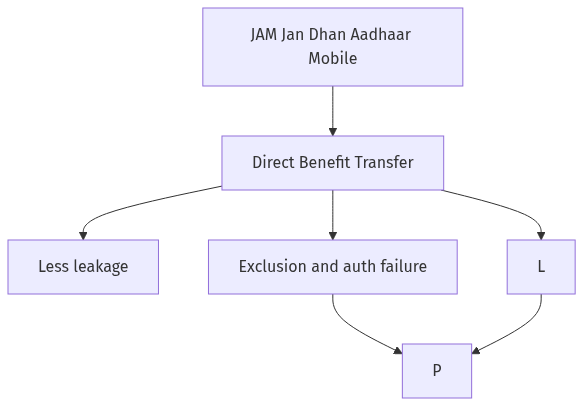
Conclusion
DBT is a progressive correction of leakage and ghost names, built on JAM and Aadhaar. It fails as a panacea wherever authentication excludes the genuine poor, cash-out is far, or public goods are mistaken for personal subsidies.
Quick related
Students also ask
-
India is an age-old friend of Sri Lanka.' Discuss India's role in the recent crisis in Sri Lanka in the light of the preceding statement.
Next question on this syllabus topic (2022 · Q9). View answer →
-
Does DBT abolish the Public Distribution System?
Not by itself. Some States experiment with cash; many still deliver grain. DBT of subsidy is not the same as ending in-kind food security.
-
Is every failed fingerprint a case of fraud?
No. Exclusion error is a known risk of biometric authentication, which is why overrides and alternative IDs matter.
Same topic · past papers
UPSC has asked this before
These previous-year questions sit on the same topic. Open one to practise the earlier ask.
More from this topic
Q15 · UPSC Mains 2026 · GS II · 15 marks · Solution
To what extent do pressure groups, social movements and corporate lobbies deepen pluralistic democracy in India by representing excluded interests? Analyse whether the growing convergence of corporate wealth and political power poses a threat to the autonomy of formal democratic institutions.
Governance and Policy
• Civil society groups and grassroots movements go beyond periodic elections to channel marginalized voices into policy spaces. • Social movements on tribal rights and environmental protection have successfully forced the state to create protective legislation. • Representation is uneven due to a severe resource asymmetry between well-funded corporate lobbies and unorganized labor. • Some interest groups act as elite fronts, subverting public welfare for narrow sectarian gains. • Corporate financial dominance through opaque funding creates severe risks of policy capture and quid pro quo corruption. • Strengthening transparency in political funding and reinforcing regulatory autonomy are essential to safeguard democratic governance.
Q12 · UPSC Mains 2026 · GS II · 15 marks · Solution
What is meant by judicial legislation? In this context, discuss the verdicts of the apex court allowing "passive euthanasia" and a "living will".
Governance and Policy
• Judicial legislation occurs when courts create binding rules to fill policy voids caused by legislative inaction. • The Supreme Court legalized passive euthanasia under Article 21, recognizing the right to die with dignity. • The *Common Cause* (2018) judgment permitted the withdrawal of life support for terminally ill patients with strict medical safeguards. • A living will is an advanced medical directive allowing individuals to pre-state their treatment preferences before incapacitation. • The Supreme Court simplified living will procedures in 2023, replacing complex magistrate approvals with basic notary attestation. • While court guidelines provide immediate relief, they underscore the need for a comprehensive parliamentary statute on end-of-life care. • Codifying these judicial norms through formal legislation ensures democratic legitimacy, ethical debate, and administrative clarity.
Q6 · UPSC Mains 2026 · GS II · 10 marks · Solution
Does India's tribal development policy reflect the aspirations for a socially grounded and equity-based governance? Justify your answer.
Governance and Policy
• India's tribal policy balances constitutional protections with socio-economic development goals. • Fifth and Sixth Schedules provide decentralized autonomy and safeguard tribal lands. • Articles 275(1) and 335 ensure grants-in-aid and reservations to bridge gaps. • PESA (1996) and FRA (2006) mark shifts toward rights-based and culturally sensitive governance. • Gram sabhas are empowered over minor forest produce and community forest rights. • Implementation is hindered by forced displacement without consent and bureaucratic inertia. • True equity requires empowering local institutions rather than relying solely on welfare delivery.