
Revision summary
Indra Sawhney (1992) led to a statutory NCBC in 1993 for the Central OBC list. The 102nd Amendment, 2018, inserted Article 338B and Article 342A and made the NCBC a constitutional body. Jaishri Laxmanrao Patil (2021) treated the 102nd Amendment as removing State identification of SEBCs. The 105th Amendment, 2021, restored State lists; the Presidential list remains for Central purposes. The Commission investigates safeguards and reports to the President; it does not by itself enact reservation.
Model answer
Copper italics in this answer — like this — are the key facts. Each one is unpacked in the Facts & figures rail.
Introduction
Indra Sawhney v. Union of India (1992) required an expert body to watch inclusions in the Central Other Backward Classes list; Parliament answered with a statutory National Commission for Backward Classes in 1993. The Constitution (One Hundred and Second Amendment) Act, 2018, raised that Commission into Article 338B; the One Hundred and Fifth Amendment Act, 2021, later restored the States’ power over their own socially and educationally backward class lists.
Body
From Indra Sawhney to a statutory commission
- Indra Sawhney upheld Central OBC reservation, imposed the creamy-layer exclusion for OBCs, and treated identification of backward classes as an expert, periodically reviewable task, not a one-time political gazette.
- The National Commission for Backward Classes Act, 1993, created a statutory NCBC to examine requests for inclusion in the Central list and to advise the Union; that advice was given statutory weight in the 1993 design.
- The Commission in that phase was not at par with the National Commissions for Scheduled Castes and Scheduled Tribes, which already sat in the Constitution.
The 102nd Amendment and Article 338B
- The 102nd Amendment (2018) inserted Article 338B, constituting a National Commission for Backward Classes with a Chairperson, Vice-Chairperson and three other members appointed by the President.
- Article 338B(5) gives the Commission duties to investigate and monitor safeguards for socially and educationally backward classes, to inquire into specific complaints, to advise on socio-economic development, and to present annual and special reports to the President, which are laid before Parliament.
- The same amendment inserted Article 342A, under which the President may, in consultation with the Governor, specify the socially and educationally backward classes for a State or Union territory, and Article 366(26C) defining those classes.
- After Jaishri Laxmanrao Patil v. Chief Minister (Maratha reservation, 2021), the 102nd Amendment was read as taking away the State’s power to identify SEBCs for its own purposes, which is why Parliament moved again the same year.
The 105th Amendment and the present role
- The Constitution (105th Amendment) Act, 2021, amended Articles 338B, 342A and 366 to restore the power of the State legislature and the State executive to prepare and maintain their own list of SEBCs, while the President’s Article 342A list remains the list for the purposes of the Central Government.
- The constitutional NCBC’s core role is therefore Central: monitoring Central safeguards, inquiring into complaints relating to those safeguards, and advising on the Central list and Central welfare, not substituting every State backward-class commission.
- It still lacks the same public visibility as the NCSC in atrocity cases; its usefulness depends on whether ministries treat Article 338B reports as binding politically even when they are recommendatory in form.
What the role is not
- The NCBC does not by itself create a new quota; reservation still needs a law and the Indra Sawhney 50 per cent ceiling unless a later, exceptional record is made out.
- It is not the 103rd Amendment’s Economically Weaker Sections machinery; EWS is a separate 10 per cent stream under Articles 15(6) and 16(6).
Flow diagram
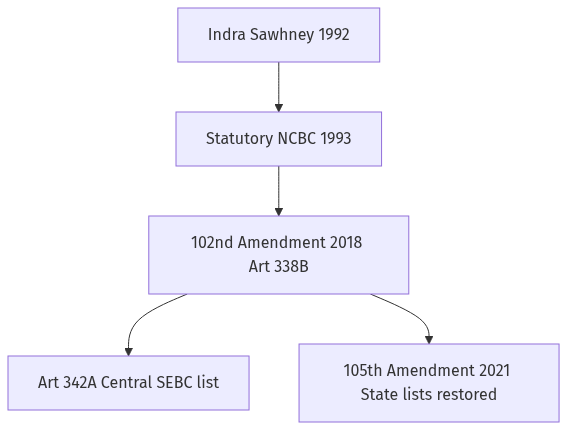
Conclusion
After 2018 the NCBC is a constitutional monitor and adviser under Article 338B, in the line Indra Sawhney asked for at the Centre. After the 105th Amendment, States again keep their own SEBC lists; the Commission’s new status did not swallow State identification.
Quick related
Students also ask
-
Discuss the role of the Election Commission of India in the light of the evolution of the Model Code of Conduct.
Next question on this syllabus topic (2022 · Q15). View answer →
-
Did the 102nd Amendment itself restore State OBC lists?
No. The 102nd Amendment (2018) constitutionalised the NCBC and Article 342A. State list power was restored by the 105th Amendment in 2021.
-
Is the NCBC the same as a State backward-class commission?
No. Article 338B is a Union body. States may still have their own commissions for their own lists after the 105th Amendment.
Same topic · past papers
UPSC has asked this before
These previous-year questions sit on the same topic. Open one to practise the earlier ask.
More from this topic
Q5 · UPSC Mains 2026 · GS II · 10 marks · Solution
Do constitutional bodies like the National Commission for Scheduled Castes (NCSC) and the National Commission for Scheduled Tribes (NCST) possess adequate enforcement powers to secure substantive social equality? Suggest measures to enhance their institutional effectiveness.
Constitutional Bodies
• NCSC (Article 338) and NCST (Article 338A
Q4 · UPSC Mains 2026 · GS II · 10 marks · Solution
Is the right to vote a fundamental right? Discuss the position of the Election Commission of India while undertaking the revision of electoral rolls. Can it also examine the question of citizenship of voters?
Constitutional Bodies
• Voting is a constitutional and statutory right under Article 326 and the RPA, 1951, not a Fundamental Right. • The Supreme Court (*PUCL v. Union of India, 2003*) recognised it as a constitutional right linked to free expression. • Under Article 324 and the 1960 Rules, the ECI conducts periodic revisions of electoral rolls. • Electoral Registration Officers handle claims, objections, and remove ineligible, deceased, or migrated voters. • The ECI checks age and residency, but cannot independently determine Indian citizenship. • Citizenship verification falls exclusively under Articles 5-11 and the Citizenship Act, 1955, handled by central authorities.
Q5 · UPSC Mains 2025 · GS II · 10 marks · Solution
"The Attorney General of India plays a crucial role in guiding the legal framework of the Union Government and ensuring sound governance through legal counsel." Discuss his responsibilities, rights and limitations in this regard.
Constitutional Bodies
Article 76 creates the Attorney General as the Union’s highest law officer. Duties: advise the Government of India, appear in court, and perform assigned legal work, including Article 143 references. Rights: audience in all courts; Article 88 right to speak in Parliament without a vote. Limits: pleasure tenure, no vote, no executive department, convention on conflicting private briefs. The office improves governance only if it is consulted early and allowed to disagree.