
Revision summary
• Voting is a constitutional and statutory right under Article 326 and the RPA, 1951, not a Fundamental Right. • The Supreme Court (*PUCL v. Union of India, 2003*) recognised it as a constitutional right linked to free expression. • Under Article 324 and the 1960 Rules, the ECI conducts periodic revisions of electoral rolls. • Electoral Registration Officers handle claims, objections, and remove ineligible, deceased, or migrated voters. • The ECI checks age and residency, but cannot independently determine Indian citizenship. • Citizenship verification falls exclusively under Articles 5-11 and the Citizenship Act, 1955, handled by central authorities.
Model answer
Copper italics in this answer — like this — are the key facts. Each one is unpacked in the Facts & figures rail.
Introduction
The right to vote forms the bedrock of democratic representation, deriving its sanctity from the constitutional framework rather than Part III of the Constitution. The Election Commission of India oversees this process, operating within strict statutory boundaries while updating electoral rolls.
Body
Legal Status of Voting
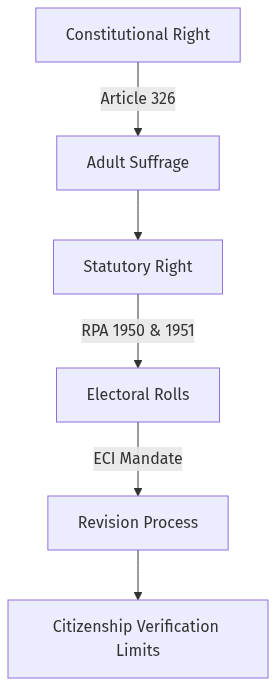
- Constitutional basis: The right to vote is a constitutional and statutory right, not a Fundamental Right under Part III of the Constitution.
- Judicial precedent: In cases such as PUCL v. Union of India (2003), the Supreme Court held that voting is a constitutional right and an expression of freedom of expression under Article 19(1)(a) in a derivative sense.
- Statutory anchor: Section 62 of the Representation of the People Act, 1951, operationalises this right for citizens registered in electoral rolls.
ECI and Electoral Rolls
- Statutory mandate: Under Article 324 and the Registration of Electors Rules, 1960, the Election Commission of India undertakes annual revisions of electoral rolls.
- Administrative role: Electoral Registration Officers verify claims and objections, ensuring that eligible citizens are included and deceased or migrated voters are removed.
Limits on Citizenship Verification
- Statutory eligibility: The Election Commission verifies whether a person meets the age and residency criteria under Article 326 and the 1950 Act.
- Jurisdictional limits: Determining citizenship under Articles 5-11 and the Citizenship Act, 1955, vests exclusively with the central government and designated civil authorities, not the Election Commission.
Flow diagram
Conclusion
While the right to vote remains a vital constitutional guarantee essential for democratic governance, its administration is carefully regulated by statute. The Election Commission of India exercises plenary powers in superintendence and roll revision, yet must respect the boundaries of citizenship determination defined by Parliament and the Constitution.
Quick related
Students also ask
-
Do constitutional bodies like the National Commission for Scheduled Castes (NCSC) and the National Commission for Scheduled Tribes (NCST) possess adequate enforcement powers to secure substantive social equality? Suggest measures to enhance their institutional effectiveness.
Next question on this syllabus topic (2026 · Q5). View answer →
-
Is the right to vote a fundamental right in India?
No, the right to vote is a constitutional and statutory right under Article 326 of the Constitution and the Representation of the People Act, 1951, rather than a Fundamental Right.
-
Can the Election Commission of India determine the citizenship of voters?
The Election Commission checks statutory eligibility for electoral rolls, but the legal determination of Indian citizenship rests with the executive authorities under the Citizenship Act, 1955.
Same topic · past papers
UPSC has asked this before
These previous-year questions sit on the same topic. Open one to practise the earlier ask.
More from this topic
Q5 · UPSC Mains 2026 · GS II · 10 marks · Solution
Do constitutional bodies like the National Commission for Scheduled Castes (NCSC) and the National Commission for Scheduled Tribes (NCST) possess adequate enforcement powers to secure substantive social equality? Suggest measures to enhance their institutional effectiveness.
Constitutional Bodies
• NCSC (Article 338) and NCST (Article 338A
Q5 · UPSC Mains 2025 · GS II · 10 marks · Solution
"The Attorney General of India plays a crucial role in guiding the legal framework of the Union Government and ensuring sound governance through legal counsel." Discuss his responsibilities, rights and limitations in this regard.
Constitutional Bodies
Article 76 creates the Attorney General as the Union’s highest law officer. Duties: advise the Government of India, appear in court, and perform assigned legal work, including Article 143 references. Rights: audience in all courts; Article 88 right to speak in Parliament without a vote. Limits: pleasure tenure, no vote, no executive department, convention on conflicting private briefs. The office improves governance only if it is consulted early and allowed to disagree.
Q15 · UPSC Mains 2022 · GS II · 15 marks · Solution
Discuss the role of the Election Commission of India in the light of the evolution of the Model Code of Conduct.
Constitutional Bodies
The ECI’s authority is Article 324, read with the Representation of the People Acts. The MCC began as a 1960s inter-party understanding and became a national campaign code administered by the Commission. Seshan-era practice turned censure, officer transfers and poll postponement into real sanctions. The Code is not itself an Act; bite comes when it overlaps the 1951 Act, IPC, and the Commission’s 324 directions. During the process, Gill-type jurisprudence keeps ordinary writs from running the election. Digital campaigning is the present stress on both the Code and the statute.