
Revision summary
The ECI’s authority is Article 324, read with the Representation of the People Acts. The MCC began as a 1960s inter-party understanding and became a national campaign code administered by the Commission. Seshan-era practice turned censure, officer transfers and poll postponement into real sanctions. The Code is not itself an Act; bite comes when it overlaps the 1951 Act, IPC, and the Commission’s 324 directions. During the process, Gill-type jurisprudence keeps ordinary writs from running the election. Digital campaigning is the present stress on both the Code and the statute.
Model answer
Copper italics in this answer — like this — are the key facts. Each one is unpacked in the Facts & figures rail.
Introduction
Article 324 gives the Election Commission of India superintendence, direction and control of elections to Parliament, State legislatures, and the offices of President and Vice-President. The Model Code of Conduct is not a statute; it is a set of political norms the Commission has thickened, since the 1960s, into the daily law of the campaign, using 324, the 1951 Act, and criminal law as the hard edge.
Body
Evolution of the Model Code
- The Code began as a modest Kerala-era understanding among parties in the 1960s about meetings, processions, and ministerial misuse of office, and was later circulated nationally by the Commission.
- Over decades it grew into a document covering the party in power, ministers’ official machinery, transfers, foundation stones, welfare announcements, hate speech, and, more recently, social-media and star-campaigner discipline.
- T.N. Seshan’s tenure in the 1990s is the inflexion: the Commission treated the Code as enforceable through postponement of polls, transfer of officers, and public censure, which made Article 324 visible to the voter.
- The Code remains morally and administratively binding on parties that have consented to it; Parliament has not enacted it as a stand-alone Act, which is both its flexibility and its weakness.
Role of the ECI through the Code
- The Commission announces the Code from the date of the election notification (and, in practice, often from the date of the programme), freezing certain kinds of government advertising and policy largesse that could swing a constituency.
- It deploys expenditure observers, police and flying squads, and media-certification cells so that the Code’s clauses on money, posters, and paid news have an operational arm.
- Where the Code overlaps a legal prohibition — corrupt practice, official machinery, or an IPC offence — the Commission can set the criminal and RPA processes in motion, not only write a letter to a party president.
- Where the Code is only a norm (tone of speeches, courtesy, timing of a welfare tweet), the Commission uses advice, naming, and the threat of a ban on campaigning for a period, which works if parties still fear the Commission’s public legitimacy.
Limits and criticisms
- Critics say the Code is extra-legal when it stalls welfare for months, and too weak when it cannot stop communal speech on encrypted platforms.
- Courts have generally respected the Commission’s Article 324 space during the process (Gill), while still reviewing patent illegality; the Code itself is not beyond judicial comment.
- Uneven enforcement between national leaders and local cadres, and the problem of the “caretaker” government’s legitimate ongoing business, are real.
- Statutory backing of some MCC clauses is a recurring Law Commission and standing-committee idea; the risk is ossifying a flexible code, the gain would be clearer penalties.
Role, restated in light of that evolution
- The ECI’s role is no longer only the preparation of rolls and the conduct of the poll; it is the referee of a long campaign, and the MCC is the referee’s handbook.
- Evolution of the Code is therefore evolution of the Commission: from a scheduling body to a constitutional regulator of incumbency advantage.
- The next test is digital campaigning, deepfakes, and cross-border money — areas where a 1960s code and a 1951 Act both strain, and where the Commission must still act under 324 without waiting for a perfect statute.
Flow diagram
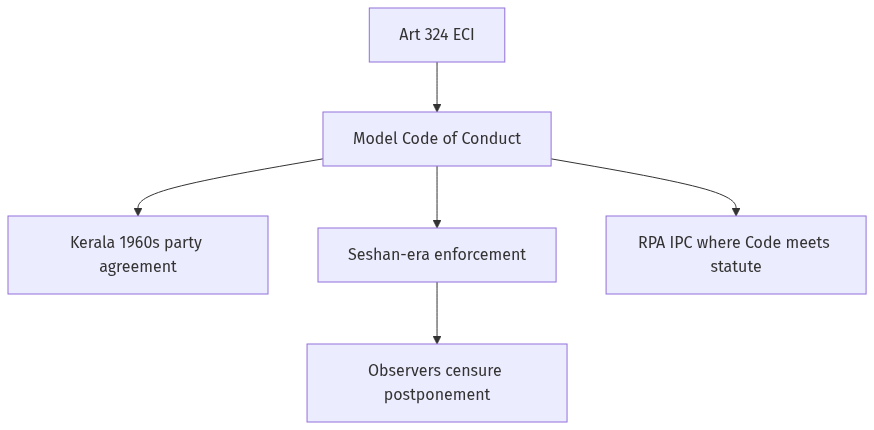
Conclusion
The Model Code of Conduct grew from a party agreement into the Election Commission’s principal tool for levelling incumbency during the poll process. Article 324, not a dedicated MCC Act, is what makes that tool bite. The Commission’s role in the light of that evolution is to remain a credible referee — firmer on official machinery and hate speech, and careful not to become an unelected government of welfare itself.
Quick related
Students also ask
-
In the light of recent controversy regarding the use of Electronic Voting Machines (EVM), what are the challenges before the Election Commission of India to ensure the trustworthiness of elections in India?
Next question on this syllabus topic (2018 · Q1). View answer →
-
Is violating the MCC automatically a corrupt practice?
Not by itself. Some MCC breaches are only code violations. They become Section 123 or criminal matters only if the statutory ingredients are met.
-
When does the MCC start?
The Commission announces it with the election schedule. In practice it binds governments and parties from that announcement for the constituencies going to poll.
Same topic · past papers
UPSC has asked this before
These previous-year questions sit on the same topic. Open one to practise the earlier ask.
-
2026 · Q2 · GS II · 10 marks
"Women as a class neither belong to a minority group nor are they regarded as forming a backward class." In the light of this statement, discuss the evolution of women's reservation from local bodies to Parliament. -
2025 · Q13 · GS II · 15 marks
Discuss the evolution of collegium system in India. Critically examine the advantages and disadvantages of the system of appointment of the Judges of the Supreme Court of India and that of the USA.
More from this topic
Q5 · UPSC Mains 2026 · GS II · 10 marks · Solution
Do constitutional bodies like the National Commission for Scheduled Castes (NCSC) and the National Commission for Scheduled Tribes (NCST) possess adequate enforcement powers to secure substantive social equality? Suggest measures to enhance their institutional effectiveness.
Constitutional Bodies
• NCSC (Article 338) and NCST (Article 338A
Q4 · UPSC Mains 2026 · GS II · 10 marks · Solution
Is the right to vote a fundamental right? Discuss the position of the Election Commission of India while undertaking the revision of electoral rolls. Can it also examine the question of citizenship of voters?
Constitutional Bodies
• Voting is a constitutional and statutory right under Article 326 and the RPA, 1951, not a Fundamental Right. • The Supreme Court (*PUCL v. Union of India, 2003*) recognised it as a constitutional right linked to free expression. • Under Article 324 and the 1960 Rules, the ECI conducts periodic revisions of electoral rolls. • Electoral Registration Officers handle claims, objections, and remove ineligible, deceased, or migrated voters. • The ECI checks age and residency, but cannot independently determine Indian citizenship. • Citizenship verification falls exclusively under Articles 5-11 and the Citizenship Act, 1955, handled by central authorities.
Q5 · UPSC Mains 2025 · GS II · 10 marks · Solution
"The Attorney General of India plays a crucial role in guiding the legal framework of the Union Government and ensuring sound governance through legal counsel." Discuss his responsibilities, rights and limitations in this regard.
Constitutional Bodies
Article 76 creates the Attorney General as the Union’s highest law officer. Duties: advise the Government of India, appear in court, and perform assigned legal work, including Article 143 references. Rights: audience in all courts; Article 88 right to speak in Parliament without a vote. Limits: pleasure tenure, no vote, no executive department, convention on conflicting private briefs. The office improves governance only if it is consulted early and allowed to disagree.