
Revision summary
Article 213 allows a Governor’s ordinance only when the legislature is not in session and immediate action is necessary. The ordinance must be within State competence and, in listed cases, issued with the President’s instructions. It must be laid before the House and lapses on the constitutional timetable unless replaced by an Act. D.C. Wadhwa (1987) held that serial re-promulgation without enacting a law is a fraud on the Constitution. Krishna Kumar Singh (2017) held laying to be mandatory and re-promulgation a constitutional violation. Ordinance power is exceptional legislation, not a standing alternative to the Assembly.
Model answer
Copper italics in this answer — like this — are the key facts. Each one is unpacked in the Facts & figures rail.
Introduction
Article 213 lets a Governor promulgate an ordinance when the State legislature is not in session and immediate action is necessary. That power is a conditional legislative power, not a parallel Parliament; D.C. Wadhwa and Krishna Kumar Singh make re-promulgation without laying a fraud on the Constitution.
Body
Essential conditions under Article 213
- The Governor may legislate by ordinance only when the Legislative Assembly, or both Houses where there is a Council, is not in session; an ordinance when the House is sitting is not the design of Article 213.
- The Governor must be satisfied that circumstances exist which render it necessary for him to take immediate action; that satisfaction is not an unreviewable political whim after later case law, even if courts are slow to second-guess emergency.
- An ordinance has the same force as an Act of the legislature, but it is expressly temporary: it must be laid before the House or Houses, and it ceases six weeks after reassembly, or earlier if a resolution disapproving it is passed, or if it is withdrawn.
- Previous instructions from the President are required in the cases Article 213(1) itself lists — notably where the bill would have needed the President’s previous sanction, where the bill would have been reserved, or where an Act of the State would have been invalid without the President’s consideration — so the Governor is not a free-standing Union-bypass on those subjects.
- The subject-matter must still lie in the State’s legislative competence; an ordinance cannot do what the legislature could not have done.
Nature of the power
- Ordinance-making is legislative, not merely executive, which is why it can amend or repeal an Act, create offences, and levy within competence.
- It remains exceptional: the Constitution prefers debate in the House. Necessity and absence of session are the price of skipping that debate.
- Aid and advice of the Council of Ministers ordinarily binds the Governor here as elsewhere, subject to the limited zones of discretion the text and later cases recognise; Article 213 is not a personal law-making fief.
Re-promulgation without placing before the Legislature
- D.C. Wadhwa v. State of Bihar (1987) condemned the Bihar practice of re-promulgating ordinances for years without enacting them as Acts. The Court called colourable re-promulgation a fraud on the Constitution, because it usurped the legislature’s role.
- Krishna Kumar Singh v. State of Bihar (2017), a seven-judge Bench, held that laying an ordinance before the legislature is mandatory, that re-promulgation is a constitutional violation, and that ordinance power is not a parallel continuing legislature.
- Failure to place an ordinance before the House is not a trivial irregularity; the 2017 majority treated it as going to the root of the temporary legislative scheme.
- The Court also discussed when rights, privileges and liabilities arising under a lapsed or unlaid ordinance may survive; that discussion does not legalise the re-promulgation itself.
Legality, stated plainly
- A single ordinance that meets Article 213’s session, necessity, competence, and Presidential-instruction conditions is lawful.
- Re-promulgating the same ordinance as a substitute for a Bill, especially without laying, is unlawful after Wadhwa and Krishna Kumar Singh.
- Administrative convenience, an unready majority, or a wish to avoid debate is not “immediate necessity” in the constitutional sense.
Flow diagram
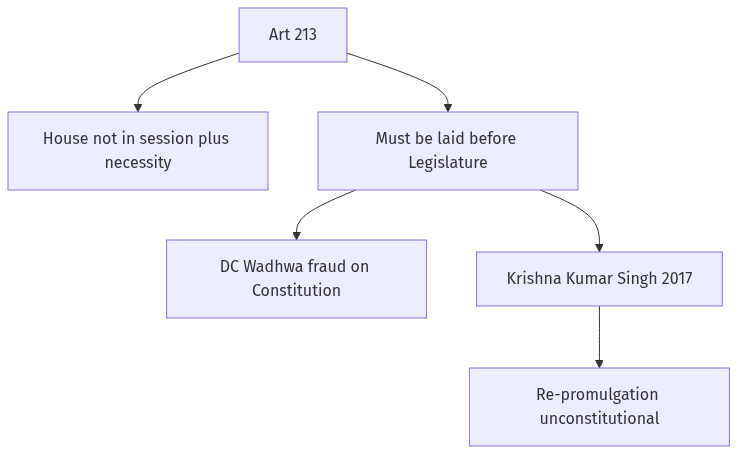
Conclusion
The Governor’s legislative power exists only when the House is not sitting, immediate action is necessary, competence and Article 213 instructions are respected, and the ordinance is laid and dies by the constitutional clock. Re-promulgation without placing the ordinance before the legislature is illegal: Wadhwa called it a fraud, and Krishna Kumar Singh (2017) confirmed that laying is mandatory and re-promulgation unconstitutional.
Quick related
Students also ask
-
Critically examine the procedures through which the Presidents of India and France are elected.
Next question on this syllabus topic (2022 · Q14). View answer →
-
May a Governor keep an ordinance alive by re-issuing it every time the House rises?
No. That is the Wadhwa and Krishna Kumar Singh prohibition. The House must be given the ordinance as a Bill or the measure must drop.
-
Does ‘satisfaction’ under Article 213 mean the courts can never look at an ordinance?
No. Later jurisprudence treats ordinance power as constitutional and therefore examinable, even if judges do not sit as a daily substitute for the Cabinet’s necessity assessment.
Same topic · past papers
UPSC has asked this before
These previous-year questions sit on the same topic. Open one to practise the earlier ask.
-
2015 · Q5 · GS II · 12 marks
Resorting to ordinances has always raised concern on violation of the spirit of separation of power doctrine. While noting the rationales justifying the power to promulgate, analyse whether the decision of the Supreme Court on the issue have further facilitated to resorting to this power. Should the power to promulgate the ordinances be repealed? -
2019 · Q4 · GS II · 10 marks
From the resolution of contentious issues regarding distribution of legislative powers by the courts, 'Principle of Federal Supremacy' and 'Harmonious Construction' have emerged. Explain.
More from this topic
Q17 · UPSC Mains 2026 · GS II · 15 marks · Solution
Can the constitutional mandate of rights-based welfare be effectively realised in the context of non-integrated governance and minimal public investment? Examine.
Indian Constitution
• India’s constitutional welfare mandate struggles due to fragmented administrative silos and low public spending. • Siloed departmental functioning causes duplication, exclusion errors, and severe frontline administrative overload. • Suboptimal public investment in health and education forces heavy reliance on profit-driven private providers. • Fiscal federalism pressures leave financially weaker states unable to co-finance central welfare mandates properly. • Overcoming these bottlenecks requires a whole-of-government approach using unified digital platforms for convergence. • Progressively increasing public expenditure on core social infrastructure is vital to meet statutory entitlements. • Strengthening social audits and grievance redressal ensures legal rights translate into tangible grassroots outcomes.
Q1 · UPSC Mains 2026 · GS II · 10 marks · Solution
Right to privacy relating to self-identity is very dear to every human being and well protected under Article 21 of the Constitution. In this context, examine the effect of the amendment in 2026 to the Transgender Persons (Protection of Rights) Act, 2019.
Indian Constitution
• Article 21 protects personal autonomy, bodily integrity, and the right to self-identity as core components of human dignity. • The Supreme Court's *K.S. Puttaswamy* judgment firmly established privacy as a fundamental right encompassing personal choices. • The 2026 amendment to the Transgender Persons Act, 2019, aims to align statutory laws with evolving constitutional jurisprudence. • Key reforms include decentralising identity certification to eliminate bureaucratic delays and arbitrary state interference. • The amendment also strengthens punitive and remedial mechanisms against social and institutional discrimination. • Persistent challenges remain, notably bridging the gap between legal recognition and deep-rooted societal stigma. • True realization of these rights requires continuous administrative sensitization and inclusive access to education, healthcare, and jobs.
Q3 · UPSC Mains 2025 · GS II · 10 marks · Solution
Compare and contrast the President's power to pardon in India and in the USA. Are there any limits to it in both the countries? What are 'preemptive pardons'?
Indian Constitution
Article 72 (and 161) are exercised on aid and advice; Maru Ram, Kehar Singh, Epuru Sudhakar and Shatrughan Chauhan frame Indian limits and delay. The US Article II pardon is personal, federal-only, and barred in impeachment. Judicial review is stronger in India; political cost is the main US brake. A preemptive pardon forgives before conviction, as in Ford–Nixon. India has no working doctrine of preemptive pardon for the untried.