
Revision summary
The Indian President is elected by elected MPs and elected State MLAs under Articles 54 and 55, by weighted STV and secret ballot. Nominated legislators do not vote; qualifications are in Article 58; disputes go to the Supreme Court under Article 71. The French President is elected by direct universal suffrage, usually in two rounds, for a five-year term since the quinquennat reform. Indian procedure matches a parliamentary, advised head of State; French procedure matches a semi-presidential executive. India’s method is federal and insulated; France’s is popular and polarising. Neither ballot can be transplanted without rewriting the executive.
Model answer
Copper italics in this answer — like this — are the key facts. Each one is unpacked in the Facts & figures rail.
Introduction
India elects a constitutional President through an indirect, weighted electoral college under Articles 54 and 55. France elects a working executive President by direct universal suffrage in a two-round poll. The procedures match two different republics: a parliamentary Union and a semi-presidential Fifth Republic.
Body
India: who votes and how
- Article 54 vests election in an electoral college of the elected members of both Houses of Parliament and the elected members of the Legislative Assemblies of the States; nominated members of the Rajya Sabha, nominated MLAs, and members of Legislative Councils do not vote.
- Article 55 aims at uniformity in the scale of representation of the different States, and at parity between the States as a whole and the Union; votes of MLAs and of MPs are therefore weighted by population and by a formula the Election Commission notifies.
- The ballot is proportional representation by means of the single transferable vote, and voting is by secret ballot; a candidate must reach the quota on first-preference or transferred votes.
- Article 58 sets qualifications: citizen of India, thirty-five years of age, and qualified for election to the Lok Sabha, with a further bar on office of profit except the President, Vice-President, Governor, or a Union or State minister.
- Disputes go to the Supreme Court under Article 71; the election is not an ordinary High Court election petition under the 1951 Act in the same way as a Lok Sabha seat.
France: who votes and how
- Since the 1962 revision, the President of the French Republic is elected by direct universal suffrage, not by Parliament or an Indian-style college.
- Election is normally in two rounds: if no candidate wins an absolute majority in the first round, a run-off is held between the two leading candidates.
- The term is five years (the quinquennat; it was seven years until the 2000 reform), with a subsequent two-term limit under later revision; the President is a partisan executive who appoints the Prime Minister and may dissolve the National Assembly.
- Eligibility and campaign finance sit in the French Constitution and organic laws: a citizen with a minimum age, sponsored by a threshold of elected officials, competing in a highly regulated media campaign — a mass democratic contest, not a legislative-college contest.
Critical comparison of procedure
- India’s method insulates the head of State from a nationwide plebiscite, which fits a President who, under Article 74, ordinarily acts on aid and advice and is a symbol of the Union rather than a rival to the Prime Minister.
- France’s method gives the President an independent popular mandate, which is why cohabitation with an opposing National Assembly is a known tension and why French presidential elections organise the whole party system.
- Weighted STV in India protects small States from being numerically irrelevant and protects the Union–State balance; it is also opaque to citizens, low-turnout in spirit (only legislators vote), and open to party-whip bargaining rather than a public argument.
- Direct two-round voting in France is transparent and legitimate as a national choice; it can polarise, elevate personality over parliament, and still leave a Prime Minister who needs the Assembly’s confidence.
- India’s inclusion of State Assemblies is a federal procedure; France is a unitary republic whose overseas territories vote in the same presidential poll, not a Union of Assemblies.
What “critical” must not miss
- Neither procedure is a defect relative to its own Constitution: copying French direct election into India would turn Rashtrapati Bhavan into a second political executive unless Articles 53, 74 and 75 were rewritten.
- Copying India’s college into France would strip the Fifth Republic of the legitimacy it chose in 1962.
- The live Indian debates are therefore about the integrity of the college (vacant Assembly seats, whip, and Article 71 speed), not about whether STV is “less democratic” in the abstract.
Flow diagram
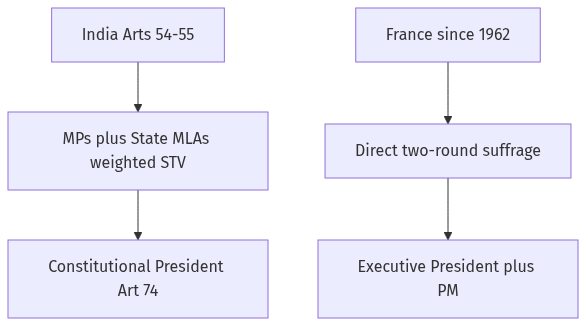
Conclusion
India’s President is chosen by a weighted, indirect STV college of elected MPs and MLAs; France’s President is chosen by the people in a two-round direct election. Each procedure is matched to a different executive: ceremonial-constitutional in India, dual executive with a dominant President in France. Criticism should judge fitness to that design, not declare one republic’s ballot universally superior.
Quick related
Students also ask
-
'Constitutional Morality' is rooted in the Constitution itself and is founded on its essential facets. Explain the doctrine of 'Constitutional Morality' with the help of relevant judicial decisions.
Next question on this syllabus topic (2021 · Q1). View answer →
-
Do Indian MLCs vote for the President?
No. Article 54 names elected members of Parliament and of State Legislative Assemblies, not Legislative Councils.
-
Is the French President only a ceremonial head?
No. The Fifth Republic President is a political executive who appoints the Prime Minister and may dissolve the Assembly, unlike the Indian President in ordinary times.
Same topic · past papers
UPSC has asked this before
These previous-year questions sit on the same topic. Open one to practise the earlier ask.
-
2022 · Q4 · GS II · 10 marks
Discuss the role of the Vice -Presidents of India as the chairman of the Rajyasabha.
More from this topic
Q17 · UPSC Mains 2026 · GS II · 15 marks · Solution
Can the constitutional mandate of rights-based welfare be effectively realised in the context of non-integrated governance and minimal public investment? Examine.
Indian Constitution
• India’s constitutional welfare mandate struggles due to fragmented administrative silos and low public spending. • Siloed departmental functioning causes duplication, exclusion errors, and severe frontline administrative overload. • Suboptimal public investment in health and education forces heavy reliance on profit-driven private providers. • Fiscal federalism pressures leave financially weaker states unable to co-finance central welfare mandates properly. • Overcoming these bottlenecks requires a whole-of-government approach using unified digital platforms for convergence. • Progressively increasing public expenditure on core social infrastructure is vital to meet statutory entitlements. • Strengthening social audits and grievance redressal ensures legal rights translate into tangible grassroots outcomes.
Q1 · UPSC Mains 2026 · GS II · 10 marks · Solution
Right to privacy relating to self-identity is very dear to every human being and well protected under Article 21 of the Constitution. In this context, examine the effect of the amendment in 2026 to the Transgender Persons (Protection of Rights) Act, 2019.
Indian Constitution
• Article 21 protects personal autonomy, bodily integrity, and the right to self-identity as core components of human dignity. • The Supreme Court's *K.S. Puttaswamy* judgment firmly established privacy as a fundamental right encompassing personal choices. • The 2026 amendment to the Transgender Persons Act, 2019, aims to align statutory laws with evolving constitutional jurisprudence. • Key reforms include decentralising identity certification to eliminate bureaucratic delays and arbitrary state interference. • The amendment also strengthens punitive and remedial mechanisms against social and institutional discrimination. • Persistent challenges remain, notably bridging the gap between legal recognition and deep-rooted societal stigma. • True realization of these rights requires continuous administrative sensitization and inclusive access to education, healthcare, and jobs.
Q3 · UPSC Mains 2025 · GS II · 10 marks · Solution
Compare and contrast the President's power to pardon in India and in the USA. Are there any limits to it in both the countries? What are 'preemptive pardons'?
Indian Constitution
Article 72 (and 161) are exercised on aid and advice; Maru Ram, Kehar Singh, Epuru Sudhakar and Shatrughan Chauhan frame Indian limits and delay. The US Article II pardon is personal, federal-only, and barred in impeachment. Judicial review is stronger in India; political cost is the main US brake. A preemptive pardon forgives before conviction, as in Ford–Nixon. India has no working doctrine of preemptive pardon for the untried.