
Revision summary
Schemes transfer food, work and cash but cannot cancel high food inflation or missing jobs. The poor are net food buyers and labour sellers, so prices and employment are distributional. CPI targeting must work with buffers and logistics, not rates alone. MGNREGA is a floor; underemployment in the informal sector needs broader demand and public hiring. Unfunded populism can raise the prices schemes were meant to offset. Articles 38, 39 and 41 make this macroeconomic task part of the welfare State, not a separate silo.
Model answer
Copper italics in this answer — like this — are the key facts. Each one is unpacked in the Facts & figures rail.
Introduction
Welfare schemes transfer food, work, and cash to named households; they do not set the price of dal or the demand for casual labour. For the poor, inflation is a silent tax and unemployment is a missing wage, so macroeconomic management is social policy by another name.
Body
Why schemes are not enough
- PDS, MGNREGA, pensions, and scholarships cushion shocks; they cannot fully offset a year of high food inflation, because the uncovered basket — vegetables, fuel, rent, medicines — still empties the wage.
- A scheme can leak or exclude; a job at a stable real wage does not need a new portal every year.
- Underprivileged households are net buyers of food and net sellers of labour. Price spikes and idle days hit them twice, which is why inflation and unemployment belong in a GS-II answer on the poor, not only in a GS-III essay.
Inflation as a distributional problem
- Food and fuel inflation regressively tax those who cannot switch to branded substitutes or to financial assets.
- The Reserve Bank of India’s monetary policy committee targets CPI inflation (4 per cent with a band), but food shocks are often supply-side: monsoon, logistics, and export-import switches that the Centre and States must manage with buffers, not only with rates.
- Fiscal populism that pumps demand without easing supply raises prices for the same poor the transfer was meant to help.
- Welfare itself can be inflationary if it is unfunded and the poor face the resulting price rise before the DBT arrives.
Unemployment and the underprivileged
- India’s poor are concentrated in informal and self-employed work; open unemployment statistics understate disguised slack and underemployment.
- MGNREGA is a demand-driven floor, not a full employment guarantee for the urban informal or for educated youth.
- Female labour-force participation and caste-coded access to stable public jobs mean that “unemployment” for the underprivileged is also a story of quality of work, not only of PLFS headlines.
- Skilling schemes fail when there is no labour-intensive demand; deft management means trade, housing, care work, and rural non-farm jobs, not only training certificates.
What deft management looks like beside welfare
- Coordinate the food ministry, State agriculture markets, and the RBI so that buffer releases and import timing meet the CPI food group rather than lag it.
- Keep real MGNREGA wages from being eaten by inflation, and pair urban employment or public works with the rural floor in a downturn.
- Use targeted transfers when prices spike, without dismantling in-kind food in thin markets (the DBT lesson).
- Treat employment as a fiscal and regulatory choice: ease of contracting, MSME credit, and public capital expenditure that hires, not only capital-intensive trophy projects.
Political economy
- Governments prefer announcing a new scheme to accepting a rate hike or a farm-supply reform, because the scheme photographs well.
- The poor need both photographs and a stable CPI; the statement in the question is therefore a constitutional-equality point as much as an economic one, given Articles 38, 39 and 41.
Flow diagram
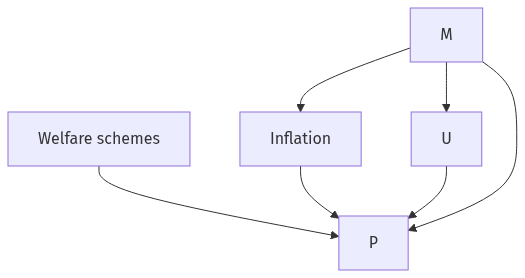
Conclusion
Welfare schemes are necessary floors. They serve the poor better only when inflation is kept from eating the basket and when employment supplies a wage that schemes can top up rather than replace. Deft management of those two macros is part of justice to the underprivileged, not a technocratic extra.
Quick related
Students also ask
-
Performance of welfare schemes that are implemented for vulnerable sections is not so effective due to absence of their awareness and active involvement at all stages of policy process - Discuss.(15).
Next question on this syllabus topic (2019 · Q18). View answer →
-
If MGNREGA exists, why talk about unemployment?
Because MGNREGA is rural, capped in days, and does not cover urban informal workers or the quality of year-round work.
-
Is inflation only the RBI’s job?
Headline CPI is the MPC’s target. Food and fuel still need fiscal, trade and logistics action by governments.
Same topic · past papers
UPSC has asked this before
These previous-year questions sit on the same topic. Open one to practise the earlier ask.
More from this topic
Q7 · UPSC Mains 2022 · GS II · 10 marks · Solution
The Rights of Persons with Disabilities Act, 2016 remains only a legal document without intense sensitisation of government functionaries and citizens regarding disability. Comment.
Welfare Schemes for Vulnerable Sections
The RPwD Act, 2016, replaced the 1995 Act and aligned Indian law with the UNCRPD. It expands specified disabilities and provides 4 per cent reservation in government jobs plus accessibility duties. Chief and State Commissioners exist to monitor and hear complaints. The main failure is attitudinal and professional: schools, offices and public works still treat compliance as optional. Sensitisation of stakeholders is therefore not a slogan; it is the condition for the Act to operate outside court.
Q18 · UPSC Mains 2019 · GS II · 15 marks · Solution
Performance of welfare schemes that are implemented for vulnerable sections is not so effective due to absence of their awareness and active involvement at all stages of policy process - Discuss.(15).
Welfare Schemes for Vulnerable Sections
Articles 15(4), 16(4) and 46 frame welfare for vulnerable sections; performance depends on last-mile knowledge and voice. Absence of awareness and of involvement in design, delivery and audit is a major cause of exclusion and leakage. MGNREGA social audits and NFSA grievance systems are statutory models of involvement. National Commissions and PESA gram sabhas are institutional voices that schemes often skip. Funding, staff and digital exclusion also matter; the statement is the core diagnosis, not the only one.
Q16 · UPSC Mains 2018 · GS II · 15 marks · Solution
Multiplicity of various commissions for the vulnerable sections of the society leads to problems of overlapping jurisdiction and duplication of functions. Is it better to merge all commissions into an umbrella Human Rights Commission? Argue your case. (15).
Welfare Schemes for Vulnerable Sections
India has NHRC plus constitutional commissions for SC, ST and OBC and statutory commissions for women, children, minorities and disability. Overlap of inquiry and advice is real and costly for the complainant. A full merge into NHRC would threaten the distinct constitutional status of Articles 338–338B and specialised expertise. An umbrella with only internal wings still risks remoteness and single-point capture. Coordination, joint sittings and shared investigation are better than one commission for all.