
Revision summary
The RPwD Act, 2016, replaced the 1995 Act and aligned Indian law with the UNCRPD. It expands specified disabilities and provides 4 per cent reservation in government jobs plus accessibility duties. Chief and State Commissioners exist to monitor and hear complaints. The main failure is attitudinal and professional: schools, offices and public works still treat compliance as optional. Sensitisation of stakeholders is therefore not a slogan; it is the condition for the Act to operate outside court.
Model answer
Copper italics in this answer — like this — are the key facts. Each one is unpacked in the Facts & figures rail.
Introduction
The Rights of Persons with Disabilities Act, 2016, replaced the 1995 Act, aligned domestic law with the UN Convention on the Rights of Persons with Disabilities, and expanded the list of specified disabilities. A comment that it remains a legal document without sensitization is largely fair: rights on paper still meet inaccessible buildings, untrained teachers, and employers who treat the 4 per cent roster as a burden.
Body
What the 2016 Act already is, as law
- The Act recognises a longer schedule of specified disabilities than the 1995 Act, and it states principles of non-discrimination, full participation, and reasonable accommodation.
- It raises reservation in government employment to 4 per cent for specified categories and provides for reservation in higher educational institutions.
- It creates duties on establishments for accessibility, equal opportunity policies, and a grievance mechanism, with a Chief Commissioner and State Commissioners for Persons with Disabilities.
- Those clauses are enforceable rights, not a welfare circular; the gap is not the absence of a statute.
Why sensitization is still the missing half
- Accessibility standards fail when public works engineers, school principals, and private HR desks have never been trained to read them as non-negotiable, so ramps, toilets, and examination scribes remain ad hoc favours.
- Inclusive education under the Act needs teachers who can work with benchmark disabilities; posting an untrained teacher next to a child with a certificate is compliance without education.
- Transport staff, police, and hospital admission desks often still use pity or refusal rather than the Act’s language of reasonable accommodation.
- Families and panchayats, who are stakeholders as much as secretaries, frequently do not know the difference between the 2016 Act and charity certificates, so entitlements are not demanded.
Comment: law without culture is thin law
- The statement is correct as a description of lived experience; it is overstated if it means the Act has no legal effect — courts have used it, and some establishments do comply.
- Sensitization is not a soft extra: without it, reservation rosters stay empty, private service-providers hide behind “undue burden,” and the Commissioners receive complaints they cannot socially enforce.
- The remedy is mandatory training in teacher education, in municipal building approval, and in corporate equal-opportunity officers, plus published accessibility audits, not another round of renaming the statute.
What should sit beside sensitization
- Budgeted retrofitting of schools and courts, digital accessibility of government portals, and community-based rehabilitation have to move with attitude change.
- Political and cultural representation of persons with disabilities in parties and media would do more to normalize the Act than a once-a-year observation day.
Flow diagram
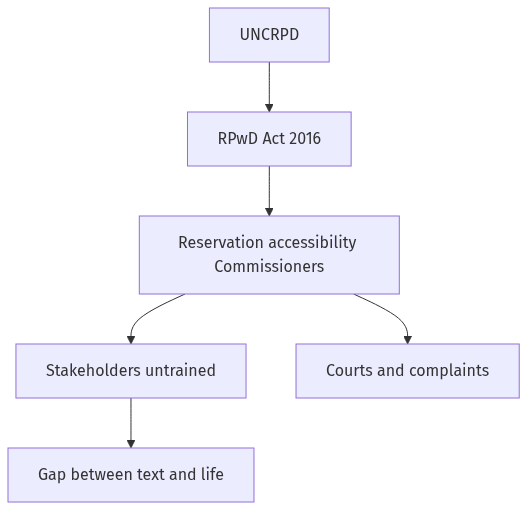
Conclusion
The 2016 Act is a rights statute with reservation, accessibility, and Commissioners already in the text. Without sensitization of teachers, employers, engineers, and local officials, those clauses remain a legal document for the few who can litigate, which is the force of the comment.
Quick related
Students also ask
-
Besides the welfare schemes, India needs deft management of inflation and unemployment to serve the poor and the underprivileged sections of the society. Discuss.
Next question on this syllabus topic (2022 · Q16). View answer →
-
Did the 2016 Act create the first disability law in India?
No. The 1995 Act already existed. The 2016 Act replaced it with a wider rights and accessibility framework.
-
Is sensitization a substitute for litigation?
No. Both are needed. Without sensitization most entitled persons never reach a Commissioner or a court.
Same topic · past papers
UPSC has asked this before
These previous-year questions sit on the same topic. Open one to practise the earlier ask.
More from this topic
Q16 · UPSC Mains 2022 · GS II · 15 marks · Solution
Besides the welfare schemes, India needs deft management of inflation and unemployment to serve the poor and the underprivileged sections of the society. Discuss.
Welfare Schemes for Vulnerable Sections
Schemes transfer food, work and cash but cannot cancel high food inflation or missing jobs. The poor are net food buyers and labour sellers, so prices and employment are distributional. CPI targeting must work with buffers and logistics, not rates alone. MGNREGA is a floor; underemployment in the informal sector needs broader demand and public hiring. Unfunded populism can raise the prices schemes were meant to offset. Articles 38, 39 and 41 make this macroeconomic task part of the welfare State, not a separate silo.
Q18 · UPSC Mains 2019 · GS II · 15 marks · Solution
Performance of welfare schemes that are implemented for vulnerable sections is not so effective due to absence of their awareness and active involvement at all stages of policy process - Discuss.(15).
Welfare Schemes for Vulnerable Sections
Articles 15(4), 16(4) and 46 frame welfare for vulnerable sections; performance depends on last-mile knowledge and voice. Absence of awareness and of involvement in design, delivery and audit is a major cause of exclusion and leakage. MGNREGA social audits and NFSA grievance systems are statutory models of involvement. National Commissions and PESA gram sabhas are institutional voices that schemes often skip. Funding, staff and digital exclusion also matter; the statement is the core diagnosis, not the only one.
Q16 · UPSC Mains 2018 · GS II · 15 marks · Solution
Multiplicity of various commissions for the vulnerable sections of the society leads to problems of overlapping jurisdiction and duplication of functions. Is it better to merge all commissions into an umbrella Human Rights Commission? Argue your case. (15).
Welfare Schemes for Vulnerable Sections
India has NHRC plus constitutional commissions for SC, ST and OBC and statutory commissions for women, children, minorities and disability. Overlap of inquiry and advice is real and costly for the complainant. A full merge into NHRC would threaten the distinct constitutional status of Articles 338–338B and specialised expertise. An umbrella with only internal wings still risks remoteness and single-point capture. Coordination, joint sittings and shared investigation are better than one commission for all.