
Revision summary
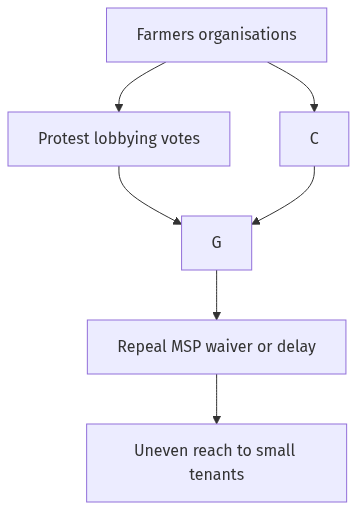
Article 19 speech, assembly and association frame farmers’ methods. Protest, memoranda, elections, media and writs are the main tools. The 2021 repeal of the three farm laws shows high effectiveness of united, long agitation. Short and split protests usually win a bonus, not a stable MSP law. Tenant and women farmers remain poorly reached, so method success is real but uneven.
Model answer
Copper italics in this answer — like this — are the key facts. Each one is unpacked in the Facts & figures rail.
Introduction
Farmers’ organisations try to move the Union and the States on prices, credit, power, water, and trade. They use the rights of speech, assembly, and association in Article 19, and they use elections, courts, and the street. Effectiveness depends on unity, duration, and whether the demand can be written into a statute or a budget line.
Body
Methods of influence
- Peaceful protest, sit-ins, rail and highway blockades, and long marches put a visible cost on governments; the 2020–21 farm-law agitation around Delhi is the largest recent example.
- Unions such as the Bharatiya Kisan Union, All India Kisan Sabha, and later coalitions submit memoranda, meet ministers, and depose before parliamentary standing committees.
- Election-time voting blocs in States with a strong kisan identity, and support or boycott of parties, turn rural numbers into a whip on policy-makers.
- Public-interest litigation, challenges to land-acquisition notifications, and petitions on drought or sugarcane arrears move the dispute into Articles 32 and 226.
- Media campaigns, social media, and alliance with traders or labour unions widen the issue beyond the village.
- Expert reports — the National Commission on Farmers chaired by M.S. Swaminathan, and later committee talks on minimum support price — give organisations a technical file to hand to the ministry.
How effective they are
- Sustained, united protest can change statute: the Farmers’ Produce Trade and Commerce (Promotion and Facilitation) Act, 2020, and the two companion farm laws were repealed in 2021 after months of mobilisation.
- Methods work better on a single, national, easy-to-name demand (repeal, loan waiver, a price announcement) than on slow reforms of marketing, storage, and tenancy.
- Fragmented unions, caste and crop splits, and short harvest-season protests often win a one-time bonus or a delayed payment, not a stable MSP statute or a full Swaminathan cost-plus formula.
- Litigation can stay a notification, but courts do not run procurement; the Food Corporation of India and State agencies still decide who actually sells at MSP.
- Small and tenant farmers, and women in agriculture, are weakly organised, so methods that look effective on television can miss those who need the National Food Security Act, 2013, and MGNREGA the most.
Short way forward
- Institutionalise consultation through a standing farmers’ council linked to the Ministry of Agriculture, so protest is not the only channel.
- Protect Article 19 protest while keeping essential services, and publish a time-bound reply to committee depositions.
- Tie MSP, PM-KISAN, and crop-insurance talk to tenant and women farmers, not only to title-holding union members.
Flow diagram
Conclusion
Farmers’ organisations influence policy through protest, lobbying, votes, media, and courts. Those methods are highly effective when unity lasts long enough to threaten a national law or an election; they are weak at delivering slow, inclusive agricultural reform for the least organised cultivators.
Quick related
Students also ask
-
Despite Consistent experience of High growth, India still goes with the lowest indicators of human development. Examine the issues that make balanced and inclusive development elusive.
Next question on this syllabus topic (2019 · Q6). View answer →
-
Did the farm-law protests prove that street methods always work?
They proved that a long, united, nationally visible protest can force repeal. They did not prove that every local dharna will rewrite procurement law.
-
Is MSP a statutory right today?
MSP is an executive procurement price for listed crops in listed mandis. Unions demand a statute; Parliament has not made MSP a justiciable right for every farmer and every crop.
Same topic · past papers
UPSC has asked this before
These previous-year questions sit on the same topic. Open one to practise the earlier ask.
-
2025 · Q8 · GS II · 10 marks
Civil Society Organizations are often perceived as being anti-State actors than non-State actors. Do you agree? Justify. -
2021 · Q18 · GS II · 15 marks
Can Civil Society and Non-Governmental Organizations present an alternative model of public service delivery to benefit the common citizen. Discuss the challenges of this alternative model.
More from this topic
Q15 · UPSC Mains 2026 · GS II · 15 marks · Solution
To what extent do pressure groups, social movements and corporate lobbies deepen pluralistic democracy in India by representing excluded interests? Analyse whether the growing convergence of corporate wealth and political power poses a threat to the autonomy of formal democratic institutions.
Governance and Policy
• Pluralism needs many competing groups so that no single interest dominates policy • Trade unions, farmer bodies and movements such as Chipko and Narmada Bachao Andolan have brought excluded voices into public debate • Movements delivered RTI, Forest Rights and Lokpal laws that give citizens lasting tools • Weak resources and FCRA and protest restrictions limit civil society reach • Corporate influence runs through party funding, lobbying, regulators and media ownership • The electoral bonds scheme was struck down in 2024 for violating citizens' right to information • Institutions such as the Supreme Court, CAG and the Election Commission still check capture, but risks remain • Reforms include funding transparency, a lobbying law, cooling-off periods and protection of dissent
Q12 · UPSC Mains 2026 · GS II · 15 marks · Solution
What is meant by judicial legislation? In this context, discuss the verdicts of the apex court allowing "passive euthanasia" and a "living will".
Governance and Policy
• Judicial legislation is court-made law that fills a legislative vacuum, using Articles 32, 141 and 142 • Vishaka, Prakash Singh and NALSA are common examples, and each invited later legislation • Gian Kaur (1996) denied a right to die but spoke of dying with dignity when death is imminent • Aruna Shanbaug (2011) permitted passive euthanasia with High Court supervision • Common Cause (2018) held the right to die with dignity to be part of Article 21 and recognised living wills • The 2023 modification simplified attestation, board composition and timelines • The tension is between dignity under Article 21 and the legislature's domain on a sensitive moral issue • A national statute on terminal illness would replace interim court guidelines
Q6 · UPSC Mains 2026 · GS II · 10 marks · Solution
Does India's tribal development policy reflect the aspirations for a socially grounded and equity-based governance? Justify your answer.
Governance and Policy
• Constitution: Fifth and Sixth Schedules create tribal self-rule, with Tribes Advisory Councils and autonomous district councils. • Law: PESA 1996 makes the Gram Sabha central and FRA 2006 recognises individual and community forest rights. • Welfare: DAPST, Article 275(1) grants, Eklavya schools, PM JANMAN and the sickle cell mission target the gap. • Weakness: mining, dams and forest clearance rules often override Gram Sabha consent. • Weakness: delayed PESA rules, FRA claim rejections and diverted funds blunt equity. • Security: LWE districts show the cost of land alienation and weak service delivery. • Verdict: strong legal design, uneven delivery, so equity is partial and conditional. • Way ahead: enforce consent, social audit, benefit-sharing through District Mineral Foundations.