
Revision summary
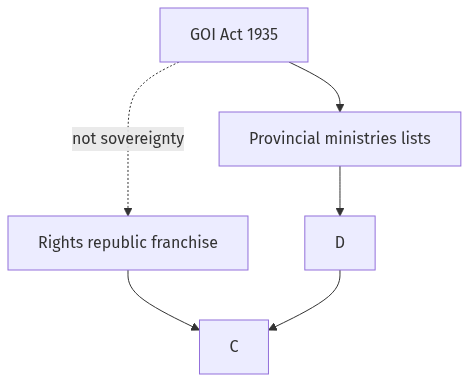
The 1935 Act trained parties in provincial government and wrote a long federal statute. The Constitution reused lists, governors, and much administrative design. Fundamental rights, adult franchise, and a republic were new nationalist work. Partition added problems 1935 never faced. Three years were possible because the scaffold already existed; the soul of the text did not.
Model answer
Copper italics in this answer — like this — are the key facts. Each one is unpacked in the Facts & figures rail.
Introduction
The Constituent Assembly sat from December 1946 and gave India a Constitution in January 1950, in about three years of work through Partition and integration. That speed was possible because the Government of India Act, 1935 had already trained lawyers, legislatures, and a federal draft. The 1935 Act was a scaffold, not the finished house.
Body
What the 1935 Act had already put in place
- It created a detailed federal scheme, provincial autonomy, three lists of powers, a federal court idea, and an elaborate office of the Governor and Governor-General.
- Provincial elections in 1937 gave Congress and other parties practice in ministries, budgets, and responsible government, even under colonial limits.
- The Indian Civil Service, auditor, public service commissions, and a written, lengthy statute taught the political class to think in articles and schedules rather than in a short charter.
- Many Assembly members had sat in central or provincial legislatures created by 1919 and 1935, so drafting was not their first contact with parliamentary form.
What the Constitution reused
- Federal lists, emergency provisions, the office of Governor, and much administrative language show a clear 1935 imprint, as Granville Austin and later lawyers have noted.
- Bicameralism, the Election Commission seed in election machinery, and a strong Centre against princely and provincial pull all had colonial precedents.
- Using a known skeleton let the Drafting Committee under Ambedkar finish a long text while refugees, Kashmir, and Hyderabad still burned.
What still had to be created in those three years
- Fundamental rights, adult franchise, abolition of untouchability, a secular citizenship, and Directive Principles were not gifts of 1935; they came from nationalist demand, the Objectives Resolution, and comparative constitutions.
- The 1935 Act kept British control, dyarchy at the centre in its original design, and no real sovereignty; the Assembly had to convert a colony statute into a republic.
- Partition forced citizenship, minority, and asset clauses that 1935 never imagined.
Way forward
- Discuss 1935 as necessary experience and borrowed architecture, then name rights and republic as the Assembly’s own historic task.
- Three years look short only if one forgets two decades of legislative practice before 1946.
Flow diagram
Conclusion
Without the Government of India Act, 1935, the Assembly would have been slower and less sure with federal lists and parliamentary procedure. With it, India could still not have a free constitution until members wrote rights, adult vote, and a republic on top of that colonial frame.
Quick related
Students also ask
-
Mumbai, Delhi and Kolkata are the three Mega cities of the country but the air pollution is much more serious problem in Delhi as compared to the other two. Why is this so?
Next question on this syllabus topic (2015 · Q15). View answer →
-
Is the Indian Constitution only a copy of the 1935 Act?
No. Structure and administration owe much to 1935. Sovereignty, rights, and adult franchise do not.
-
Could the Assembly have started from a blank page?
It could, but Partition, integration, and the need for a working union would have made a three-year finish far harder.
Same topic · past papers
UPSC has asked this before
These previous-year questions sit on the same topic. Open one to practise the earlier ask.
More from this topic
Q17 · UPSC Mains 2026 · GS I · 15 marks · Solution
Analyze the major drivers of human-induced land-use changes in India and their geographical consequences.
World's Physical Geography
India's land-use change is driven by agricultural intensification, urban growth, infrastructure, mining, plantations, tourism and livelihood shifts. These changes support food, connectivity and jobs, but they also disturb hydrology, soil, habitats, microclimates, hills, coasts and access to commons. Sustainable land governance must combine mapping, carrying-capacity assessment and local participation.
Q16 · UPSC Mains 2026 · GS I · 15 marks · Solution
"The centre of global trade is gradually shifting from the Atlantic region to the Indo-Pacific region." Examine this statement.
World's Physical Geography
Global trade’s centre of gravity is moving towards the Indo-Pacific because manufacturing, consumption, energy shipping and new tech rules are concentrating between the Indian and Pacific Oceans. China-plus-one, ASEAN growth, India’s market, Malacca–Hormuz lanes, RCEP/IPEF and semiconductor corridors drive the trend. The Atlantic still matters in finance and standards, so the change is gradual rebalancing. India gains only if ports, manufacturing and sea-lane security keep pace.
Q14 · UPSC Mains 2026 · GS I · 15 marks · Solution
Compare the Loo, Chinook and Foehn winds with respect to their regions of prevalence, their nature and climatic impacts.
World's Physical Geography
The Loo is a hot, dusty pre-monsoon wind of northwestern India and the Indo-Gangetic plains. Chinook and Foehn are warm, dry downslope winds of the Rockies and Alps, formed by adiabatic compression. Their impacts differ from Indian heat stress to snowmelt and mountain hazards.