
Revision summary
Demographic winter means long below-replacement fertility, ageing, and a shrinking worker-to-retiree balance. Replacement fertility is about 2.1 in low-mortality societies. Japan, South Korea and much of Europe already fit this description. World fertility has fallen and the planet is ageing, but Africa still drives global population growth. India’s fertility is near replacement, with sharp differences among States. The world is diverging. It is not entering one single winter.
Model answer
Copper italics in this answer — like this — are the key facts. Each one is unpacked in the Facts & figures rail.
Introduction
Demographic winter is a popular phrase, not a UN category. It names a society whose fertility stays below replacement, whose age pyramid inverts, and whose workforce shrinks relative to the old. The phrase points to fewer births, more deaths among the aged, and a politics of pensions and care. The world as a whole is ageing, but it is not yet one frozen planet. Africa and parts of West Asia still have young, growing populations.
Body
The concept
Replacement total fertility is about 2.1 children per woman in low-mortality societies. Below that for decades, each generation is smaller. Median age rises. The share of people above 65 grows. The potential support ratio of workers to retirees falls. The idea also implies social effects: fewer siblings, delayed marriage, empty schools, immigration as a labour fix, and anxiety about decline. East Asia and much of Europe are the textbook cases: Japan, South Korea, Italy, Spain, Germany. Some governments pay baby bonuses. None has found a simple switch.
The concept is regional. A country can have below-replacement fertility and still grow for a time because of population momentum and immigration.
- Below-replacement fertility: This is the engine of the idea.
- Ageing and shrinkage: First the pyramid greys. Then absolute numbers may fall.
- Political economy: Pensions, health, and who does care work become the central state problem.
Is the world moving there?
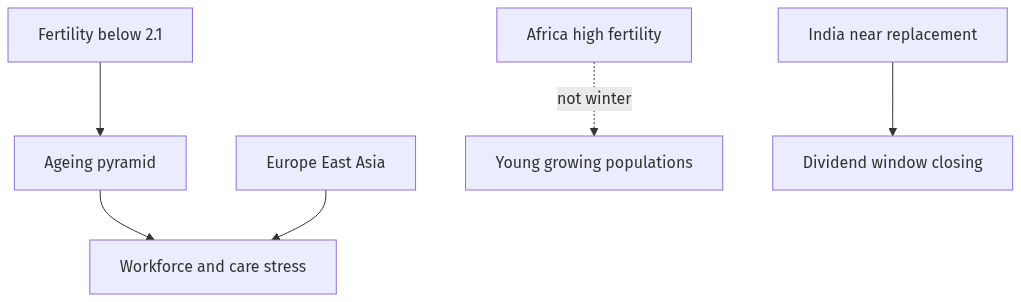
Globally, fertility has fallen sharply from the mid-twentieth century. UN population projections show a world that grows more slowly and ages, with a peak later this century in many central scenarios. That is a move toward winter in the average. It is not an arrival. Sub-Saharan Africa still has high fertility and will supply much of future world population growth. South Asia is mixed. India’s fertility has fallen to around replacement in recent National Family Health Survey rounds, with large State variation. Latin America and East Asia are already in or near winter. The world is therefore diverging. There is a grey North and East Asia, a still-young Africa, and a middle belt.
Migration can postpone winter in receiving countries. It does not raise the world’s birth rate. Climate, housing costs, women’s education and the unfinished gender contract of care are the real drivers of low fertility. There is not a single cultural death.
- Yes, in structure: Global ageing and sub-replacement fertility appear in a rising share of countries.
- No, as a uniform fate: Africa’s youth and momentum keep world population from a sudden freeze.
- India’s place: India has a closing window of dividend. It is not yet a Japanese-style winter. Some States already look East Asian.
Demographic winter is a fair warning for rich low-fertility societies. It is a bad map if it erases the child-rich parts of the world that still need schools more than geriatric wards.
Flow diagram
Conclusion
Demographic winter means durable below-replacement fertility and a greying, shrinking labour force. Much of Europe and East Asia already live there. The world is moving toward older age structures, yet growth continues where fertility remains high. Policy has to plan both for pensions in the grey belt and for education in the young belt.
Quick related
Students also ask
-
The groundwater potential of the gangetic valley is on a serious decline. How may it affect the food security of India?
Next question on this syllabus topic (2024 · Q14). View answer →
-
Will world population collapse soon?
No. Ageing and slower growth are underway, but high-fertility regions and momentum keep global numbers rising for decades in standard projections.
-
Does immigration solve demographic winter?
It can fill labour gaps in receiving countries. It does not raise global births; origin countries may then age faster.
Same topic · past papers
UPSC has asked this before
These previous-year questions sit on the same topic. Open one to practise the earlier ask.
-
2026 · Q19 · GS I · 15 marks
Critically examine the challenges of demographic transition in contemporary India.
More from this topic
Q17 · UPSC Mains 2026 · GS I · 15 marks · Solution
Analyze the major drivers of human-induced land-use changes in India and their geographical consequences.
World's Physical Geography
Anthropogenic pressures driven by population growth and economic development are the primary catalysts of rapid land-use and land-cover change (LULCC) across India. Agricultural expansion and intensive multi-cropping, particularly
Q16 · UPSC Mains 2026 · GS I · 15 marks · Solution
"The centre of global trade is gradually shifting from the Atlantic region to the Indo-Pacific region." Examine this statement.
World's Physical Geography
• The global center of economic gravity has decisively shifted from the Euro-Atlantic axis to the Indo-Pacific. • The rise of China, Southeast Asia, and India as primary manufacturing and consumption hubs drives this transition. • Vital maritime chokepoints like the Malacca Strait serve as critical arteries for global energy and merchant trade. • Mega free-trade agreements such as RCEP and IPEF have established new regional trade and rule-making architectures. • Post-pandemic supply chain vulnerabilities have accelerated diversification strategies like 'China-plus-one' and 'friend-shoring'. • Control over critical mineral supply chains powers the ongoing digital and green energy transitions in the region. • Sustaining this geo-economic shift requires robust multilateral frameworks, freedom of navigation, and rules-based maritime governance.
Q14 · UPSC Mains 2026 · GS I · 15 marks · Solution
Compare the Loo, Chinook and Foehn winds with respect to their regions of prevalence, their nature and climatic impacts.
World's Physical Geography
• Local winds like the Loo, Chinook, and Foehn are driven by distinct regional pressure gradients and orographic barriers. • The Loo prevails over the Indo-Gangetic Plain, the Chinook along the Rockies' eastern slopes, and the Foehn across the northern Alpine valleys. • The Loo is a scorching, dust-laden convective surface wind generated by intense summer continental heating. • Both the Chinook and Foehn are warm, dry katabatic winds formed via rapid adiabatic compression on the leeward sides of mountains. • The Loo induces severe agricultural stress, crop wilting, and high health risks like heat strokes in South Asia. • Chinooks act as 'snow eaters' in North America, rapidly melting winter snowpacks and opening up pasturelands for grazing. • Foehn winds accelerate Alpine snowmelt, which simultaneously triggers hazardous avalanches and elevates regional wildfire risks.