
Revision summary
The proposition claims a high correlation between cultural diversity and socio-economic marginality in India. Tribal forest belts, some Muslim urban clusters, and certain frontiers show a real overlap. Causation runs largely through land, stigma, connectivity, and the colonial-modern state, not through culture as such. Counter-examples include high-development southern States and poverty in culturally core plains districts. Diversity is a constitutional good. Disparity is the injustice. Treat the overlap as a warning for inclusive policy. Do not treat it as a law that pluralism causes poverty.
Model answer
Copper italics in this answer — like this — are the key facts. Each one is unpacked in the Facts & figures rail.
Introduction
Some writers claim that India’s cultural diversity is closely linked with socio-economic disadvantage. They lay the map of languages, tribes, faiths, and regions over the map of poverty as if culture itself caused poverty. There is a visible overlap. Many Adivasi belts, some Muslim concentrations after the Sachar report, and parts of the Northeast and rainfed interior are both culturally distinct and economically squeezed. A high correlation as a law of the land does not survive a hard look. Kerala’s social development, Tamil social justice plus industry, and poor districts in culturally mainstream plains show that the claimed law does not hold everywhere.
Body
Where the correlation seems high
Scheduled Tribes in central Indian forests are culturally distinct and, as groups, have worse health, land, and schooling outcomes. Fifth Schedule areas show that the Constitution itself linked cultural vulnerability to economic predation through land alienation and mines. Muslims in many urban clusters face education and credit gaps that Sachar documented. This is a religious-cultural minority with socio-economic lag. It is not because Islam is anti-market. It is because of history, discrimination, and occupational lock-in. Hill and border cultures paid a connectivity tax. Dalit difference is not regional culture in the tourist sense, yet caste is a cultural system with harsh economic effects.
If one draws a crude GIS of not the dominant caste-Hindu plains culture and below-average HDI, the eye finds overlap. That overlap is the proposition’s limited truth.
- Adivasi belts: Culture and resource dispossession often travel together.
- Minority localities: Identity and labour-market closure often travel together.
- Frontiers: Distance and security regimes often travel with cultural difference.
Where the proposition fails
Diversity is not destiny. The south is linguistically diverse and several States lead on human development. Punjab’s distinct culture sat with agrarian surplus and its own inequalities. Coastal communities with strong identities have used ports and Gulf migration. Conversely, eastern Uttar Pradesh and parts of the Hindi belt can be described as culturally core in nationalist rhetoric and still show deep poverty. Elite minorities, including some trading diasporas, are culturally marked and rich. Gender cuts every culture. A dominant-caste woman may be culturally inside and still property-poor.
The causal arrow often runs from political economy to culture’s fate. Who was conquered, whose land was surveyed, who got the canal, and who was labelled criminal or backward matter more. Culture then marks the losers. It does not create the loss by itself. A high-correlation thesis that blames diversity for marginality is one step from saying pluralism is the problem. The Constitution rejects that claim.
- Counter-examples: There is high diversity with high development. There is also low exotic diversity with high poverty.
- Causation: State, market, and stigma allocate irrigation and schools. Folk culture does not.
- Risk of the thesis: Cultural stereotyping becomes development policy.
Critical verdict
There is a moderate, historically produced association between some cultural margins and socio-economic margins. There is not a tight scientific law that more diversity means more poverty. Policy should protect diversity through language, Schedule areas, and minority rights. It should attack disparity through land, schools, anti-discrimination, and connectivity. Mixing the two into one correlation is bad geography and worse ethics.
The proposition is useful as a warning against ignoring identity in poverty data. It is dangerous as a theory of Indian underdevelopment.
Flow diagram
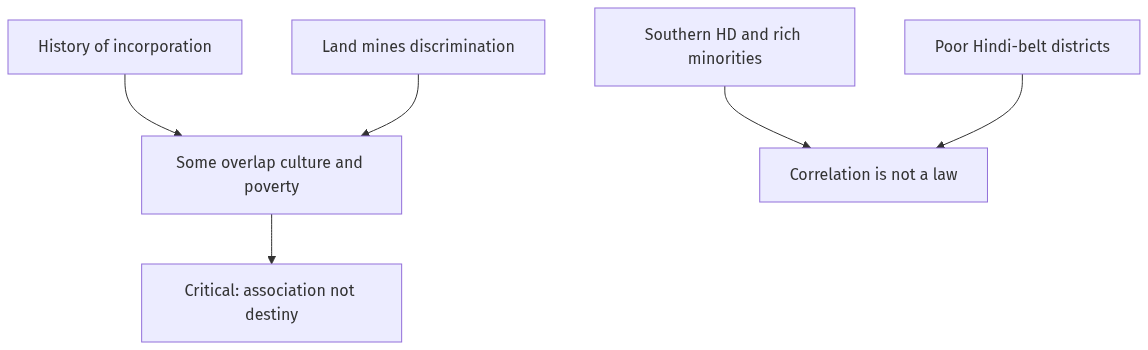
Conclusion
Cultural diversity and socio-economic marginality overlap in tribal belts, some minority neighbourhoods, and neglected frontiers. They do not move together across all of India. The Republic’s task is to separate them. Diversity should be kept. The development gap should be closed. That is federalism plus Article 15. It is not a complaint that India has too many cultures.
Quick related
Students also ask
-
Explain the role of geographical factors towards the development of Ancient India.
Next question on this syllabus topic (2023 · Q1). View answer →
-
Are tribal people poor because of their culture?
No. Forest rights, displacement, schooling language, and market power explain far more than custom.
-
Should development flatten cultural difference?
No. Flattening is assimilation. Development should add schools, land security and non-discriminatory jobs without demanding cultural suicide.
Same topic · past papers
UPSC has asked this before
These previous-year questions sit on the same topic. Open one to practise the earlier ask.
More from this topic
Q17 · UPSC Mains 2026 · GS I · 15 marks · Solution
Analyze the major drivers of human-induced land-use changes in India and their geographical consequences.
World's Physical Geography
Anthropogenic pressures driven by population growth and economic development are the primary catalysts of rapid land-use and land-cover change (LULCC) across India. Agricultural expansion and intensive multi-cropping, particularly
Q16 · UPSC Mains 2026 · GS I · 15 marks · Solution
"The centre of global trade is gradually shifting from the Atlantic region to the Indo-Pacific region." Examine this statement.
World's Physical Geography
• The global center of economic gravity has decisively shifted from the Euro-Atlantic axis to the Indo-Pacific. • The rise of China, Southeast Asia, and India as primary manufacturing and consumption hubs drives this transition. • Vital maritime chokepoints like the Malacca Strait serve as critical arteries for global energy and merchant trade. • Mega free-trade agreements such as RCEP and IPEF have established new regional trade and rule-making architectures. • Post-pandemic supply chain vulnerabilities have accelerated diversification strategies like 'China-plus-one' and 'friend-shoring'. • Control over critical mineral supply chains powers the ongoing digital and green energy transitions in the region. • Sustaining this geo-economic shift requires robust multilateral frameworks, freedom of navigation, and rules-based maritime governance.
Q14 · UPSC Mains 2026 · GS I · 15 marks · Solution
Compare the Loo, Chinook and Foehn winds with respect to their regions of prevalence, their nature and climatic impacts.
World's Physical Geography
• Local winds like the Loo, Chinook, and Foehn are driven by distinct regional pressure gradients and orographic barriers. • The Loo prevails over the Indo-Gangetic Plain, the Chinook along the Rockies' eastern slopes, and the Foehn across the northern Alpine valleys. • The Loo is a scorching, dust-laden convective surface wind generated by intense summer continental heating. • Both the Chinook and Foehn are warm, dry katabatic winds formed via rapid adiabatic compression on the leeward sides of mountains. • The Loo induces severe agricultural stress, crop wilting, and high health risks like heat strokes in South Asia. • Chinooks act as 'snow eaters' in North America, rapidly melting winter snowpacks and opening up pasturelands for grazing. • Foehn winds accelerate Alpine snowmelt, which simultaneously triggers hazardous avalanches and elevates regional wildfire risks.