
Revision summary
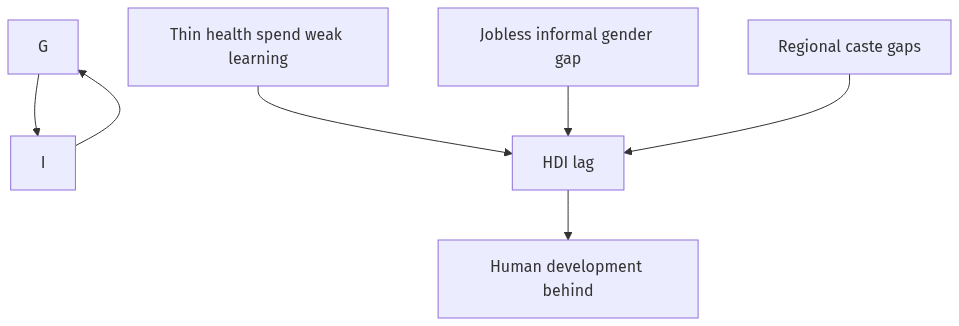
Post-1991 growth raised GDP and cut some poverty without matching gains in health and learning. Low public health spend and child stunting show the social gap. Enrolment without learning and informal jobs limit capabilities. Women’s low paid work and regional caste gaps split the average. GDP is not HDI; India grew richer faster than it grew healthier and better taught.
Model answer
Copper italics in this answer — like this — are the key facts. Each one is unpacked in the Facts & figures rail.
Introduction
India’s national income and a modern services-industrial sector grew faster after 1991 than in the Hindu-rate decades. Health, learning, jobs, and gender equality did not rise at the same speed, so human development lagged economic development.
Body
What economic development did
- GDP and a large middle-class market expanded with liberalisation, IT and services exports, and later infrastructure spends.
- Absolute poverty rates fell, and grain stocks and telecom access spread far beyond the 1970s picture.
- That growth was real; the question is why capabilities of the average person did not rise in step.
Why human development lagged
- Public spending on health stayed near one to two percent of GDP for many years, so nutrition, district hospitals, and primary care stayed thin even as private hospitals grew in cities.
- NFHS rounds still show stunting in about one-third of children under five, which is a human-development failure inside a growing economy.
- ASER-type surveys show that school enrolment rose while reading and arithmetic in government schools often did not, so years of schooling were not learning.
- Growth was more capital- and skill-intensive than job-rich, and a huge informal workforce lacked security, which Amartya Sen’s capability view would not count as full development.
- Female labour-force participation stayed low, and unpaid care work was invisible in GDP, so half the population’s human development was discounted.
- Regional and caste gaps meant Maharashtra or Karnataka services booms did not automatically lift Bundelkhand or a Musahar hamlet.
- Pollution, urban crowding, and weak local government made income gains sit beside dirty air and unsafe water.
Politics and policy design
- Centrally sponsored schemes multiplied, but teacher vacancy, anganwadi load, and last-mile leakage limited outcomes.
- Human development needs the state in health and school quality; a growth model that trusted markets first under-provided those goods.
Way forward
- Raise public health toward a round two-and-a-half to three percent of GDP and fund primary care, not only insurance bills.
- Tie school grants to actual learning, as NEP 2020 asks, and expand creches so women can work.
- Use multidimensional poverty measures, not only GDP, in state ranking so the gap stays visible.
Flow diagram
Conclusion
Economic development outpaced human development because growth did not buy enough public health, learning, and women’s work. The way forward is to treat those as core infrastructure of growth, not as welfare after the fact.
Quick related
Students also ask
-
From being net food importer in 1960s, India has emerged as a net food exporter to the world. Provide reasons.
Next question on this syllabus topic (2023 · Q17). View answer →
-
Did human development fail completely?
No. Life expectancy, literacy, and poverty measures improved. They improved slower than income and unevenly.
-
Is the lag only because of population?
Numbers matter. The deeper lag is public health, school quality, jobs, and gender, which policy can change.
More from this topic
Q17 · UPSC Mains 2026 · GS I · 15 marks · Solution
Analyze the major drivers of human-induced land-use changes in India and their geographical consequences.
World's Physical Geography
Anthropogenic pressures driven by population growth and economic development are the primary catalysts of rapid land-use and land-cover change (LULCC) across India. Agricultural expansion and intensive multi-cropping, particularly
Q16 · UPSC Mains 2026 · GS I · 15 marks · Solution
"The centre of global trade is gradually shifting from the Atlantic region to the Indo-Pacific region." Examine this statement.
World's Physical Geography
• The global center of economic gravity has decisively shifted from the Euro-Atlantic axis to the Indo-Pacific. • The rise of China, Southeast Asia, and India as primary manufacturing and consumption hubs drives this transition. • Vital maritime chokepoints like the Malacca Strait serve as critical arteries for global energy and merchant trade. • Mega free-trade agreements such as RCEP and IPEF have established new regional trade and rule-making architectures. • Post-pandemic supply chain vulnerabilities have accelerated diversification strategies like 'China-plus-one' and 'friend-shoring'. • Control over critical mineral supply chains powers the ongoing digital and green energy transitions in the region. • Sustaining this geo-economic shift requires robust multilateral frameworks, freedom of navigation, and rules-based maritime governance.
Q14 · UPSC Mains 2026 · GS I · 15 marks · Solution
Compare the Loo, Chinook and Foehn winds with respect to their regions of prevalence, their nature and climatic impacts.
World's Physical Geography
• Local winds like the Loo, Chinook, and Foehn are driven by distinct regional pressure gradients and orographic barriers. • The Loo prevails over the Indo-Gangetic Plain, the Chinook along the Rockies' eastern slopes, and the Foehn across the northern Alpine valleys. • The Loo is a scorching, dust-laden convective surface wind generated by intense summer continental heating. • Both the Chinook and Foehn are warm, dry katabatic winds formed via rapid adiabatic compression on the leeward sides of mountains. • The Loo induces severe agricultural stress, crop wilting, and high health risks like heat strokes in South Asia. • Chinooks act as 'snow eaters' in North America, rapidly melting winter snowpacks and opening up pasturelands for grazing. • Foehn winds accelerate Alpine snowmelt, which simultaneously triggers hazardous avalanches and elevates regional wildfire risks.