
Revision summary
NCRB patterns point to young women and housewives as a large share of women who die by suicide. Dowry, early marriage, and domestic violence close exit routes. Education without safe work and voice creates a hope gap. Mental-health stigma and thin district care leave distress untreated. The response is law enforcement, confidential care, and economic independence, not only awareness weeks.
Model answer
Copper italics in this answer — like this — are the key facts. Each one is unpacked in the Facts & figures rail.
Introduction
NCRB reports have long shown that a large share of recorded suicides in India are of young people, and that housewives and young women form a heavy group among women who die this way. The rise, or the stubbornly high toll, is social before it is only medical.
Body
Household and gender power
- Early marriage, dowry pressure, and the Dowry Prohibition Act, 1961, still unmet in practice, trap many young women between natal and marital homes.
- Domestic violence continues despite the Protection of Women from Domestic Violence Act, 2005, and police and panchayat responses are often slow.
- Son preference, unpaid care, and limited say in money make daily life feel closed, which is a risk setting, not a private weakness.
- Honour rules around sexuality, phone use, and inter-caste friendship punish young women more than young men for the same conduct.
Economy, school, and the public sphere
- Education and paid work raise hopes, but female labour-force participation stays low and job quality is often informal, so the gap between hope and control is sharp.
- Exam pressure, coaching towns, and public shame after failure hit young women who are also judged for marriageability.
- Social media multiplies comparison, stalking, and image-based abuse, while help is still hard to seek without family blame.
Health and recording
- Depression, anaemia, and lack of confidential counselling are common, and mental health is still stigmatised in many families.
- The Mental Healthcare Act, 2017, decriminalised suicide attempt in spirit and promised care, but district services remain thin.
- Better reporting can raise counted numbers even when the underlying harm was already there, so explanation must not treat every statistical rise as a new fashion.
Way forward
- Enforce dowry and domestic-violence law, and make one-stop centres and women’s helplines actually answer.
- Put school and college counsellors, and the Tele-MANAS and KIRAN mental-health lines, within reach of young women without a guardian’s veto.
- Expand safe paid work and delayed marriage so adulthood is not only a transfer between two families.
Flow diagram
Conclusion
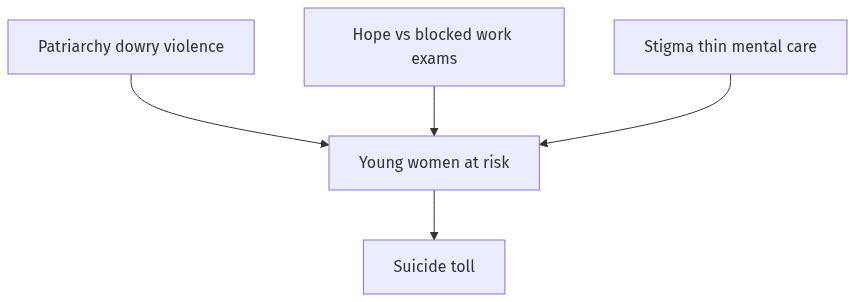
Suicide among young women rises where patriarchy, dowry, violence, blocked work, and untreated distress meet. Law already names some of these harms; the way forward is enforcement, confidential care, and real economic options.
Quick related
Students also ask
-
Does urbanization lead to more segregation and/or marginalization of the poor in Indian metropolises?
Next question on this syllabus topic (2023 · Q18). View answer →
-
Is this only a mental-illness problem?
Illness matters and needs treatment. The pattern among young women also tracks gender power, marriage, and work.
-
Do helplines solve the rise?
They reduce delay in care. They cannot replace safety in the household or a path out of a violent marriage.
Same topic · past papers
UPSC has asked this before
These previous-year questions sit on the same topic. Open one to practise the earlier ask.
-
2024 · Q19 · GS I · 15 marks
Globalization has increased urban migration by skilled, young, unmarried women from various classes. How has this trend impacted upon their personal freedom and relationship with family? -
2021 · Q2 · GS I · 10 marks
Trace the rise and growth of socio-religious reform movements with special reference to Young Bengal and Brahmo Samaj.
More from this topic
Q18 · UPSC Mains 2026 · GS I · 15 marks · Solution
Is caste disappearing in urban India? Illustrate your answer with examples.
Women, Population and Urbanisation
Urbanization does not erase caste but mutates it from a ritual hierarchy into modern
Q17 · UPSC Mains 2025 · GS I · 15 marks · Solution
Discuss the distribution and density of population in the Ganga River Basin with special reference to land, soil and water resources.
Women, Population and Urbanisation
The Ganga plains from western Uttar Pradesh through Bihar to the Bengal delta are among the world's densest rural regions. Alluvial soil, shallow water and a long growing season explain that density. Himalayan hills and some dry western margins of the basin are thinner. The same water that feeds the field produces flood, and some groundwater is now chemically unsafe. Cities on the corridor are the urban expression of the same fertile strip. Land, soil and water therefore explain both the crowd and the hazard.
Q19 · UPSC Mains 2024 · GS I · 15 marks · Solution
Globalization has increased urban migration by skilled, young, unmarried women from various classes. How has this trend impacted upon their personal freedom and relationship with family?
Women, Population and Urbanisation
Globalisation pulled young unmarried women into urban garments, care, hospitality, and IT-enabled work. The stream cuts across classes, from professionals to shop-floor workers. Personal freedom grows through wages, delayed marriage, and city skills. It remains bounded by curfews, street risk, precarious contracts, and digital surveillance by kin. Families often allow the move for remittances while keeping honour and marriage as levers. The relationship is renegotiated. It is not simply broken and not simply liberated.