
Revision summary
The Ganga plains from western Uttar Pradesh through Bihar to the Bengal delta are among the world's densest rural regions. Alluvial soil, shallow water and a long growing season explain that density. Himalayan hills and some dry western margins of the basin are thinner. The same water that feeds the field produces flood, and some groundwater is now chemically unsafe. Cities on the corridor are the urban expression of the same fertile strip. Land, soil and water therefore explain both the crowd and the hazard.
Model answer
Copper italics in this answer — like this — are the key facts. Each one is unpacked in the Facts & figures rail.
Introduction
The Ganga river basin is one of the most crowded pieces of the Earth. People did not gather there for a view of the Himalaya. They gathered because silt, shallow groundwater and a long growing season could feed a village, then a town, then a million. Distribution and density still follow land, soil and water, with floods as the bill.
Body
The dense core
- Western Uttar Pradesh to Bihar: Rural densities are among India's highest on watered alluvium.
- West Bengal delta: People pack onto every unflooded levee because the soil and water still feed intensive agriculture.
- Khadar and bhangar: New and old alluvium hold moisture and nutrients that support repeated cropping.
- Canals and tube wells: A green-revolution layer, especially in the western basin, raised carrying capacity further.
- River cities: Patna, Varanasi, Kanpur, Prayagraj and Kolkata sit on that corridor because a river is a road as well as a field.
Where it thins
- Himalayan head: Uttarakhand districts and Nepal's hills are steeper, colder and thinner in population.
- Dry western margins: Chambal badlands and some drier western edges of the basin hold fewer people per square kilometre.
- Terai contrast: The terai can be fertile and malarial in history; density follows cleared, drained land more than raw swamp.
- Sundarbans edge: The fringe is dense but fragile, because people live with tide and hazard when the mainland is already packed.
Soil, water, hazard
- Alluvium explains the crowd: Fertile silt is the first geographical reason for high density.
- Water as gift and tax: Shallow groundwater and monsoon support the field, then return as flood in north Bihar.
- Chemical limits: Arsenic in parts of the Bengal delta and adjoining plains, and fluoride elsewhere, tax the same water gift.
- Pollution and fragmentation: Dirty surface water and tiny holdings concentrate risk on the densest map.
- Urban crush: Million-plus UP cities and Kolkata are the urban expression of the same fertile strip.
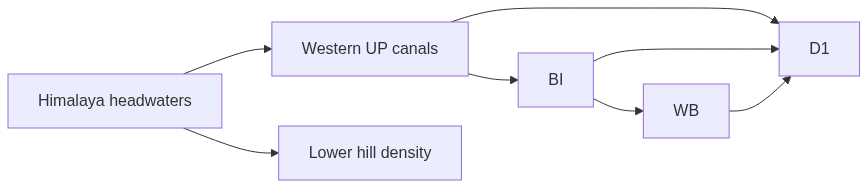
Flow diagram
Conclusion
Population in the Ganga basin is thickest on fertile, watered alluvium from western Uttar Pradesh through Bihar to the Bengal delta, and thinner in the hills and dry margins. Land, soil and water explain the crowd. Flood and pollution are the same map's other face.
Quick related
Students also ask
-
Distinguish between gender equality, gender equity and women's empowerment. Why is it important to take gender concerns into account in programme design and implementation?
Next question on this syllabus topic (2024 · Q8). View answer →
-
Is the whole basin uniformly dense?
No. The mountain districts and some western dry tracts are far lighter than the Bihar–Bengal rural core.
-
Why not move people out?
Livelihood, language and land rights are on that soil. Planning has to work with density, not wish it away.
Same topic · past papers
UPSC has asked this before
These previous-year questions sit on the same topic. Open one to practise the earlier ask.
-
2018 · Q14 · GS I · 15 marks
"The ideal solution of depleting ground water resources in India is water harvesting system." How can it be made effective in urban areas? -
2026 · Q7 · GS I · 10 marks
"Water resources are both an asset and a source of conflict in South Asia." Examine this statement giving examples. -
2023 · Q5 · GS I · 10 marks
Why is the world today confronted with a crisis of availability of and access to freshwater resources? -
2022 · Q20 · GS I · 15 marks
Elucidate the relationship between globalization and new technology in a world of scarce resources, with special reference to India. -
2021 · Q2 · GS I · 10 marks
Trace the rise and growth of socio-religious reform movements with special reference to Young Bengal and Brahmo Samaj.
More from this topic
Q18 · UPSC Mains 2026 · GS I · 15 marks · Solution
Is caste disappearing in urban India? Illustrate your answer with examples.
Women, Population and Urbanisation
Urbanization does not erase caste but mutates it from a ritual hierarchy into modern
Q19 · UPSC Mains 2024 · GS I · 15 marks · Solution
Globalization has increased urban migration by skilled, young, unmarried women from various classes. How has this trend impacted upon their personal freedom and relationship with family?
Women, Population and Urbanisation
Globalisation pulled young unmarried women into urban garments, care, hospitality, and IT-enabled work. The stream cuts across classes, from professionals to shop-floor workers. Personal freedom grows through wages, delayed marriage, and city skills. It remains bounded by curfews, street risk, precarious contracts, and digital surveillance by kin. Families often allow the move for remittances while keeping honour and marriage as levers. The relationship is renegotiated. It is not simply broken and not simply liberated.
Q8 · UPSC Mains 2024 · GS I · 10 marks · Solution
Distinguish between gender equality, gender equity and women's empowerment. Why is it important to take gender concerns into account in programme design and implementation?
Women, Population and Urbanisation
Gender equality is sameness of rights and opportunities in law and public life. Gender equity uses special measures because starting points and unpaid care are unequal. Women’s empowerment is agency over body, income, voice and movement. Article 15(3) allows special provision for women; CEDAW and SDG 5 frame empowerment as a process. Gender-blind schemes leak through male capture, unsafe access and digital exclusion. Design and implementation need data, safety, childcare and control of the benefit by the woman herself.