
Revision summary
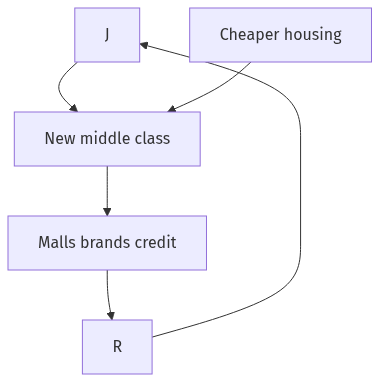
Offices, colleges, and hospitals in Tier 2 cities created salaried households beyond the old metros. Cheaper housing made apartments, vehicles, and private school feasible. Malls, multiplexes, and online retail taught a culture of display and credit. Spending then pulled more services into the same cities. Informal workers still stand outside that consuming public.
Model answer
Copper italics in this answer — like this — are the key facts. Each one is unpacked in the Facts & figures rail.
Introduction
Tier 2 cities grew as offices, colleges, hospitals, and logistics spread beyond the old metros. A new middle class formed there around salaries, English-medium schooling, and a culture that shows itself through consumption.
Body
How Tier 2 growth made a new middle class
- IT parks, banks, teaching hospitals, and retail chains in cities such as Pune’s wider region, Jaipur, Indore, Coimbatore, Kochi, and Lucknow created white-collar jobs outside Mumbai, Delhi, Kolkata, and Chennai cores.
- Cheaper land than the metro core allowed apartments, two-wheelers, and then cars, which are the first assets of a consuming middle class.
- Private schools, coaching, and malls clustered on the same ring roads, so status was bought as education and branded goods, not only as a government post.
- Return migrants and students who could not afford metro rents brought metro tastes home, which thickened local demand.
Culture of consumption
- Malls, multiplexes, cafes, and online marketplaces teach a lifestyle of choice, display, and credit cards rather than of joint-family thrift alone.
- Weddings, phones, and packaged food become public proof of having arrived, which sociologists call a consuming new middle class.
- Caste and region do not vanish; they are performed through housing societies, clubs, and branded dress in the same cities.
- Media and influencer culture make consumption a daily language of respectability for this class.
The link, with a limit
- Tier 2 growth supplies the jobs and rents that let this class exist; the class’s spending then pulls more retail, real estate, and services into those cities.
- A large informal workforce still serves the mall without entering the same consuming public, so the city’s growth is dual, not a single middle-class story.
Flow diagram
Conclusion
- Tier 2 cities and the new middle class grew together: jobs and cheaper housing created buyers, and a culture of malls, schooling, and brands marked belonging. Consumption is the badge of that class, not the whole of the city’s labour.
Quick related
Students also ask
-
Discuss the main contributions of Gupta period and Chola period to Indian heritage and culture.
Next question on this syllabus topic (2022 · Q12). View answer →
-
Is the new middle class only in metros?
No. Tier 2 growth is precisely where a larger consuming middle class became visible after the 1990s.
-
Does consumption erase caste?
It changes how status is shown. Housing and marriage markets in the same cities still carry caste.
Same topic · past papers
UPSC has asked this before
These previous-year questions sit on the same topic. Open one to practise the earlier ask.
More from this topic
Q11 · UPSC Mains 2026 · GS I · 15 marks · Solution
Vijayanagara architecture exemplifies the amalgamation of past traditions with contemporary practices. Elucidate with examples.
Indian Heritage and Culture
• The Vijayanagara architectural style (14th–17th centuries) brilliantly synthesized classical Dravidian traditions with contemporary Deccan innovations. • It preserved grand spatial layouts, towering gopurams, and enclosed prakaras inspired by earlier Chola and Pandya idioms. • Sacred centers maintained canonical sanctum alignments while expanding peripheral structures to encourage greater public participation. • Secular buildings, such as the Lotus Mahal and Elephant Stables, integrated Islamic arched vaults and domes. • Builders utilized locally available hard granite, shifting ornamentation techniques toward bold, deep-relief stone carving. • Innovative structural typologies included multi-shafted composite pillars featuring rearing yalis, horse riders, and hanging brackets. • The Vittalaswami Temple at Hampi showcased pioneering acoustic engineering through famous resonant musical pillars.
Q1 · UPSC Mains 2026 · GS I · 10 marks · Solution
Analyze the importance of Ashokan inscriptions for reconstructing Mauryan history.
Indian Heritage and Culture
Ashokan inscriptions serve as the bedrock for reconstructing Mauryan history by offering authentic, contemporaneous evidence directly from the emperor. Written primarily in Brahmi, Kharosthi, Aramaic, and Greek scripts, they illuminate Ashoka's administrative reach, socio-religious policies, and the moral framework of Dhamma. Distributed across the Indian subcontinent and beyond, these edicts document spatial boundaries, diplomatic ties with Hellenistic kingdoms, and the socio-economic milieu. They bridge the gap between literary accounts and archaeological finds, providing an invaluable indigenous chronology.
Q15 · UPSC Mains 2025 · GS I · 15 marks · Solution
How can Artificial Intelligence (AI) and drones be effectively used along with GIS and RS techniques in locational and areal planning?
Indian Heritage and Culture
Remote sensing supplies pictures of land and water; GIS stores them with administrative boundaries. Drones add cheap, repeatable local maps for disasters, utilities and village layouts. Artificial intelligence classifies pixels and can forecast flood, heat or sprawl on that GIS base. Indian platforms such as Bhuvan and Gati Shakti already try to combine these tools. Planning still needs ground checks and a public purpose, or the map only watches the poor. The four tools are a chain: locate, refresh, read, then choose the public use.