
Revision summary
IMD cyclone colours are Green, Yellow, Orange, and Red. Green means no special action; Yellow means watch and stay updated. Orange means prepare for flood, wind, and failed services. Red means take action, including evacuation of the vulnerable. The colours sit on a timed watch–alert–warning–outlook sequence for named coasts.
Model answer
Copper italics in this answer — like this — are the key facts. Each one is unpacked in the Facts & figures rail.
Introduction
The India Meteorological Department uses colour-coded warnings so coastal states can read cyclone risk at a glance. Green, Yellow, Orange, and Red are not decorations; they are graded orders to watch, prepare, or move.
Body
What the four colours mean
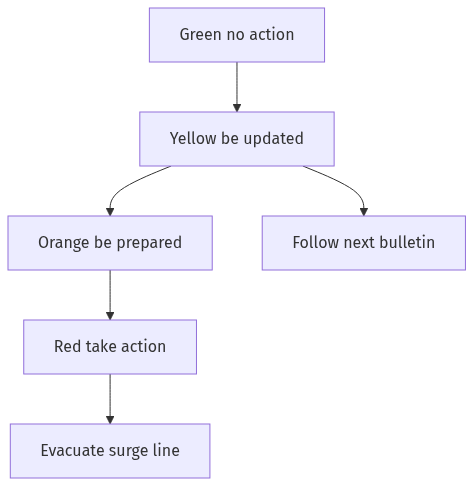
- Green means no cyclonic warning: the sea and coast are in a normal watch, and no special public action is required.
- Yellow means be updated: a watch is on, heavy rain or wind may hurt kutcha houses and low fields, and people should follow the next bulletins.
- Orange means be prepared: an alert that power, roads, and communications may fail, flooding is likely, and disaster units should stand ready.
- Red means take action: a warning of extreme rain and wind, likely extensive damage, and the need to evacuate vulnerable people from the surge line.
How IMD times the cyclone message
- A pre-cyclone watch is typically issued about seventy-two hours ahead, then a cyclone alert, a cyclone warning, and a post-landfall outlook as the storm nears and crosses.
- Colour on the map is tied to expected wind, rain, and storm surge for named coastal districts, not to a single national mood.
- Ports, fisheries, and railways use the same ladder so boats return, trains slow, and salt workers leave exposed bunds.
Why colour codes matter in cyclone belts
- Odisha, Andhra Pradesh, Tamil Nadu, West Bengal, Gujarat, and the island territories need a shared language that works on radio and phone when literacy and time are short.
- After the Super Cyclone of 1999, Odisha’s later success in storms such as Phailin (2013) showed that early colour-coded warning plus evacuation saves lives even when crops and huts still fall.
- The code is a public-safety tool; it does not itself stop the cyclone.
Flow diagram
Conclusion
IMD’s Green–Yellow–Orange–Red ladder tells cyclone coasts when to ignore, watch, prepare, or evacuate. The meaning is action, timed to the storm’s approach, not a forecast of zero damage once Red is hoisted.
Quick related
Students also ask
-
How is the growth of Tier 2 cities related to the rise of a new middle class with an emphasis on the culture of consumption?
Next question on this syllabus topic (2022 · Q9). View answer →
-
Does Red mean the cyclone will certainly destroy the city?
It means extreme risk and the duty to act. Damage still depends on surge, tide, and whether people leave the line.
-
Is this the same as a heatwave colour code?
The four colours are a shared IMD language. Thresholds differ for cyclone, rain, and heat; read the cyclone product for coasts.
Same topic · past papers
UPSC has asked this before
These previous-year questions sit on the same topic. Open one to practise the earlier ask.
More from this topic
Q11 · UPSC Mains 2026 · GS I · 15 marks · Solution
Vijayanagara architecture exemplifies the amalgamation of past traditions with contemporary practices. Elucidate with examples.
Indian Heritage and Culture
• The Vijayanagara architectural style (14th–17th centuries) brilliantly synthesized classical Dravidian traditions with contemporary Deccan innovations. • It preserved grand spatial layouts, towering gopurams, and enclosed prakaras inspired by earlier Chola and Pandya idioms. • Sacred centers maintained canonical sanctum alignments while expanding peripheral structures to encourage greater public participation. • Secular buildings, such as the Lotus Mahal and Elephant Stables, integrated Islamic arched vaults and domes. • Builders utilized locally available hard granite, shifting ornamentation techniques toward bold, deep-relief stone carving. • Innovative structural typologies included multi-shafted composite pillars featuring rearing yalis, horse riders, and hanging brackets. • The Vittalaswami Temple at Hampi showcased pioneering acoustic engineering through famous resonant musical pillars.
Q1 · UPSC Mains 2026 · GS I · 10 marks · Solution
Analyze the importance of Ashokan inscriptions for reconstructing Mauryan history.
Indian Heritage and Culture
Ashokan inscriptions serve as the bedrock for reconstructing Mauryan history by offering authentic, contemporaneous evidence directly from the emperor. Written primarily in Brahmi, Kharosthi, Aramaic, and Greek scripts, they illuminate Ashoka's administrative reach, socio-religious policies, and the moral framework of Dhamma. Distributed across the Indian subcontinent and beyond, these edicts document spatial boundaries, diplomatic ties with Hellenistic kingdoms, and the socio-economic milieu. They bridge the gap between literary accounts and archaeological finds, providing an invaluable indigenous chronology.
Q15 · UPSC Mains 2025 · GS I · 15 marks · Solution
How can Artificial Intelligence (AI) and drones be effectively used along with GIS and RS techniques in locational and areal planning?
Indian Heritage and Culture
Remote sensing supplies pictures of land and water; GIS stores them with administrative boundaries. Drones add cheap, repeatable local maps for disasters, utilities and village layouts. Artificial intelligence classifies pixels and can forecast flood, heat or sprawl on that GIS base. Indian platforms such as Bhuvan and Gati Shakti already try to combine these tools. Planning still needs ground checks and a public purpose, or the map only watches the poor. The four tools are a chain: locate, refresh, read, then choose the public use.