
Revision summary
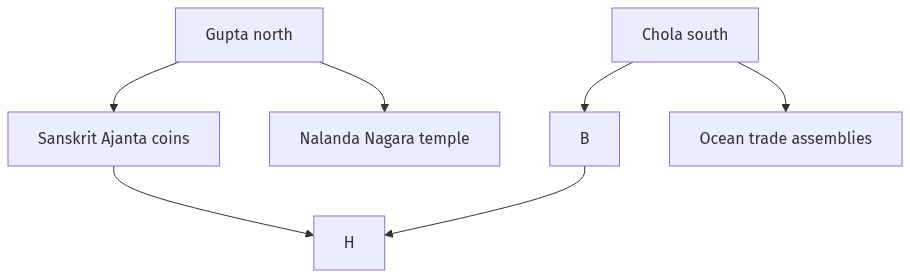
Gupta culture set Sanskrit classicism, Ajanta painting, Sarnath sculpture, and early Nagara temples. Aryabhata, Nalanda, and gold coins mark science, learning, and royal image. Chola culture set the Thanjavur-type vimana, Nataraja bronzes, and inscribed local assemblies. Chola sea power carried Tamil Saiva forms into the Indian Ocean world. The two ages are complementary regional canons, not rivals for a single capital.
Model answer
Copper italics in this answer — like this — are the key facts. Each one is unpacked in the Facts & figures rail.
Introduction
The Gupta age in the north and the Chola age in the south are two high watermarks of classical Indian culture. One set the Sanskrit, coin, and early Nagara temple template; the other set the Dravida imperial temple, bronze, and Indian Ocean reach.
Body
Gupta letters, thought, and science
- Kalidasa’s plays and poems, and a wider Sanskrit court culture, gave later India its classical literary standard.
- The Gupta period saw Aryabhata’s astronomy and mathematics, including place-value work associated with the zero tradition, which later travelled with Indian numerals.
- Nalanda grew as a mahavihara of Buddhist learning, while Brahmanical smriti and Puranic Hinduism also thickened in the same centuries.
- Ajanta’s later caves preserve painting of courtly and Buddhist narrative that still defines Indian mural memory.
- Gold coins with king and goddess types advertised a stable, literate monarchy and a visual language of Lakshmi and the lyrist king.
Gupta art, temple, and polity as culture
- The Sarnath seated Buddha and related sculpture set a calm, translucent classical style.
- Early structural temples such as the Dashavatara at Deogarh show the Nagara tower in formation, which north Indian sacred architecture then followed.
- The Mehrauli iron pillar, associated with a Gupta or immediately later court, displays metallurgical skill as public heritage.
- Land grants to brahmanas and temples spread Sanskritic culture into the countryside, so heritage was an administrative project as well as an aesthetic one.
Chola temple, bronze, and local culture
- Rajaraja I’s Brihadisvara at Thanjavur and Rajendra I’s Gangaikonda Cholapuram made the imperial Dravida vimana a state monument and a social archive of dance, gift, and staff.
- Chola Nataraja and related bronzes, using the lost-wax method, are among the world’s great sacred sculptures and still shape how Nataraja is seen.
- Temple walls and inscriptions record ur, sabha, and nagaram assemblies, so Chola culture includes a documented local self-government around the shrine.
- Painting and sculpture in these temples, and the Tamil bhakti canon already in liturgical use, made the Kaveri delta a living religious public.
Chola ocean and the two ages together
- Chola naval expeditions and trade toward Sri Lanka and South-East Asia carried Saiva temples, Tamil merchants, and Indian iconography abroad.
- Gupta heritage is the north Indian classical package of Sanskrit, coin, cave, and early stone temple; Chola heritage is the south Indian imperial temple-bronze-assembly-ocean package.
- Indian culture after both ages treated these forms as canons to copy, not as closed museums.
Flow diagram
Conclusion
Guptas gave India a classical Sanskrit, scientific, coin, and early Nagara-Buddhist visual order. Cholas gave the Dravida imperial temple, bronze, inscribed local assemblies, and an Indian Ocean cultural reach. Together they are two regional peaks of one civilisational stock.
Quick related
Students also ask
-
Discuss the significance of the lion and bull figures in Indian mythology, art and architecture.
Next question on this syllabus topic (2022 · Q13). View answer →
-
Were the Guptas and Cholas contemporaries?
No. The Gupta high period is about the fourth–sixth centuries; imperial Cholas peak around the tenth–twelfth.
-
Is Ajanta only Gupta?
Caves span centuries. Later painted caves are a Gupta-age contribution to that longer Buddhist site.
Same topic · past papers
UPSC has asked this before
These previous-year questions sit on the same topic. Open one to practise the earlier ask.
-
2018 · Q1 · GS I · 10 marks
Safeguarding the Indian art heritage is the need of the moment. Comment.
More from this topic
Q11 · UPSC Mains 2026 · GS I · 15 marks · Solution
Vijayanagara architecture exemplifies the amalgamation of past traditions with contemporary practices. Elucidate with examples.
Indian Heritage and Culture
• The Vijayanagara architectural style (14th–17th centuries) brilliantly synthesized classical Dravidian traditions with contemporary Deccan innovations. • It preserved grand spatial layouts, towering gopurams, and enclosed prakaras inspired by earlier Chola and Pandya idioms. • Sacred centers maintained canonical sanctum alignments while expanding peripheral structures to encourage greater public participation. • Secular buildings, such as the Lotus Mahal and Elephant Stables, integrated Islamic arched vaults and domes. • Builders utilized locally available hard granite, shifting ornamentation techniques toward bold, deep-relief stone carving. • Innovative structural typologies included multi-shafted composite pillars featuring rearing yalis, horse riders, and hanging brackets. • The Vittalaswami Temple at Hampi showcased pioneering acoustic engineering through famous resonant musical pillars.
Q1 · UPSC Mains 2026 · GS I · 10 marks · Solution
Analyze the importance of Ashokan inscriptions for reconstructing Mauryan history.
Indian Heritage and Culture
Ashokan inscriptions serve as the bedrock for reconstructing Mauryan history by offering authentic, contemporaneous evidence directly from the emperor. Written primarily in Brahmi, Kharosthi, Aramaic, and Greek scripts, they illuminate Ashoka's administrative reach, socio-religious policies, and the moral framework of Dhamma. Distributed across the Indian subcontinent and beyond, these edicts document spatial boundaries, diplomatic ties with Hellenistic kingdoms, and the socio-economic milieu. They bridge the gap between literary accounts and archaeological finds, providing an invaluable indigenous chronology.
Q15 · UPSC Mains 2025 · GS I · 15 marks · Solution
How can Artificial Intelligence (AI) and drones be effectively used along with GIS and RS techniques in locational and areal planning?
Indian Heritage and Culture
Remote sensing supplies pictures of land and water; GIS stores them with administrative boundaries. Drones add cheap, repeatable local maps for disasters, utilities and village layouts. Artificial intelligence classifies pixels and can forecast flood, heat or sprawl on that GIS base. Indian platforms such as Bhuvan and Gati Shakti already try to combine these tools. Planning still needs ground checks and a public purpose, or the map only watches the poor. The four tools are a chain: locate, refresh, read, then choose the public use.