
Revision summary
ST is a constitutional list under Article 342, not a defined scientific type. Lokur criteria: primitive traits, distinctive culture, isolation, shyness, backwardness. They fail urban and mining STs, insult communities, and overlap other backwardness lists. State-wise lists and court limits on portability create border anomalies. Xaxa, PESA, FRA and Niyamgiri treat tribe as a rights-bearing community, which is the better concept.
Model answer
Copper italics in this answer — like this — are the key facts. Each one is unpacked in the Facts & figures rail.
Introduction
Scheduled Tribe is a constitutional and administrative name, not a scientific species. Anthropology’s tribe is a type of society — often kin-based, historically outside or beside caste — that never matched the list one-for-one. The gap between concept and criteria is the question.
Body
Concept
Colonial ethnography (Risley, Elwin, Ghurye, Hutton) argued over isolation, animism and “backward Hindu”. Article 342 lets the President, after consultation, specify STs for a state; Parliament amends the list. The word in the Constitution is not defined by a section of traits. Article 366(25) only points back to the specified list. Fifth and Sixth Schedules add area to people.
Anthropologically, Indian “tribes” include foragers, jhum cultivators, peasants and urban workers. Bailey’s continuum and Sinha’s tribe-caste already said the boundary is historical.
Administrator’s criteria
- The Lokur Committee (1965) criteria, still the administrative gospel, are: indication of primitive traits, distinctive culture, geographical isolation, shyness of contact, and backwardness. The Xaxa Committee (2014) quoted them and showed how they insult and misfire. Earlier, the Dhebar Commission (1960–61) and Renuka Ray, and later Bhuria, talked of development and autonomy more than of “shyness”.
- Listing is political: a community is ST in one state and OBC or unlisted across the border (Gonds, Bhils, tea-tribes of Assam). PVTGs are a further administrative layer inside ST, born from Dhebar’s primitive tribal groups.
Limitations
- Primitive traits is a colonial leftover. A laptop and a clan god can sit in one house.
- Isolation fails for tea-garden, mining and city STs. Shyness pathologises people who avoid a hostile thana.
- Distinctive culture is real but not unique to STs; every jati claims it.
- Backwardness overlaps OBC and SC. It cannot tell a tribe from a caste by itself.
- State-specific lists create border injustice. Courts have generally refused to let a person carry ST status across states as a personal portable race (Marri Chandra Shekhar Rao; later Bir Singh on similar SC/ST portability logic).
- Inclusion politics: groups campaign with dressed folklore. Nomenclature fights (tea tribes, Gorkha, some Rajasthan claims) show criteria cannot be applied like a blood test.
- FRA and PESA need a territorial community; a listed ST in a city may have the certificate and not the forest.
Samata, Niyamgiri (Orissa Mining Corporation, 2013) and Wildlife First FRA litigation show that the live legal tribe is a community with Gram Sabha and hill or forest rights, which Lokur’s adjectives never described.
Xaxa asked to drop “primitive” and to use livelihood, historical injustice, relative isolation where it exists, and self-identification with safeguards against fraud. The administrator’s five tests remain because they are easy to photocopy, not because they are true.
Flow diagram
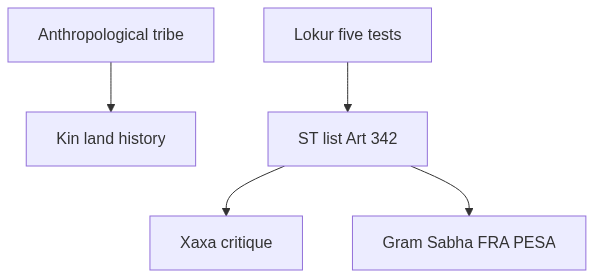
Conclusion
Tribe in anthropology is a social-historical formation. ST in law is a list under Article 342. Lokur’s five tests are narrow, colonial and unevenly applied. Courts and Xaxa point toward community, history and area, not shyness.
Quick related
Students also ask
-
Tribalism and Pseudotribalism
Next question on this syllabus topic (2025 · Q5(c)). View answer →
-
Can the Court declare a community ST?
It can police the process and rights, but the list itself is an Article 342 political-legal act, not a judicial caste census.
-
Are all tribals Scheduled Tribes?
No. Some communities are tribally organised in ethnography but unlisted, or listed only in some states.
Same topic · past papers
UPSC has asked this before
These previous-year questions sit on the same topic. Open one to practise the earlier ask.
-
2025 · Q7(a) · Anthropology GS 2 · 20 marks
Identify the contemporary limitations in the process of tribal development. How can anthropological knowledge contribute in this process? -
2016 · Q5(c) · Anthropology GS 2 · 10 marks
Impact of industrialization on scheduled tribe population of Jharkhand -
2026 · Q7(c) · Anthropology GS 2 · 15 marks
Write an account on Development Action Plan for Scheduled Tribes (DAPST) -
2025 · Q2(c) · Anthropology GS 2 · 15 marks
Evaluate the impact of Christianity on Scheduled Tribe societies of North-East India -
2022 · Q7(b) · Anthropology GS 2 · 15 marks
Discuss the issues and solutions related to the Scheduled Caste and the Scheduled Tribe populations in India
More from this topic
Q6(a) · UPSC Mains 2026 · Anthropology GS 2 · 20 marks · Solution
Make a critical appraisal of the mesolithic culture of Ganga basin with reference to artifacts, faunal and human skeletal remains excavated from different sites
Evolution of the Indian Culture and Civilization
• Ganga basin Mesolithic sites like Sarai Nahar Rai, Mahadaha, and Damd
Q5(e) · UPSC Mains 2026 · Anthropology GS 2 · 10 marks · Solution
Contribution of L. K. Ananthakrishna Iyer in Anthropology.
Evolution of the Indian Culture and Civilization
L. K. Ananthakrishna Iyer is a pioneering figure in Indian anthropology, known for his monumental ethnographic surveys like The Cochin Tribes and Castes and The Mysore Tribes and Castes. Working during the colonial era, he bridged western anthropological methods with indigenous scholarship. His documentation of social stratification, material culture, and folklore laid the empirical foundation for Indian sociology and anthropology. Iyer also established the first department of anthropology in India at the University of Calcutta, shaping institutional teaching and research.
Q5(c) · UPSC Mains 2026 · Anthropology GS 2 · 10 marks · Solution
Article 371A of the Indian Constitution.
Evolution of the Indian Culture and Civilization
Article 371A of the Indian Constitution grants special autonomous status to Nagaland, protecting its traditional socio-religious practices, customary laws, and land ownership rights. Enacted via the 13th Constitutional Amendment Act, 1962, following the 16-point Agreement, it reflects the asymmetrical federal framework of India. The article places a special responsibility on the Governor regarding law and order and regional financial allocations. It balances tribal autonomy with national integration, though it faces implementation challenges in modern governance.