
Revision summary
Upper Palaeolithic India is a late Pleistocene blade, burin and ornament phase between Middle Palaeolithic and Mesolithic. Patne ostrich-eggshell beads and Baghor’s ritual stone are distinctive behavioural finds. Distribution: Maharashtra–Madhya Pradesh–Uttar Pradesh valleys, Kurnool caves, some Thar–Gujarat and southern sites. Authors are generally taken as Homo sapiens; skeletal proof is scarce. The phase grades into microlithic industries and must be dated site by site.
Model answer
Copper italics in this answer — like this — are the key facts. Each one is unpacked in the Facts & figures rail.
Introduction
The Upper Palaeolithic in India is the late Pleistocene blade-and-burin horizon that sits after Middle Palaeolithic prepared-core industries and before the full microlithic Mesolithic. It is patchy compared with Europe, but it is no longer a missing chapter.
Body
Distinctive features
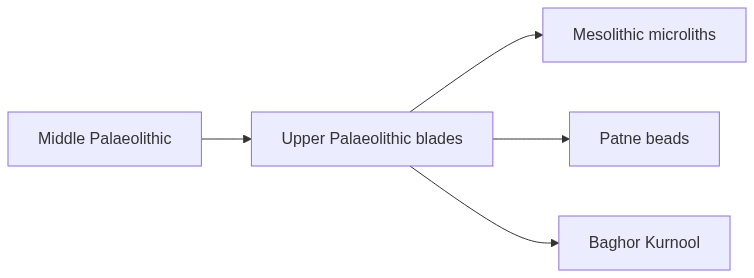
Technologically the phase is marked by punched or pressure blades, bladelets, burins, backed tools, scrapers and points, sometimes on chert, chalcedony and crystal. Bone tools are rare but reported. Ostrich eggshell beads (Patne and related western Indian finds) are a behavioural marker of ornament. Some workers link rock art beginnings and ochre use to this horizon, though much Indian rock art is later.
Settlement is often open-air, in river valleys, dune edges and rock shelters (Kurnool caves, Bhimbetka sequence). Groups were still foragers. The phase overlaps the Toba debate and the spread of Homo sapiens into South Asia; Indian Upper Palaeolithic is usually read as modern human, not Neanderthal, though skeletal proof is thin.
Dates commonly cited fall in the late Pleistocene, roughly 40,000–10,000 years ago, with some blade industries argued earlier at sites such as Mehtakheri. Chronology is site-specific.
Distribution
- Western and central India: Patne (Maharashtra) for eggshell beads; Bhimbetka and neighbouring Vindhyan shelters; Baghor (Son valley, Madhya Pradesh) with a possible stone shrine or triangular plaque that Kenoyer, Clark and Pal discussed as ritual.
- Eastern and southern: Kurnool caves (Andhra) bone and stone; parts of the Belan and Son valleys (Uttar Pradesh–Madhya Pradesh) in the Allahabad–G. R. Sharma tradition; Jwalapuram related Late Pleistocene sequences in Andhra (more famous for Middle Palaeolithic around Toba).
- North-west: blade elements in some Thar and Gujarat contexts (Visadi, dune sites).
- Sri Lanka and Nepal have related late Pleistocene hunter-gatherer records that help frame the peninsula.
H. D. Sankalia, V. N. Misra, J. N. Pal, M. L. K. Murty and S. Pappu are the names that moved the phase from a European copy to an Indian sequence.
Limits
Many so-called Upper Palaeolithic collections grade into microlithic Mesolithic. Some blade industries may be Middle Palaeolithic variants. Art is hard to date. The distribution is real but uneven: it is denser where quartz and chert and shelters coincide, not a uniform national “culture”.
Flow diagram
Conclusion
Indian Upper Palaeolithic is a late Pleistocene blade–burin and ornament horizon, best seen at Patne, Baghor, Kurnool and related valleys. It marks modern-human behaviour in the peninsula without copying the European cave story term for term.
Quick related
Students also ask
-
Critically examine the concept of Scheduled Tribe (ST) and mention the limitations of administrator's criteria
Next question on this syllabus topic (2025 · Q4(c)). View answer →
-
Is Indian Upper Palaeolithic the same as the European one?
It shares blades, burins and ornaments, not the same cave-art sequence or the same named cultures (Aurignacian, Gravettian).
-
Did it begin only after 40,000 years ago?
That is the usual teaching window. Some blade sites are argued earlier. Each date needs its own stratigraphy.
Same topic · past papers
UPSC has asked this before
These previous-year questions sit on the same topic. Open one to practise the earlier ask.
-
2021 · Q2(b) · Anthropology GS 2 · 15 marks
Give the distribution and characteristic features of Upper Paleolithic culture in India
More from this topic
Q6(a) · UPSC Mains 2026 · Anthropology GS 2 · 20 marks · Solution
Make a critical appraisal of the mesolithic culture of Ganga basin with reference to artifacts, faunal and human skeletal remains excavated from different sites
Evolution of the Indian Culture and Civilization
• Ganga basin Mesolithic sites like Sarai Nahar Rai, Mahadaha, and Damd
Q5(e) · UPSC Mains 2026 · Anthropology GS 2 · 10 marks · Solution
Contribution of L. K. Ananthakrishna Iyer in Anthropology.
Evolution of the Indian Culture and Civilization
L. K. Ananthakrishna Iyer is a pioneering figure in Indian anthropology, known for his monumental ethnographic surveys like The Cochin Tribes and Castes and The Mysore Tribes and Castes. Working during the colonial era, he bridged western anthropological methods with indigenous scholarship. His documentation of social stratification, material culture, and folklore laid the empirical foundation for Indian sociology and anthropology. Iyer also established the first department of anthropology in India at the University of Calcutta, shaping institutional teaching and research.
Q5(c) · UPSC Mains 2026 · Anthropology GS 2 · 10 marks · Solution
Article 371A of the Indian Constitution.
Evolution of the Indian Culture and Civilization
Article 371A of the Indian Constitution grants special autonomous status to Nagaland, protecting its traditional socio-religious practices, customary laws, and land ownership rights. Enacted via the 13th Constitutional Amendment Act, 1962, following the 16-point Agreement, it reflects the asymmetrical federal framework of India. The article places a special responsibility on the Governor regarding law and order and regional financial allocations. It balances tribal autonomy with national integration, though it faces implementation challenges in modern governance.