
Revision summary
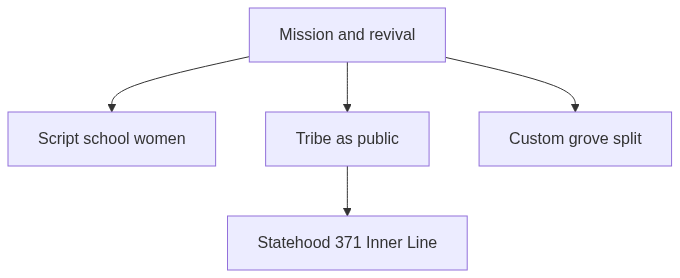
Baptist, Presbyterian and Catholic missions, then local revivals, planted Christianity in many NE ST hills. Gains include Roman-script literacy, women’s education, peace brokering and a middle class using 371 and Inner Line. Strains include pressure on morung and grove, denominational factions, and distance between church elite and jhum households. The church is now indigenous social structure, not a foreign camp. Land rights still run through custom, Inner Line, FRA and councils, not through the pulpit.
Model answer
Copper italics in this answer — like this — are the key facts. Each one is unpacked in the Facts & figures rail.
Introduction
Christianity among Scheduled Tribes of North-East India is a social conversion as much as a creedal one. It arrived with Baptist, Presbyterian, Catholic and later independent missions from the nineteenth century, and it now shapes Naga, Mizo, Khasi, Garo, some Adi and other hill societies. Evaluation means both the school and the split in the village.
Body
Historical paths
American Baptists among Nagas and Garos, Welsh Presbyterians in the Khasi-Jaintia and Mizo hills, and Catholics in parts of Nagaland, Manipur and Arunachal built scripts, hymns and hostels. Mizo revival (1906 and after) and the Naga Baptist network tied church to tribe. In Arunachal the process is later and uneven: Buddhist belts in the west, Christian growth in some central and eastern districts, still politically sensitive.
Mission was never only foreign. Local catechists, women teachers and youth associations made the church a tribal public.
Gains
Literacy in Roman script, especially Mizo and some Naga languages, ran ahead of many plains districts. Women entered schools earlier than in neighbouring caste societies. Church organisations provided a civil society that later fed statehood movements (Nagaland 1963, Mizoram peace 1986). A common Christian identity sometimes eased clan feud, as Mizo historians argue for the end of raiding. Public health and temperance campaigns, however moralising, cut some forms of ritual drinking.
Politically, churches have been brokers in peace talks. They also run schools that feed the Indian university system, producing an ST middle class that uses reservation, Article 371A/G, Inner Line and Sixth Schedule with confidence.
Strains
Customary law on marriage, bridewealth and clan land sits uneasily with Christian personal ethics and with a Uniform Civil Code debate. Sacred groves and morung lost ground where the church called them pagan; revival and cultural boards now try to restage them as heritage. Intra-tribal denominational splits (Baptist versus Catholic versus revival sects) can map onto village factions.
- Land: mission compounds were small; the larger issue is non-tribal traders and plantation capital behind the Inner Line, not the pastor. Still, a salaried church elite can distance itself from jhum cultivators.
- The Indian state often reads hill Christianity through security: Nagaland insurgency, Manipur hill–valley conflict, conversions debates in Arunachal. That reading hides ordinary village Christianity — Sunday school, burial, youth choir — which is now as indigenous as wet-rice.
Xaxa Committee asked that development not treat tribe as a religious problem. Forest Rights Act and village councils remain the land tools; church is not a substitute Gram Sabha.
Flow diagram
Conclusion
Christianity in the North-Eastern ST hills built literacy, women’s schooling and a political public, and it strained custom, grove and clan. It is now a local tradition among others. Evaluation should follow village land and school, not a census panic about conversion.
Quick related
Students also ask
-
Critically assess the impact of Christianity on tribal culture and identity
Next question on this syllabus topic (2021 · Q3(c)). View answer →
-
Did Christianity abolish tribe?
No. It often re-coded tribe as a Baptist or Presbyterian nation, which is why Naga and Mizo identity grew with the church, not against it.
-
Is Arunachal the same as Mizoram?
No. Mizoram is overwhelmingly Christian. Arunachal remains religiously mixed, with strong Buddhist and indigenous ritual belts and a later, contested Christian presence.
Same topic · past papers
UPSC has asked this before
These previous-year questions sit on the same topic. Open one to practise the earlier ask.
-
2025 · Q7(c) · Anthropology GS 2 · 15 marks
Critically evaluate the concept of Nation-State and describe its impact on indigenous societies -
2023 · Q8(b) · Anthropology GS 2 · 15 marks
Critically evaluate the contributions of S.C. Roy to Indian anthropology.
More from this topic
Q3(b) · UPSC Mains 2026 · Anthropology GS 2 · 15 marks · Solution
Discuss the impact of Christianity on the tribal population of Jharkhand
Impact of Hinduism, Buddhism, Christianity, Islam and other religions on tribal societies.
Christian missionaries arrived in mid-19th century Chota Nagpur, profoundly transforming Jharkhand's indigenous societies. They established village schools and elite institutions like St. Xavier's, which drastically improved tribal literacy rates. Western medicine and hospitals were introduced, replacing traditional healing systems and curbing endemic diseases. Conversion to Christianity often meant abandoning Sarnaism, creating a lasting socio-religious divide among tribals. Missionaries also provided crucial legal advocacy against exploitative moneylenders, helping shape the Chota Nagpur Tenancy Act of 1908. Access to education created an educated tribal middle class that later led political movements for regional autonomy. Ultimately, Christianity acted as a dual catalyst for structural modernization and complex cultural identity shifts.
Q3(c) · UPSC Mains 2021 · Anthropology GS 2 · 15 marks · Solution
Critically assess the impact of Christianity on tribal culture and identity
Impact of Hinduism, Buddhism, Christianity, Islam and other religions on tribal societies.
Missions cut some brew, hunt, and ancestor rites. Schools and scripture created a literate tribal public. Naga and Chotanagpur cases show church fused with clan politics. Converts and non-converts may split the same tribe. Legal ST status and Christian census religion can sit together.
Q3(b) · UPSC Mains 2015 · Anthropology GS 2 · 15 marks · Solution
Discuss the impact of Hinduism on the status of tribal women in Central India
Impact of Hinduism, Buddhism, Christianity, Islam and other religions on tribal societies.
Hindu contact in Central India often means Sanskritisation of Gond and Bhil groups. Srinivas’s model predicts purity, dowry, and curbs on widow remarriage. Elwin warned that tribal women’s customary freedoms would shrink. Ghurye treated the same process as Hindu absorption. Forest work and FRA still keep women economically central.