
Revision summary
State societies have central offices, territory and surplus extraction beyond kinship. Service and Fried staged the move from tribe and chiefdom to state; Childe linked it to urban surplus. Carneiro stressed warfare and circumscription; hydraulic theories over-fit India. Rakhigarhi and other Harappan cities show urban organisation; Magadha shows a clearer early state. Hill and forest polities in India often remained chiefly or acephalous until colonial mapping.
Model answer
Copper italics in this answer — like this — are the key facts. Each one is unpacked in the Facts & figures rail.
Introduction
State societies are polities with a centralised, specialised authority that can extract surplus, settle disputes beyond kinship, and claim a territory. Anthropology asks how that form arose from bands, tribes and chiefdoms, not only who the first king was.
Body
Theories of origin
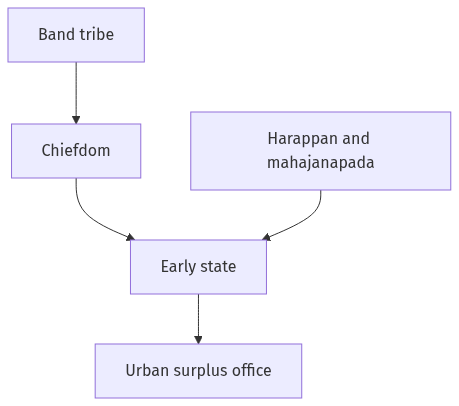
Elman Service and Morton Fried staged bands, tribes, chiefdoms and states. A chiefdom still rests on kinship rank; a state has offices that outlast a lineage. V. Gordon Childe linked the state to the urban revolution: surplus, writing, specialists and monumental centres. Karl Wittfogel over-stressed irrigation (“hydraulic”) despotism; Indian monsoon agriculture does not require that single cause. Robert Carneiro argued that circumscription and warfare concentrate power. Maurice Godelier and Marxist anthropologists treated the state as control of surplus and ideology together.
Henri Claessen and Peter Skalník described the early state as a transitional type: sacral kingship, tribute, and incomplete bureaucracy. Pierre Clastres warned that some Amazonian societies actively prevented the state; the origin is not an inevitable climb.
Indian illustrations
Harappan cities — Rakhigarhi, Mohenjo-daro, Harappa, Dholavira — show urban planning, craft specialisation and long-distance trade without a palatial text that names a king. That is a state-level organisation whose political form is still argued. Later mahajanapadas, Magadha and the Mauryan empire fit Fried’s state more clearly: tax, army, and dharma as public ideology.
Tribal India supplies the other end. Nuer segmentary opposition (Evans-Pritchard) and many Indian hill polities remained acephalous or chiefly. S. C. Roy on the Mundas and Verrier Elwin on NEFA described headmanship and khuntkatti without a territorial bureaucracy. Colonial ethnography then made a state by mapping tribes onto districts.
Caution
No single cause — irrigation, trade, conquest or religion — explains every origin. Indian evidence favours multiple pathways: Bronze Age urbanism in the north-west, iron-age territorial kingdoms in the Ganga plain, and delayed or resisted state formation in forest and hill tracts.
Flow diagram
Conclusion
The origin of state societies is the appearance of durable, surplus-extracting offices beyond kinship. Service, Fried, Childe and Carneiro give the toolkit. Harappan cities and later mahajanapadas illustrate it in India; many tribal polities show that the state is not universal or automatic.
Quick related
Students also ask
-
Syro-Malabar Christians
Next question on this syllabus topic (2024 · Q1(c)). View answer →
-
Is every civilisation a state?
Urbanism and a state often travel together, but archaeologists still argue whether Harappan authority was palatial, corporate or priestly.
-
Did all Indian tribes lack a state?
Many were acephalous or chiefly. Some, such as later Ahom or Gond polities, built kingdoms. The label tribe is not a stage of incapacity.
Same topic · past papers
UPSC has asked this before
These previous-year questions sit on the same topic. Open one to practise the earlier ask.
-
2021 · Q2(a) · Anthropology GS 2 · 20 marks
Critically discuss the origin of Indus Valley Civilization. Mention the evidences of its endogenous origin from the pre-Harappan sites
More from this topic
Q6(a) · UPSC Mains 2026 · Anthropology GS 2 · 20 marks · Solution
Make a critical appraisal of the mesolithic culture of Ganga basin with reference to artifacts, faunal and human skeletal remains excavated from different sites
Evolution of the Indian Culture and Civilization
• Ganga basin Mesolithic sites like Sarai Nahar Rai, Mahadaha, and Damd
Q5(e) · UPSC Mains 2026 · Anthropology GS 2 · 10 marks · Solution
Contribution of L. K. Ananthakrishna Iyer in Anthropology.
Evolution of the Indian Culture and Civilization
L. K. Ananthakrishna Iyer is a pioneering figure in Indian anthropology, known for his monumental ethnographic surveys like The Cochin Tribes and Castes and The Mysore Tribes and Castes. Working during the colonial era, he bridged western anthropological methods with indigenous scholarship. His documentation of social stratification, material culture, and folklore laid the empirical foundation for Indian sociology and anthropology. Iyer also established the first department of anthropology in India at the University of Calcutta, shaping institutional teaching and research.
Q5(c) · UPSC Mains 2026 · Anthropology GS 2 · 10 marks · Solution
Article 371A of the Indian Constitution.
Evolution of the Indian Culture and Civilization
Article 371A of the Indian Constitution grants special autonomous status to Nagaland, protecting its traditional socio-religious practices, customary laws, and land ownership rights. Enacted via the 13th Constitutional Amendment Act, 1962, following the 16-point Agreement, it reflects the asymmetrical federal framework of India. The article places a special responsibility on the Governor regarding law and order and regional financial allocations. It balances tribal autonomy with national integration, though it faces implementation challenges in modern governance.