
Revision summary
Digitisation of the rural economy means electronic payments, identity, credit, markets and welfare records in the village. Jan Dhan, Aadhaar, UPI, e-NAM and computerised land records are the main instruments. Village power now includes control of phones, OTPs and Common Service Centres. Women, elderly people and many tribal hamlets remain excluded where biometrics and language fail. Without PESA and secure titles, digital records can lock in older dispossession.
Model answer
Copper italics in this answer — like this — are the key facts. Each one is unpacked in the Facts & figures rail.
Introduction
Digitisation of the rural economy is the shift of village production, exchange, credit and welfare onto electronic records, phones and bank platforms. It is not only a technical upgrade. It reorders who can sell, who can prove identity, and who still depends on the old middleman.
Body
What has been digitised
After the 2010s, Jan Dhan accounts, Aadhaar authentication, Direct Benefit Transfer, UPI payments, e-NAM and state e-procurement, land-record computerisation, Kisan credit on core banking, and e-Shram or MGNREGA electronic muster rolls became ordinary rural infrastructure. Common Service Centres and banking correspondents sit in the same space as the kirana shop. NITI and ministry dashboards treat this as financial inclusion.
For anthropology the village is still a social system. M. N. Srinivas’s dominant caste and F. G. Bailey’s faction now operate through who owns the smartphone, the SIM in a woman’s name, and the password for the PDS or pension app. McKim Marriott’s little tradition meets a national payment grid.
Effects on livelihood and power
Cashless procurement and DBT can cut leakage that André Béteille and later political economists associated with local brokers. A tribal tendu or lac seller who is paid into an account is less easily short-changed at the weekly hat, if she can read the SMS. Contract farming and warehouse receipts, however, still favour literate, landed households. L. P. Vidyarthi’s nature–man–spirit complex is strained when forest produce is invoiced on a portal that the Gram Sabha does not control.
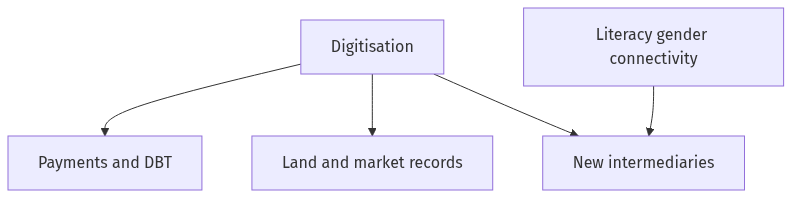
- Digitisation also creates new intermediaries: the Common Service Centre operator, the cyber-cafe, the relative who “helps” with OTP. Women and older Adivasis often hand the phone to a male kin. Irawati Karve’s kinship map still predicts who holds the device.
Limits
Connectivity, biometric failure (especially among elderly and manual workers), and English or Hindi interfaces exclude many Scheduled Tribe hamlets. Land records that are wrong on paper become wrong at speed once they are online. A purely digital rural economy without PESA Gram Sabha oversight and without FRA titles can freeze dispossession rather than reverse it.
Flow diagram
Conclusion
Digitisation has entered rural production and welfare as a new layer of the village system. It can reduce some older leakages, but it does not abolish caste, gender or literacy as gates. Inclusion is a social outcome, not an automatic result of a payment app.
Quick related
Students also ask
-
Origin of State Societies
Next question on this syllabus topic (2024 · Q1(b)). View answer →
-
Does digitisation end the village moneylender?
Formal credit has expanded, but informal lenders remain where documents, collateral and digital literacy are weak.
-
Is a digital land record always more just?
Only if the underlying title is correct and the Gram Sabha can contest errors. A wrong survey digitised is still a wrong survey.
Same topic · past papers
UPSC has asked this before
These previous-year questions sit on the same topic. Open one to practise the earlier ask.
-
2021 · Q8(a) · Anthropology GS 2 · 20 marks
Examine how structural transformation in economy is affecting traditional social relationships in agrarian society -
2015 · Q6(b) · Anthropology GS 2 · 15 marks
Discuss the impact of globalization on village economy in India
More from this topic
Q6(a) · UPSC Mains 2026 · Anthropology GS 2 · 20 marks · Solution
Make a critical appraisal of the mesolithic culture of Ganga basin with reference to artifacts, faunal and human skeletal remains excavated from different sites
Evolution of the Indian Culture and Civilization
• Ganga basin Mesolithic sites like Sarai Nahar Rai, Mahadaha, and Damd
Q5(e) · UPSC Mains 2026 · Anthropology GS 2 · 10 marks · Solution
Contribution of L. K. Ananthakrishna Iyer in Anthropology.
Evolution of the Indian Culture and Civilization
L. K. Ananthakrishna Iyer is a pioneering figure in Indian anthropology, known for his monumental ethnographic surveys like The Cochin Tribes and Castes and The Mysore Tribes and Castes. Working during the colonial era, he bridged western anthropological methods with indigenous scholarship. His documentation of social stratification, material culture, and folklore laid the empirical foundation for Indian sociology and anthropology. Iyer also established the first department of anthropology in India at the University of Calcutta, shaping institutional teaching and research.
Q5(c) · UPSC Mains 2026 · Anthropology GS 2 · 10 marks · Solution
Article 371A of the Indian Constitution.
Evolution of the Indian Culture and Civilization
Article 371A of the Indian Constitution grants special autonomous status to Nagaland, protecting its traditional socio-religious practices, customary laws, and land ownership rights. Enacted via the 13th Constitutional Amendment Act, 1962, following the 16-point Agreement, it reflects the asymmetrical federal framework of India. The article places a special responsibility on the Governor regarding law and order and regional financial allocations. It balances tribal autonomy with national integration, though it faces implementation challenges in modern governance.