
Revision summary
Ethno-nationalism is the political claim of an ethnic people to a state or autonomy. Geertz (primordial attachment), Barth (boundary) and Brass (elites) are the core lens. Resurgence follows weakened class ideology, census-media numbers, resource conflicts and indigenous world talk. Indian cases include Naga, Mizo, Bodo, Gorkha, Jharkhand, linguistic nativism and majoritarian fusion with religion. It can defend language and land; it can also create inner minorities.
Model answer
Copper italics in this answer — like this — are the key facts. Each one is unpacked in the Facts & figures rail.
Introduction
Ethno-nationalism is the claim that a people defined by ethnicity — language, tribe, religion as descent, or a named history — ought to have a state, or a state-like autonomy. Anthropology treats it as a modern way of organising identity, not as a return to a tribal essence. Its resurgence is the return of that claim after a period when class, secular party or developmental nationalism seemed to dominate.
Body
The lens
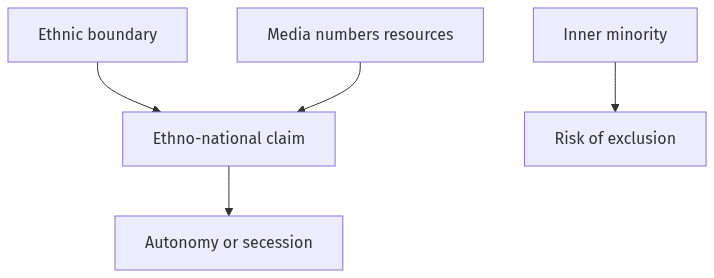
Clifford Geertz (Old Societies and New States) described primordial attachments — blood, language, sacredness — that new states inherit. Fredrik Barth showed that ethnicity is a boundary maintained by contact, not a museum culture. Paul Brass and instrumentalists stress elites who convert culture into votes. Walker Connor called the nation a felt kinship. Indian material needs all three: feeling, boundary, and organisation.
Ethno-nationalism differs from civic nationalism (Constitution as membership) and from religious fundamentalism (scripture as law), though they can fuse (majoritarian Hindu rashtra talk; Khalistan; some Islamist nationalisms). Tribal ethno-nationalism asks for a Jharkhand, a Nagalim, a Bodoland, or a Sixth Schedule, often without exiting India.
Why resurgence
After 1989, socialist class language weakened globally; census, television and later social media made ethnic numbers visible. In India, Mandal, Mandir, and the reorganisation of states (2000, 2014) taught that identity pays. Insurgency and peace accords in the North-East institutionalised ethnicity as a negotiating unit. Global indigenous discourse (UNDRIP, even without ILO 169 in India) gave ST movements a world vocabulary of peoples.
Economic liberalisation produced winners in some linguistic states and losers in tribal resource belts; mining and dams (Narmada, Niyamgiri, Jharkhand coal) ethnicised development conflict. Diasporas fund homeland parties. COVID-19 and migration revived “outsider” talk in cities and in Assam.
Indian illustrations
Naga nationalism is the longest; accords try to fit it inside the Union. Mizo ethno-nationalism became a state. Bodo and Gorkha movements seek councils or states. Jharkhand fused tribe and region. Tamil, Telangana and Shiv Sena nativism show that ethno-nationalism is not only tribal. Khalistan and Kashmiri nationalisms (distinct histories) show the hard edge. Majoritarian Hindu nationalism is ethno-religious: it uses a civilisational majority rather than a small people, which is why Ghurye’s unity and Ambedkar’s warning both remain relevant.
Resurgence does not mean every tribe wants a nation. Many want PESA, FRA and dignity inside the republic. Anthropology’s task is to see when a cultural boundary becomes a sovereignty claim, and when the state answers with autonomy rather than only force.
Risks
Ethno-nationalism can protect a language. It can also minoritise an inner other (Muslims in a Hindu nation-talk; non-Bodos in BTR; Bru in Mizoram). Barth’s boundary is always two-sided. A secular, liberal, democratic state (the next question’s contrast) must allow cultural politics without letting blood define citizenship.
Flow diagram
Conclusion
Ethno-nationalism is ethnicity organised as a claim to political sovereignty or autonomy. It has resurged because numbers, media, resource conflict and weak class language make peoplehood pay. In India it ranges from Sixth Schedule demands to majoritarian nation-talk. The anthropological question is who is enclosed as the people, and who is left outside the boundary.
Quick related
Students also ask
-
Material culture and archaeology
Next question on this syllabus topic (2023 · Q1(a)). View answer →
-
Is every regional party ethno-nationalist?
No. Many bargain inside the Constitution for a larger share. Ethno-nationalism begins when the ethnic we is treated as the rightful owner of the territory.
-
Is tribal self-rule secession?
PESA and Sixth Schedule are autonomy inside the Union. Secession denies the Constitution. Movements may slide from one to the other; the words are not the same.
Same topic · past papers
UPSC has asked this before
These previous-year questions sit on the same topic. Open one to practise the earlier ask.
-
2024 · Q6(b) · Anthropology GS 2 · 15 marks
Elucidate the difference between secularism, religiosity, religious fundamentalism, and spiritualism from an anthropological perspective.
More from this topic
Q6(a) · UPSC Mains 2026 · Anthropology GS 2 · 20 marks · Solution
Make a critical appraisal of the mesolithic culture of Ganga basin with reference to artifacts, faunal and human skeletal remains excavated from different sites
Evolution of the Indian Culture and Civilization
• Ganga basin Mesolithic sites like Sarai Nahar Rai, Mahadaha, and Damd
Q5(e) · UPSC Mains 2026 · Anthropology GS 2 · 10 marks · Solution
Contribution of L. K. Ananthakrishna Iyer in Anthropology.
Evolution of the Indian Culture and Civilization
L. K. Ananthakrishna Iyer is a pioneering figure in Indian anthropology, known for his monumental ethnographic surveys like The Cochin Tribes and Castes and The Mysore Tribes and Castes. Working during the colonial era, he bridged western anthropological methods with indigenous scholarship. His documentation of social stratification, material culture, and folklore laid the empirical foundation for Indian sociology and anthropology. Iyer also established the first department of anthropology in India at the University of Calcutta, shaping institutional teaching and research.
Q5(c) · UPSC Mains 2026 · Anthropology GS 2 · 10 marks · Solution
Article 371A of the Indian Constitution.
Evolution of the Indian Culture and Civilization
Article 371A of the Indian Constitution grants special autonomous status to Nagaland, protecting its traditional socio-religious practices, customary laws, and land ownership rights. Enacted via the 13th Constitutional Amendment Act, 1962, following the 16-point Agreement, it reflects the asymmetrical federal framework of India. The article places a special responsibility on the Governor regarding law and order and regional financial allocations. It balances tribal autonomy with national integration, though it faces implementation challenges in modern governance.