
Revision summary
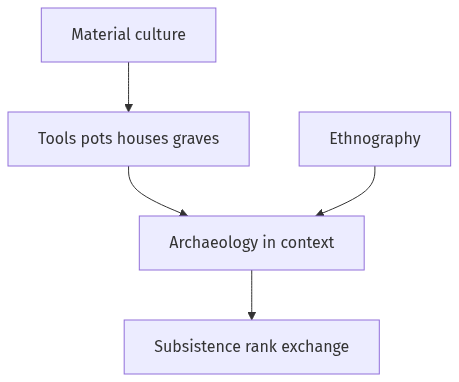
Material culture is objects and built space left by people. Archaeology recovers them in stratigraphy and infers subsistence, rank, and exchange. Binford stressed function; Hodder stressed meaning. Indian illustrations include Hunsgi, Navdatoli, Bhimbetka, and Harappan weights. Ethnography of living potters and hunters checks how objects enter the soil.
Model answer
Copper italics in this answer — like this — are the key facts. Each one is unpacked in the Facts & figures rail.
Introduction
Material culture is the set of objects, tools, houses, graves, and waste that people make and leave. Archaeology is the method that recovers those objects in context and infers social life from them.
Body
What material culture is
- Material culture includes stone tools, pottery, metals, beads, houses, hearths, burials, and food remains.
- Lewis Binford treated objects as the hard evidence of subsistence and site use.
- Ian Hodder added that objects also carry meaning, rank, and identity, so a pot is both a container and a social sign.
- M. N. Srinivas and village ethnography show that living people still use ploughs, hearths, and jewellery as rank and ritual, which helps the archaeologist read the past.
How archaeology uses it
- Stratigraphy, typology, and association turn a find into a dated activity, not a museum curiosity.
- H. D. Sankalia at Navdatoli and Nevasa, K. Paddayya at Hunsgi–Baichbal, and the Allchins at sites such as Bhimbetka showed how tools and houses reconstruct settlement.
- Ethnoarchaeology in India, including M. D. Kajale on plant remains and studies of living potter and hunter camps, tests how objects enter the ground.
- Harappan weights at Dholavira and Lothal, and megalithic iron and pottery in South India, are material culture that records trade, craft, and death rites.
Limit of the method
- Objects survive unevenly. Wood, cloth, and speech vanish, so the record is biased toward stone, bone, and fired clay.
- Without ethnography and texts, the same bead can be read as trade, ritual, or waste.
Flow diagram
Conclusion
Material culture is the durable residue of social life. Archaeology dates and places it. Indian sites and living craft show the method, but perishable life always exceeds the find.
Quick related
Students also ask
-
Interface between Purushartha and Ashrama
Next question on this syllabus topic (2023 · Q1(b)). View answer →
-
Is material culture only ancient?
No. Living villages still use ploughs, hearths, and ornaments. Archaeology studies past objects; ethnography studies present ones.
-
Can archaeology recover belief from objects?
Only with context, comparison, and caution. A figurine may be a toy, a god, or waste. Texts and ethnography narrow the reading.
Same topic · past papers
UPSC has asked this before
These previous-year questions sit on the same topic. Open one to practise the earlier ask.
-
2026 · Q6(a) · Anthropology GS 2 · 20 marks
Make a critical appraisal of the mesolithic culture of Ganga basin with reference to artifacts, faunal and human skeletal remains excavated from different sites -
2023 · Q3(b) · Anthropology GS 2 · 15 marks
Was Mesolithic culture the first step towards a sedentary way of life? Illustrate your answer by citing suitable examples. -
2016 · Q4(a) · Anthropology GS 2 · 20 marks
Give a detailed appraisal of skeletal remains from Chalcolithic culture of undivided Punjab -
2021 · Q2(b) · Anthropology GS 2 · 15 marks
Give the distribution and characteristic features of Upper Paleolithic culture in India -
2021 · Q3(c) · Anthropology GS 2 · 15 marks
Critically assess the impact of Christianity on tribal culture and identity
More from this topic
Q6(a) · UPSC Mains 2026 · Anthropology GS 2 · 20 marks · Solution
Make a critical appraisal of the mesolithic culture of Ganga basin with reference to artifacts, faunal and human skeletal remains excavated from different sites
Evolution of the Indian Culture and Civilization
• Ganga basin Mesolithic sites like Sarai Nahar Rai, Mahadaha, and Damd
Q5(e) · UPSC Mains 2026 · Anthropology GS 2 · 10 marks · Solution
Contribution of L. K. Ananthakrishna Iyer in Anthropology.
Evolution of the Indian Culture and Civilization
L. K. Ananthakrishna Iyer is a pioneering figure in Indian anthropology, known for his monumental ethnographic surveys like The Cochin Tribes and Castes and The Mysore Tribes and Castes. Working during the colonial era, he bridged western anthropological methods with indigenous scholarship. His documentation of social stratification, material culture, and folklore laid the empirical foundation for Indian sociology and anthropology. Iyer also established the first department of anthropology in India at the University of Calcutta, shaping institutional teaching and research.
Q5(c) · UPSC Mains 2026 · Anthropology GS 2 · 10 marks · Solution
Article 371A of the Indian Constitution.
Evolution of the Indian Culture and Civilization
Article 371A of the Indian Constitution grants special autonomous status to Nagaland, protecting its traditional socio-religious practices, customary laws, and land ownership rights. Enacted via the 13th Constitutional Amendment Act, 1962, following the 16-point Agreement, it reflects the asymmetrical federal framework of India. The article places a special responsibility on the Governor regarding law and order and regional financial allocations. It balances tribal autonomy with national integration, though it faces implementation challenges in modern governance.