
Revision summary
Mesolithic means Holocene microlith-using hunter-gatherers and early herders. Sedentism means staying through much of the year, not a single overnight camp. Bagor, Langhnaj, Adamgarh, Bhimbetka, and Ganga sites such as Damdama show repeated occupation and burials. That is a first step, comparable in logic to the Natufian, not a finished village. Mehrgarh, Burzahom, and Chirand mark fuller Neolithic sedentism.
Model answer
Copper italics in this answer — like this — are the key facts. Each one is unpacked in the Facts & figures rail.
Introduction
The Mesolithic is the Holocene hunter-gatherer and early herder phase of microliths, between Palaeolithic mobility and Neolithic farming villages. Sedentism means staying at one place through much of the year. The Mesolithic is a first step toward that life in some places, not a completed village revolution.
Body
What Mesolithic people did
- Microliths, composite tools, fishing, hunting, and wild plant use mark the phase. In India, Bagor (Rajasthan), Adamgarh and Bhimbetka (Madhya Pradesh), Langhnaj (Gujarat), Sarai Nahar Rai, Mahadaha, and Damdama (Ganga valley) are type sites.
- V. N. Misra at Bagor showed a long occupation with later cattle, still not a full Neolithic town.
- Ganga valley cemeteries with many burials suggest repeated return to the same ground, which is a step beyond a one-night camp.
- Rock art at Bhimbetka records animals and groups in a landscape that was used again and again.
First step, not full sedentism
- True year-round farming villages in the north-west appear at Mehrgarh in the Neolithic, with mud-brick houses and stored grain.
- Burzahom (Kashmir) and Chirand (Bihar) are later settled Neolithic–Chalcolithic points. They are not Mesolithic.
- Many Mesolithic groups remained seasonally mobile: base camps plus hunting stations. Lewis Binford’s forager–collector model fits this better than a village map.
- West Asia shows the same nuance: Natufian hamlets before full Neolithic farming are a famous “first step”; Indian Bagor is a regional analogue, not a copy.
Regional variation
- Coastal and lake sites with fish and water plants can support longer stays than dry-upland hunting.
- Contact with early herders at Bagor blurs Mesolithic and pastoral. Sedentism here is a gradient.
Answer to the question
- Yes, Mesolithic repeated-use camps, burials, and broader diet were the first widespread step toward staying put after the Pleistocene.
- No, they were not yet the sedentary farming village. That step is Neolithic.
Flow diagram
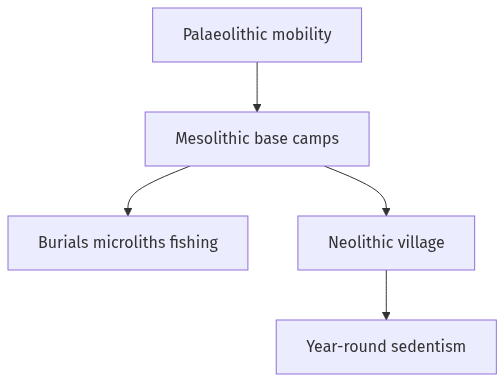
Conclusion
Mesolithic culture was the first step toward sedentism where people reused camps, buried their dead, and widened diet. It was not yet the farming village. Indian examples are Bagor, Ganga cemeteries, and Bhimbetka; Mehrgarh still marks the fuller sedentary turn.
Quick related
Students also ask
-
Critically compare Risley's and Sarkar's approaches to the classification of peoples of India.
Next question on this syllabus topic (2023 · Q4(b)). View answer →
-
Did all Mesolithic people live in villages?
No. Many stayed seasonal. Cemeteries and thick deposits show repeated use, not always twelve-month farming hamlets.
-
Is Bagor a Neolithic site?
It is classed as Mesolithic with later pastoral elements. It is not a mud-brick farming town like Mehrgarh.
Same topic · past papers
UPSC has asked this before
These previous-year questions sit on the same topic. Open one to practise the earlier ask.
-
2026 · Q6(a) · Anthropology GS 2 · 20 marks
Make a critical appraisal of the mesolithic culture of Ganga basin with reference to artifacts, faunal and human skeletal remains excavated from different sites -
2023 · Q2(b) · Anthropology GS 2 · 15 marks
"Indus Valley was the first settlement of the big civilization." Comment critically.
More from this topic
Q6(a) · UPSC Mains 2026 · Anthropology GS 2 · 20 marks · Solution
Make a critical appraisal of the mesolithic culture of Ganga basin with reference to artifacts, faunal and human skeletal remains excavated from different sites
Evolution of the Indian Culture and Civilization
• Ganga basin Mesolithic sites like Sarai Nahar Rai, Mahadaha, and Damd
Q5(e) · UPSC Mains 2026 · Anthropology GS 2 · 10 marks · Solution
Contribution of L. K. Ananthakrishna Iyer in Anthropology.
Evolution of the Indian Culture and Civilization
L. K. Ananthakrishna Iyer is a pioneering figure in Indian anthropology, known for his monumental ethnographic surveys like The Cochin Tribes and Castes and The Mysore Tribes and Castes. Working during the colonial era, he bridged western anthropological methods with indigenous scholarship. His documentation of social stratification, material culture, and folklore laid the empirical foundation for Indian sociology and anthropology. Iyer also established the first department of anthropology in India at the University of Calcutta, shaping institutional teaching and research.
Q5(c) · UPSC Mains 2026 · Anthropology GS 2 · 10 marks · Solution
Article 371A of the Indian Constitution.
Evolution of the Indian Culture and Civilization
Article 371A of the Indian Constitution grants special autonomous status to Nagaland, protecting its traditional socio-religious practices, customary laws, and land ownership rights. Enacted via the 13th Constitutional Amendment Act, 1962, following the 16-point Agreement, it reflects the asymmetrical federal framework of India. The article places a special responsibility on the Governor regarding law and order and regional financial allocations. It balances tribal autonomy with national integration, though it faces implementation challenges in modern governance.