
Revision summary
Mature Harappan cities are the first large Bronze Age urban system of the Indus–Gujarat belt. Mehrgarh and Early Harappan sites show farming settlement many millennia earlier. Palaeolithic and Mesolithic camps are older still, so “first settlement” is false. Egypt and Mesopotamia are separate Old World civilisations. The Indus script is unread, so political form remains argued even while urbanism is clear.
Model answer
Copper italics in this answer — like this — are the key facts. Each one is unpacked in the Facts & figures rail.
Introduction
The Indus or Harappan urban phase is the first large Bronze Age civilisation of the north-west subcontinent. It is not the first human settlement there, and it is not the only early civilisation in the world. The statement mixes three different facts and must be taken apart.
Body
What the Indus urban phase is
- Mature Harappan cities such as Mohenjo-daro, Harappa, Dholavira, Rakhigarhi, and Lothal (about 2600–1900 BCE in standard teaching chronology) show planned streets, drains, craft specialisation, weights, and long-distance trade.
- John Marshall, R. E. M. Wheeler, S. R. Rao, J. P. Joshi, and later R. S. Bisht at Dholavira established this as urban, not a village cluster with a grand name.
- In that limited sense it is the first “big” civilisation on the Indus–Ghaggar–Hakra and Gujarat systems.
Why “first settlement” is false
- Settlement long predates the cities. Mehrgarh (Balochistan) has aceramic and ceramic Neolithic farming from the eighth–seventh millennium BCE, with houses, barley, and later craft.
- Early Harappan or regional phases — Ravi, Hakra, Kot Diji, Amri, Sothi–Siswal, Bhirrana and Girawad in the Ghaggar belt — are towns and villages before Mature street grids.
- Palaeolithic and Mesolithic occupation of the same rivers is older still. “First settlement” would erase Soanian terraces, Upper Palaeolithic, and Mesolithic camps.
Why “the” big civilisation is too large a claim
- Egypt, Mesopotamia, and China have their own urban sequences. Indus is one of the Old World river civilisations, not the world’s first.
- Inside India, later Ganga urbanism (mahajanapadas) is another “big” civilisation on a different crop and iron base. It is not a child of Mohenjo-daro in a simple line.
- The script remains undeciphered, so political form — palace, priest-corporate, or merchant elite — is still argued. Urbanism is clear; a single “settlement of civilisation” story is not.
Critical comment
- Keep the praise: Mature Harappan is the subcontinent’s first fully urban Bronze Age system at a large geographic scale.
- Reject the wording: settlement is older, civilisation has several centres, and “first” without dates misleads.
Flow diagram
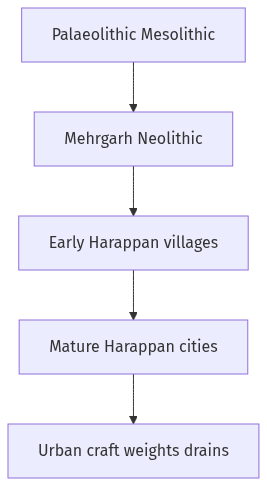
Conclusion
Indus cities are the first big urban civilisation of the north-west Bronze Age. They are not the first settlements and not the only civilisation. Mehrgarh, Early Harappan villages, and other world rivers break the slogan.
Quick related
Students also ask
-
Was Mesolithic culture the first step towards a sedentary way of life? Illustrate your answer by citing suitable examples.
Next question on this syllabus topic (2023 · Q3(b)). View answer →
-
Was Harappa the first farming village in the subcontinent?
No. Mehrgarh and other Neolithic sites farmed long before Harappan street grids.
-
Is Indus the first civilisation in the world?
No. It is one of the early river urban systems. Mesopotamia and Egypt are separate sequences.
Same topic · past papers
UPSC has asked this before
These previous-year questions sit on the same topic. Open one to practise the earlier ask.
-
2016 · Q3(c) · Anthropology GS 2 · 15 marks
Describe the traditional patterns of settlement of Indian villages
More from this topic
Q6(a) · UPSC Mains 2026 · Anthropology GS 2 · 20 marks · Solution
Make a critical appraisal of the mesolithic culture of Ganga basin with reference to artifacts, faunal and human skeletal remains excavated from different sites
Evolution of the Indian Culture and Civilization
• Ganga basin Mesolithic sites like Sarai Nahar Rai, Mahadaha, and Damd
Q5(e) · UPSC Mains 2026 · Anthropology GS 2 · 10 marks · Solution
Contribution of L. K. Ananthakrishna Iyer in Anthropology.
Evolution of the Indian Culture and Civilization
L. K. Ananthakrishna Iyer is a pioneering figure in Indian anthropology, known for his monumental ethnographic surveys like The Cochin Tribes and Castes and The Mysore Tribes and Castes. Working during the colonial era, he bridged western anthropological methods with indigenous scholarship. His documentation of social stratification, material culture, and folklore laid the empirical foundation for Indian sociology and anthropology. Iyer also established the first department of anthropology in India at the University of Calcutta, shaping institutional teaching and research.
Q5(c) · UPSC Mains 2026 · Anthropology GS 2 · 10 marks · Solution
Article 371A of the Indian Constitution.
Evolution of the Indian Culture and Civilization
Article 371A of the Indian Constitution grants special autonomous status to Nagaland, protecting its traditional socio-religious practices, customary laws, and land ownership rights. Enacted via the 13th Constitutional Amendment Act, 1962, following the 16-point Agreement, it reflects the asymmetrical federal framework of India. The article places a special responsibility on the Governor regarding law and order and regional financial allocations. It balances tribal autonomy with national integration, though it faces implementation challenges in modern governance.